
Wealth Gap

13,723 Views | 277 Replies | Last: 4 yr ago by aTmAg
aTmAg
How long do you want to ignore this user?
fixer said:

aTmAg said:

fixer said:

aTmAg said:

fixer said:

See my edit.


Supply just can't magically go up. The market forces seek to balance supply and demand. Prices reflect this.

Producers seek to maximize profit while consumers seek to reduce costs.

A producer is incentivized to make more by higher profits. One aspect is a higher selling cost. Another is lower cost input materials and resources.

Producers will make a certain amount of product for a certain price. Consumers buy a certain amount of a product at a certain price.

If supply goes above this equilibrium the prices tend to come down because it is an incentive for consumers.

The equilibrium aspect in supply and demand is missing in your assumption that a simple increase in supply ( apparently of all or most goods) will lower costs.
I never said supply would magically go up. I went out of my way to to say if we "double their production" to make it clear that I was talking philosophical. Of course, I do not think we can snap our fingers and double their production in an instant. Nor did I say that prices would go below equilibrium. The equilibrium price would become much lower.

If government stopped welfare then that would greatly reduce salary requirements since people who now refrain from working for any offers lower than X will get off their asses and work for vastly lower salaries in order to not starve. Since salaries are the top expense in most businesses, suddenly entire industries that are unsustainable in America now would become viable again. That would move the supply curve right lowering prices. In addition, since everybody would be paying lower salaries, competition would also push the supply curve down and prices lower until it reaches equilibrium.


Ok so I was with you on lower input costs for labor.

But if a company lowered their input costs they aren't going to simply ramp up production. There has to be a signal for increased demand.


When the supply curve moves down the equilibrium point moves right in addition to down. A more right equilibrium, point means a larger quantity. So if they don't want to lose money, then they better increase their production. If they do not, then somebody else will. Even if they have to enter the market to do so.


This is all true and is also not the same thing as " increasing production will lower prices".


I never said "production". I said "supply". For a guy who is tossing around "Econ 101" quips, you would think you would know the difference.

To argue that a larger supply does not push down prices is like arguing that the world is flat.
Malibu
How long do you want to ignore this user?
aTmAg said:

Malibu2 said:

aTmAg said:

fixer said:

aTmAg said:

Malibu2 said:

aTmAg said:

Malibu2 said:

Set prices on goods for a publicly traded company to maximize profits. But I suppose that doesn't qualify me to opine on how firms change prices in response to supply and demand.
If you are claiming that prices do not go down in response to higher supply (all else being equal) then you should be fired. In fact, you probably should quit in shame.

There is nothing hard about supply and demand. Where people get lost is the higher order effects of that simple law.

Yes, I'm claiming that in the real word rather than Econistan all else is never equal and that your assertions about how things always work like the laws of physics is amusingly myopic.
Then describe what other factors would keep the price the same in the face of drastically lower labor and regulation costs.


Profit. That is the factor.
Then your competitors will undercut you by a little and take all of your market share. Have you guys taken economics at all?

You're not doing yourself any favors regurgitating Econ 101 talking points about commodity widgets sold by interchangeable companies. I can say for an absolute fact my last companies best selling product was 50% more expensive than the competition despite being functionally identical in specs. The more expensive one outsold 5:1 with similar retail coverage.
Then there was something else that made your product more valuable. Either that or you were fraudsters.

Well, obviously. Branding, ubiquity, halo products, SPIFFs, leveraging relationships for better shelf placement, etc all play a role. Our competition beat their frustrated heads against the walls for years and only saw the gap widen, even after we raised prices due to tariffs.

The problem with your arguments is that you are speaking professorial with absolutes that those of us that do this for a living know aren't the entire variable set in decision making at the firm or customer level. Econ 101 models are extremely useful in decision making and thought experiments and are ultimately right at scale and over time. But the present is messy and and things are rarely as simple as you make them out to be.
Joe Boudain
How long do you want to ignore this user?
aTmAg said:

Malibu2 said:

Stubborn CEOs, sunk cost fallacy, keeping your largest customer extremely happy, slipping in sales to a new quarter to hit goal, changes in marketing strategy you think will influence demand, the programs that were already printed at your industry trade show, the lack of a knob that is turned to immediately and unemotionally change prices instantaneously, and a whole lot more
Again with the "instantaneously" I never said instantaneously. But of course you know this.

It doesn't matter how stubborn your CEO is, how much money you have sunk, etc. If you ignore lower prices elsewhere, you will lose your ass. Just ask the nearly infinite number of defunct companies out there.


So many factors go into this, you're assuming the product is a commodity for one with no differentiation between competing products. Every point you've made is a laboratory case study assuming no other variables. That doesn't happen in the real world.
Malibu
How long do you want to ignore this user?
Joe Boudain said:

aTmAg said:

Malibu2 said:

Stubborn CEOs, sunk cost fallacy, keeping your largest customer extremely happy, slipping in sales to a new quarter to hit goal, changes in marketing strategy you think will influence demand, the programs that were already printed at your industry trade show, the lack of a knob that is turned to immediately and unemotionally change prices instantaneously, and a whole lot more
Again with the "instantaneously" I never said instantaneously. But of course you know this.

It doesn't matter how stubborn your CEO is, how much money you have sunk, etc. If you ignore lower prices elsewhere, you will lose your ass. Just ask the nearly infinite number of defunct companies out there.


So many factors go into this, you're assuming the product is a commodity for one with no differentiation between competing products. Every point you've made is a laboratory case study assuming no other variables. That doesn't happen in the real world.

And even if a commodity, that the buyer is a perfectly rational economic automaton that is not influenced by marketing.
aTmAg
How long do you want to ignore this user?
Malibu2 said:

aTmAg said:

Malibu2 said:

aTmAg said:

fixer said:

aTmAg said:

Malibu2 said:

aTmAg said:

Malibu2 said:

Set prices on goods for a publicly traded company to maximize profits. But I suppose that doesn't qualify me to opine on how firms change prices in response to supply and demand.
If you are claiming that prices do not go down in response to higher supply (all else being equal) then you should be fired. In fact, you probably should quit in shame.

There is nothing hard about supply and demand. Where people get lost is the higher order effects of that simple law.

Yes, I'm claiming that in the real word rather than Econistan all else is never equal and that your assertions about how things always work like the laws of physics is amusingly myopic.
Then describe what other factors would keep the price the same in the face of drastically lower labor and regulation costs.


Profit. That is the factor.
Then your competitors will undercut you by a little and take all of your market share. Have you guys taken economics at all?

You're not doing yourself any favors regurgitating Econ 101 talking points about commodity widgets sold by interchangeable companies. I can say for an absolute fact my last companies best selling product was 50% more expensive than the competition despite being functionally identical in specs. The more expensive one outsold 5:1 with similar retail coverage.
Then there was something else that made your product more valuable. Either that or you were fraudsters.

Well, obviously. Branding, ubiquity, halo products, SPIFFs, leveraging relationships for better shelf placement, etc all play a role. Our competition beat their frustrated heads against the walls for years and only saw the gap widen, even after we raised prices due to tariffs.

The problem with your arguments is that you are speaking professorial with absolutes that those of us that do this for a living know aren't the entire variable set in decision making at the firm or customer level. Econ 101 models are extremely useful in decision making and thought experiments and are ultimately right at scale and over time. But the present is messy and and things are rarely as simple as you make them out to be.
So you seriously think, that if salaries went down by 50% that your customers STILL would purchase your product at the same price? That they would forgo other stuff they need for your overpriced product? Unless you are selling the worlds best heroin, you are deluding yourself. I don't give a crap how great your shelf placement is.
aTmAg
How long do you want to ignore this user?
Joe Boudain said:

aTmAg said:

Malibu2 said:

Stubborn CEOs, sunk cost fallacy, keeping your largest customer extremely happy, slipping in sales to a new quarter to hit goal, changes in marketing strategy you think will influence demand, the programs that were already printed at your industry trade show, the lack of a knob that is turned to immediately and unemotionally change prices instantaneously, and a whole lot more
Again with the "instantaneously" I never said instantaneously. But of course you know this.

It doesn't matter how stubborn your CEO is, how much money you have sunk, etc. If you ignore lower prices elsewhere, you will lose your ass. Just ask the nearly infinite number of defunct companies out there.


So many factors go into this, you're assuming the product is a commodity for one with no differentiation between competing products. Every point you've made is a laboratory case study assuming no other variables. That doesn't happen in the real world.
It happens ALL THE TIME in the real world. I've been in industry for 25 years and have seen it MANY times. The entire reason many companies move their manufacturing to overseas in the first place is to lower costs to keep their prices competitive (including Malibu's employer, apparently). Every single employer I have had that moved their production overseas lowered their prices as a result. You guys are delusional to pretend that it doesn't happen.
aTmAg
How long do you want to ignore this user?
Malibu2 said:

Joe Boudain said:

aTmAg said:

Malibu2 said:

Stubborn CEOs, sunk cost fallacy, keeping your largest customer extremely happy, slipping in sales to a new quarter to hit goal, changes in marketing strategy you think will influence demand, the programs that were already printed at your industry trade show, the lack of a knob that is turned to immediately and unemotionally change prices instantaneously, and a whole lot more
Again with the "instantaneously" I never said instantaneously. But of course you know this.

It doesn't matter how stubborn your CEO is, how much money you have sunk, etc. If you ignore lower prices elsewhere, you will lose your ass. Just ask the nearly infinite number of defunct companies out there.


So many factors go into this, you're assuming the product is a commodity for one with no differentiation between competing products. Every point you've made is a laboratory case study assuming no other variables. That doesn't happen in the real world.

And even if a commodity, that the buyer is a perfectly rational economic automaton that is not influenced by marketing.
People find a way to become more rational when their salaries are drastically cut.
fixer
How long do you want to ignore this user?
aTmAg said:

fixer said:

aTmAg said:

fixer said:

aTmAg said:

fixer said:

See my edit.


Supply just can't magically go up. The market forces seek to balance supply and demand. Prices reflect this.

Producers seek to maximize profit while consumers seek to reduce costs.

A producer is incentivized to make more by higher profits. One aspect is a higher selling cost. Another is lower cost input materials and resources.

Producers will make a certain amount of product for a certain price. Consumers buy a certain amount of a product at a certain price.

If supply goes above this equilibrium the prices tend to come down because it is an incentive for consumers.

The equilibrium aspect in supply and demand is missing in your assumption that a simple increase in supply ( apparently of all or most goods) will lower costs.
I never said supply would magically go up. I went out of my way to to say if we "double their production" to make it clear that I was talking philosophical. Of course, I do not think we can snap our fingers and double their production in an instant. Nor did I say that prices would go below equilibrium. The equilibrium price would become much lower.

If government stopped welfare then that would greatly reduce salary requirements since people who now refrain from working for any offers lower than X will get off their asses and work for vastly lower salaries in order to not starve. Since salaries are the top expense in most businesses, suddenly entire industries that are unsustainable in America now would become viable again. That would move the supply curve right lowering prices. In addition, since everybody would be paying lower salaries, competition would also push the supply curve down and prices lower until it reaches equilibrium.


Ok so I was with you on lower input costs for labor.

But if a company lowered their input costs they aren't going to simply ramp up production. There has to be a signal for increased demand.


When the supply curve moves down the equilibrium point moves right in addition to down. A more right equilibrium, point means a larger quantity. So if they don't want to lose money, then they better increase their production. If they do not, then somebody else will. Even if they have to enter the market to do so.


This is all true and is also not the same thing as " increasing production will lower prices".


I never said "production". I said "supply". For a guy who is tossing around "Econ 101" quips, you would think you would know the difference.

To argue that a larger supply does not push down prices is like arguing that the world is flat.


So the concept of production is totally divorced from that of supply?

administrative errors
How long do you want to ignore this user?
aTmAg said:

Joe Boudain said:

aTmAg said:

Malibu2 said:

Stubborn CEOs, sunk cost fallacy, keeping your largest customer extremely happy, slipping in sales to a new quarter to hit goal, changes in marketing strategy you think will influence demand, the programs that were already printed at your industry trade show, the lack of a knob that is turned to immediately and unemotionally change prices instantaneously, and a whole lot more
Again with the "instantaneously" I never said instantaneously. But of course you know this.

It doesn't matter how stubborn your CEO is, how much money you have sunk, etc. If you ignore lower prices elsewhere, you will lose your ass. Just ask the nearly infinite number of defunct companies out there.


So many factors go into this, you're assuming the product is a commodity for one with no differentiation between competing products. Every point you've made is a laboratory case study assuming no other variables. That doesn't happen in the real world.
It happens ALL THE TIME in the real world. I've been in industry for 25 years and have seen it MANY times. The entire reason many companies move their manufacturing to overseas in the first place is to lower costs to keep their prices competitive (including Malibu's employer, apparently). Every single employer I have had that moved their production overseas lowered their prices as a result. You guys are delusional to pretend that it doesn't happen.
triffin paradox...
SMM48
How long do you want to ignore this user?
How about the ammo gap?
medwriter
How long do you want to ignore this user?
titan said:


One thing would be a cap on what can be earned in national politics to dissuade abuse of it. Taxpayer money should only make someone so rich. Biden's is inexplicable.
You're correct titan. All politicians who become wealthy while in office should be investigated. It's supposed to be public service and not a get rich quick scheme. The rich and powerful private citizens shouldn't be tied at the hip with the other rich and powerful, the politicians.
Malibu
How long do you want to ignore this user?
aTmAg said:

Malibu2 said:

aTmAg said:

Malibu2 said:

aTmAg said:

fixer said:

aTmAg said:

Malibu2 said:

aTmAg said:

Malibu2 said:

Set prices on goods for a publicly traded company to maximize profits. But I suppose that doesn't qualify me to opine on how firms change prices in response to supply and demand.
If you are claiming that prices do not go down in response to higher supply (all else being equal) then you should be fired. In fact, you probably should quit in shame.

There is nothing hard about supply and demand. Where people get lost is the higher order effects of that simple law.

Yes, I'm claiming that in the real word rather than Econistan all else is never equal and that your assertions about how things always work like the laws of physics is amusingly myopic.
Then describe what other factors would keep the price the same in the face of drastically lower labor and regulation costs.


Profit. That is the factor.
Then your competitors will undercut you by a little and take all of your market share. Have you guys taken economics at all?

You're not doing yourself any favors regurgitating Econ 101 talking points about commodity widgets sold by interchangeable companies. I can say for an absolute fact my last companies best selling product was 50% more expensive than the competition despite being functionally identical in specs. The more expensive one outsold 5:1 with similar retail coverage.
Then there was something else that made your product more valuable. Either that or you were fraudsters.

Well, obviously. Branding, ubiquity, halo products, SPIFFs, leveraging relationships for better shelf placement, etc all play a role. Our competition beat their frustrated heads against the walls for years and only saw the gap widen, even after we raised prices due to tariffs.

The problem with your arguments is that you are speaking professorial with absolutes that those of us that do this for a living know aren't the entire variable set in decision making at the firm or customer level. Econ 101 models are extremely useful in decision making and thought experiments and are ultimately right at scale and over time. But the present is messy and and things are rarely as simple as you make them out to be.
So you seriously think, that if salaries went down by 50% that your customers STILL would purchase your product at the same price? That they would forgo other stuff they need for your overpriced product? Unless you are selling the worlds best heroin, you are deluding yourself. I don't give a crap how great your shelf placement is.

In other words if demand dropped dramatically would price drop? Well, duh.
aTmAg
How long do you want to ignore this user?
fixer said:

aTmAg said:

fixer said:

aTmAg said:

fixer said:

aTmAg said:

fixer said:

See my edit.


Supply just can't magically go up. The market forces seek to balance supply and demand. Prices reflect this.

Producers seek to maximize profit while consumers seek to reduce costs.

A producer is incentivized to make more by higher profits. One aspect is a higher selling cost. Another is lower cost input materials and resources.

Producers will make a certain amount of product for a certain price. Consumers buy a certain amount of a product at a certain price.

If supply goes above this equilibrium the prices tend to come down because it is an incentive for consumers.

The equilibrium aspect in supply and demand is missing in your assumption that a simple increase in supply ( apparently of all or most goods) will lower costs.
I never said supply would magically go up. I went out of my way to to say if we "double their production" to make it clear that I was talking philosophical. Of course, I do not think we can snap our fingers and double their production in an instant. Nor did I say that prices would go below equilibrium. The equilibrium price would become much lower.

If government stopped welfare then that would greatly reduce salary requirements since people who now refrain from working for any offers lower than X will get off their asses and work for vastly lower salaries in order to not starve. Since salaries are the top expense in most businesses, suddenly entire industries that are unsustainable in America now would become viable again. That would move the supply curve right lowering prices. In addition, since everybody would be paying lower salaries, competition would also push the supply curve down and prices lower until it reaches equilibrium.


Ok so I was with you on lower input costs for labor.

But if a company lowered their input costs they aren't going to simply ramp up production. There has to be a signal for increased demand.


When the supply curve moves down the equilibrium point moves right in addition to down. A more right equilibrium, point means a larger quantity. So if they don't want to lose money, then they better increase their production. If they do not, then somebody else will. Even if they have to enter the market to do so.


This is all true and is also not the same thing as " increasing production will lower prices".


I never said "production". I said "supply". For a guy who is tossing around "Econ 101" quips, you would think you would know the difference.

To argue that a larger supply does not push down prices is like arguing that the world is flat.


So the concept of production is totally divorced from that of supply?


No. But you guys are implying that I said (paraphrasing) "companies would increase production in order to lower price." That is not at all what I said. I said supply would increase which would result in a lower price. Those are two totally different statements. The former violates the supply curve. The latter adheres to the law of supply and demand.
fixer
How long do you want to ignore this user?
aTmAg said:

fixer said:

aTmAg said:

fixer said:

aTmAg said:

fixer said:

See my edit.


Supply just can't magically go up. The market forces seek to balance supply and demand. Prices reflect this.

Producers seek to maximize profit while consumers seek to reduce costs.

A producer is incentivized to make more by higher profits. One aspect is a higher selling cost. Another is lower cost input materials and resources.

Producers will make a certain amount of product for a certain price. Consumers buy a certain amount of a product at a certain price.

If supply goes above this equilibrium the prices tend to come down because it is an incentive for consumers.

The equilibrium aspect in supply and demand is missing in your assumption that a simple increase in supply ( apparently of all or most goods) will lower costs.
I never said supply would magically go up. I went out of my way to to say if we "double their production" to make it clear that I was talking philosophical. Of course, I do not think we can snap our fingers and double their production in an instant. Nor did I say that prices would go below equilibrium. The equilibrium price would become much lower.

If government stopped welfare then that would greatly reduce salary requirements since people who now refrain from working for any offers lower than X will get off their asses and work for vastly lower salaries in order to not starve. Since salaries are the top expense in most businesses, suddenly entire industries that are unsustainable in America now would become viable again. That would move the supply curve right lowering prices. In addition, since everybody would be paying lower salaries, competition would also push the supply curve down and prices lower until it reaches equilibrium.


Ok so I was with you on lower input costs for labor.

But if a company lowered their input costs they aren't going to simply ramp up production. There has to be a signal for increased demand.


When the supply curve moves down the equilibrium point moves right in addition to down. A more right equilibrium, point means a larger quantity. So if they don't want to lose money, then they better increase their production. If they do not, then somebody else will. Even if they have to enter the market to do so.


This is all true and is also not the same thing as " increasing production will lower prices".


I never said "production". I said "supply". For a guy who is tossing around "Econ 101" quips, you would think you would know the difference.

To argue that a larger supply does not push down prices is like arguing that the world is flat.


How does supply increase without increasing production ?
fixer
How long do you want to ignore this user?
aTmAg said:

fixer said:

aTmAg said:

fixer said:

aTmAg said:

fixer said:

aTmAg said:

fixer said:

See my edit.


Supply just can't magically go up. The market forces seek to balance supply and demand. Prices reflect this.

Producers seek to maximize profit while consumers seek to reduce costs.

A producer is incentivized to make more by higher profits. One aspect is a higher selling cost. Another is lower cost input materials and resources.

Producers will make a certain amount of product for a certain price. Consumers buy a certain amount of a product at a certain price.

If supply goes above this equilibrium the prices tend to come down because it is an incentive for consumers.

The equilibrium aspect in supply and demand is missing in your assumption that a simple increase in supply ( apparently of all or most goods) will lower costs.
I never said supply would magically go up. I went out of my way to to say if we "double their production" to make it clear that I was talking philosophical. Of course, I do not think we can snap our fingers and double their production in an instant. Nor did I say that prices would go below equilibrium. The equilibrium price would become much lower.

If government stopped welfare then that would greatly reduce salary requirements since people who now refrain from working for any offers lower than X will get off their asses and work for vastly lower salaries in order to not starve. Since salaries are the top expense in most businesses, suddenly entire industries that are unsustainable in America now would become viable again. That would move the supply curve right lowering prices. In addition, since everybody would be paying lower salaries, competition would also push the supply curve down and prices lower until it reaches equilibrium.


Ok so I was with you on lower input costs for labor.

But if a company lowered their input costs they aren't going to simply ramp up production. There has to be a signal for increased demand.


When the supply curve moves down the equilibrium point moves right in addition to down. A more right equilibrium, point means a larger quantity. So if they don't want to lose money, then they better increase their production. If they do not, then somebody else will. Even if they have to enter the market to do so.


This is all true and is also not the same thing as " increasing production will lower prices".


I never said "production". I said "supply". For a guy who is tossing around "Econ 101" quips, you would think you would know the difference.

To argue that a larger supply does not push down prices is like arguing that the world is flat.


So the concept of production is totally divorced from that of supply?


No. But you guys are implying that I said (paraphrasing) "companies would increase production in order to lower price." That is not at all what I said. I said supply would increase which would result in a lower price. Those are two totally different statements. The former violates the supply curve. The latter adheres to the law of supply and demand.


That is exactly what you said: to get competitive with China supply of things needed to increase and prices would fall.

Own it
aTmAg
How long do you want to ignore this user?
Malibu2 said:

aTmAg said:

Malibu2 said:

aTmAg said:

Malibu2 said:

aTmAg said:

fixer said:

aTmAg said:

Malibu2 said:

aTmAg said:

Malibu2 said:

Set prices on goods for a publicly traded company to maximize profits. But I suppose that doesn't qualify me to opine on how firms change prices in response to supply and demand.
If you are claiming that prices do not go down in response to higher supply (all else being equal) then you should be fired. In fact, you probably should quit in shame.

There is nothing hard about supply and demand. Where people get lost is the higher order effects of that simple law.

Yes, I'm claiming that in the real word rather than Econistan all else is never equal and that your assertions about how things always work like the laws of physics is amusingly myopic.
Then describe what other factors would keep the price the same in the face of drastically lower labor and regulation costs.


Profit. That is the factor.
Then your competitors will undercut you by a little and take all of your market share. Have you guys taken economics at all?

You're not doing yourself any favors regurgitating Econ 101 talking points about commodity widgets sold by interchangeable companies. I can say for an absolute fact my last companies best selling product was 50% more expensive than the competition despite being functionally identical in specs. The more expensive one outsold 5:1 with similar retail coverage.
Then there was something else that made your product more valuable. Either that or you were fraudsters.

Well, obviously. Branding, ubiquity, halo products, SPIFFs, leveraging relationships for better shelf placement, etc all play a role. Our competition beat their frustrated heads against the walls for years and only saw the gap widen, even after we raised prices due to tariffs.

The problem with your arguments is that you are speaking professorial with absolutes that those of us that do this for a living know aren't the entire variable set in decision making at the firm or customer level. Econ 101 models are extremely useful in decision making and thought experiments and are ultimately right at scale and over time. But the present is messy and and things are rarely as simple as you make them out to be.
So you seriously think, that if salaries went down by 50% that your customers STILL would purchase your product at the same price? That they would forgo other stuff they need for your overpriced product? Unless you are selling the worlds best heroin, you are deluding yourself. I don't give a crap how great your shelf placement is.

In other words if demand dropped dramatically would price drop? Well, duh.
Uuuuhh dude.. what have you been arguing this entire time? I've said from my first post or so that salaries would go way the hell down. These last 50 posts have been a waste of time.
aTmAg
How long do you want to ignore this user?
fixer said:

aTmAg said:

fixer said:

aTmAg said:

fixer said:

aTmAg said:

fixer said:

See my edit.


Supply just can't magically go up. The market forces seek to balance supply and demand. Prices reflect this.

Producers seek to maximize profit while consumers seek to reduce costs.

A producer is incentivized to make more by higher profits. One aspect is a higher selling cost. Another is lower cost input materials and resources.

Producers will make a certain amount of product for a certain price. Consumers buy a certain amount of a product at a certain price.

If supply goes above this equilibrium the prices tend to come down because it is an incentive for consumers.

The equilibrium aspect in supply and demand is missing in your assumption that a simple increase in supply ( apparently of all or most goods) will lower costs.
I never said supply would magically go up. I went out of my way to to say if we "double their production" to make it clear that I was talking philosophical. Of course, I do not think we can snap our fingers and double their production in an instant. Nor did I say that prices would go below equilibrium. The equilibrium price would become much lower.

If government stopped welfare then that would greatly reduce salary requirements since people who now refrain from working for any offers lower than X will get off their asses and work for vastly lower salaries in order to not starve. Since salaries are the top expense in most businesses, suddenly entire industries that are unsustainable in America now would become viable again. That would move the supply curve right lowering prices. In addition, since everybody would be paying lower salaries, competition would also push the supply curve down and prices lower until it reaches equilibrium.


Ok so I was with you on lower input costs for labor.

But if a company lowered their input costs they aren't going to simply ramp up production. There has to be a signal for increased demand.


When the supply curve moves down the equilibrium point moves right in addition to down. A more right equilibrium, point means a larger quantity. So if they don't want to lose money, then they better increase their production. If they do not, then somebody else will. Even if they have to enter the market to do so.


This is all true and is also not the same thing as " increasing production will lower prices".


I never said "production". I said "supply". For a guy who is tossing around "Econ 101" quips, you would think you would know the difference.

To argue that a larger supply does not push down prices is like arguing that the world is flat.


How does supply increase without increasing production ?
By additional suppliers/producers entering the market. Can you not see the difference between a firm declaring "let's produce more widgets to lower the price!" (which would not happen) and a firm being able to hire twice as many employees for the same money and producing more that way (which would happen)?
Malibu
How long do you want to ignore this user?
aTmAg said:

fixer said:

aTmAg said:

fixer said:

aTmAg said:

fixer said:

aTmAg said:

fixer said:

See my edit.


Supply just can't magically go up. The market forces seek to balance supply and demand. Prices reflect this.

Producers seek to maximize profit while consumers seek to reduce costs.

A producer is incentivized to make more by higher profits. One aspect is a higher selling cost. Another is lower cost input materials and resources.

Producers will make a certain amount of product for a certain price. Consumers buy a certain amount of a product at a certain price.

If supply goes above this equilibrium the prices tend to come down because it is an incentive for consumers.

The equilibrium aspect in supply and demand is missing in your assumption that a simple increase in supply ( apparently of all or most goods) will lower costs.
I never said supply would magically go up. I went out of my way to to say if we "double their production" to make it clear that I was talking philosophical. Of course, I do not think we can snap our fingers and double their production in an instant. Nor did I say that prices would go below equilibrium. The equilibrium price would become much lower.

If government stopped welfare then that would greatly reduce salary requirements since people who now refrain from working for any offers lower than X will get off their asses and work for vastly lower salaries in order to not starve. Since salaries are the top expense in most businesses, suddenly entire industries that are unsustainable in America now would become viable again. That would move the supply curve right lowering prices. In addition, since everybody would be paying lower salaries, competition would also push the supply curve down and prices lower until it reaches equilibrium.


Ok so I was with you on lower input costs for labor.

But if a company lowered their input costs they aren't going to simply ramp up production. There has to be a signal for increased demand.


When the supply curve moves down the equilibrium point moves right in addition to down. A more right equilibrium, point means a larger quantity. So if they don't want to lose money, then they better increase their production. If they do not, then somebody else will. Even if they have to enter the market to do so.


This is all true and is also not the same thing as " increasing production will lower prices".


I never said "production". I said "supply". For a guy who is tossing around "Econ 101" quips, you would think you would know the difference.

To argue that a larger supply does not push down prices is like arguing that the world is flat.


How does supply increase without increasing production ?
By additional suppliers/producers entering the market. Can you not see the difference between a firm declaring "let's produce more widgets to lower the price!" (which would not happen) and a firm being able to hire twice as many employees for the same money and producing more that way (which would happen)?

That would not happen that way. A firm would not hire more workers unless they were needed to satisfy for additional demand, as a worker cost money and therefore lowers profit.
Malibu
How long do you want to ignore this user?
Dinner time then poker night. I'll check in on this thread tomorrow have a good one.
aTmAg
How long do you want to ignore this user?
Malibu2 said:

aTmAg said:

fixer said:

aTmAg said:

fixer said:

aTmAg said:

fixer said:

aTmAg said:

fixer said:

See my edit.


Supply just can't magically go up. The market forces seek to balance supply and demand. Prices reflect this.

Producers seek to maximize profit while consumers seek to reduce costs.

A producer is incentivized to make more by higher profits. One aspect is a higher selling cost. Another is lower cost input materials and resources.

Producers will make a certain amount of product for a certain price. Consumers buy a certain amount of a product at a certain price.

If supply goes above this equilibrium the prices tend to come down because it is an incentive for consumers.

The equilibrium aspect in supply and demand is missing in your assumption that a simple increase in supply ( apparently of all or most goods) will lower costs.
I never said supply would magically go up. I went out of my way to to say if we "double their production" to make it clear that I was talking philosophical. Of course, I do not think we can snap our fingers and double their production in an instant. Nor did I say that prices would go below equilibrium. The equilibrium price would become much lower.

If government stopped welfare then that would greatly reduce salary requirements since people who now refrain from working for any offers lower than X will get off their asses and work for vastly lower salaries in order to not starve. Since salaries are the top expense in most businesses, suddenly entire industries that are unsustainable in America now would become viable again. That would move the supply curve right lowering prices. In addition, since everybody would be paying lower salaries, competition would also push the supply curve down and prices lower until it reaches equilibrium.


Ok so I was with you on lower input costs for labor.

But if a company lowered their input costs they aren't going to simply ramp up production. There has to be a signal for increased demand.


When the supply curve moves down the equilibrium point moves right in addition to down. A more right equilibrium, point means a larger quantity. So if they don't want to lose money, then they better increase their production. If they do not, then somebody else will. Even if they have to enter the market to do so.


This is all true and is also not the same thing as " increasing production will lower prices".


I never said "production". I said "supply". For a guy who is tossing around "Econ 101" quips, you would think you would know the difference.

To argue that a larger supply does not push down prices is like arguing that the world is flat.


How does supply increase without increasing production ?
By additional suppliers/producers entering the market. Can you not see the difference between a firm declaring "let's produce more widgets to lower the price!" (which would not happen) and a firm being able to hire twice as many employees for the same money and producing more that way (which would happen)?

That would not happen that way. A firm would not hire more workers unless they were needed to satisfy for additional demand, as a worker cost money and therefore lowers profit.
Maybe not twice for the same money, but their marginal cost curve would go down which would move the equilibrium point down and to the right. Therefore ,unless they want to miss the opportunity to make more money they would hire more and produce more.
itsyourboypookie
How long do you want to ignore this user?
The middle class is shrinking.

Into the upper middle class
fixer
How long do you want to ignore this user?
aTmAg said:

fixer said:

aTmAg said:

fixer said:

aTmAg said:

fixer said:

aTmAg said:

fixer said:

See my edit.


Supply just can't magically go up. The market forces seek to balance supply and demand. Prices reflect this.

Producers seek to maximize profit while consumers seek to reduce costs.

A producer is incentivized to make more by higher profits. One aspect is a higher selling cost. Another is lower cost input materials and resources.

Producers will make a certain amount of product for a certain price. Consumers buy a certain amount of a product at a certain price.

If supply goes above this equilibrium the prices tend to come down because it is an incentive for consumers.

The equilibrium aspect in supply and demand is missing in your assumption that a simple increase in supply ( apparently of all or most goods) will lower costs.
I never said supply would magically go up. I went out of my way to to say if we "double their production" to make it clear that I was talking philosophical. Of course, I do not think we can snap our fingers and double their production in an instant. Nor did I say that prices would go below equilibrium. The equilibrium price would become much lower.

If government stopped welfare then that would greatly reduce salary requirements since people who now refrain from working for any offers lower than X will get off their asses and work for vastly lower salaries in order to not starve. Since salaries are the top expense in most businesses, suddenly entire industries that are unsustainable in America now would become viable again. That would move the supply curve right lowering prices. In addition, since everybody would be paying lower salaries, competition would also push the supply curve down and prices lower until it reaches equilibrium.


Ok so I was with you on lower input costs for labor.

But if a company lowered their input costs they aren't going to simply ramp up production. There has to be a signal for increased demand.


When the supply curve moves down the equilibrium point moves right in addition to down. A more right equilibrium, point means a larger quantity. So if they don't want to lose money, then they better increase their production. If they do not, then somebody else will. Even if they have to enter the market to do so.


This is all true and is also not the same thing as " increasing production will lower prices".


I never said "production". I said "supply". For a guy who is tossing around "Econ 101" quips, you would think you would know the difference.

To argue that a larger supply does not push down prices is like arguing that the world is flat.


How does supply increase without increasing production ?
By additional suppliers/producers entering the market. Can you not see the difference between a firm declaring "let's produce more widgets to lower the price!" (which would not happen) and a firm being able to hire twice as many employees for the same money and producing more that way (which would happen)?


Throwing in " other suppliers entering the market" is not congruent with " all things equal ".

Besides that...

there has to be a signal of demand. Companies arent going to enter a market just to out produce other companies for sport.

There has to be a competitive differentiation between companies and products.


aTmAg
How long do you want to ignore this user?
fixer said:

aTmAg said:

fixer said:

aTmAg said:

fixer said:

aTmAg said:

fixer said:

aTmAg said:

fixer said:

See my edit.


Supply just can't magically go up. The market forces seek to balance supply and demand. Prices reflect this.

Producers seek to maximize profit while consumers seek to reduce costs.

A producer is incentivized to make more by higher profits. One aspect is a higher selling cost. Another is lower cost input materials and resources.

Producers will make a certain amount of product for a certain price. Consumers buy a certain amount of a product at a certain price.

If supply goes above this equilibrium the prices tend to come down because it is an incentive for consumers.

The equilibrium aspect in supply and demand is missing in your assumption that a simple increase in supply ( apparently of all or most goods) will lower costs.
I never said supply would magically go up. I went out of my way to to say if we "double their production" to make it clear that I was talking philosophical. Of course, I do not think we can snap our fingers and double their production in an instant. Nor did I say that prices would go below equilibrium. The equilibrium price would become much lower.

If government stopped welfare then that would greatly reduce salary requirements since people who now refrain from working for any offers lower than X will get off their asses and work for vastly lower salaries in order to not starve. Since salaries are the top expense in most businesses, suddenly entire industries that are unsustainable in America now would become viable again. That would move the supply curve right lowering prices. In addition, since everybody would be paying lower salaries, competition would also push the supply curve down and prices lower until it reaches equilibrium.


Ok so I was with you on lower input costs for labor.

But if a company lowered their input costs they aren't going to simply ramp up production. There has to be a signal for increased demand.


When the supply curve moves down the equilibrium point moves right in addition to down. A more right equilibrium, point means a larger quantity. So if they don't want to lose money, then they better increase their production. If they do not, then somebody else will. Even if they have to enter the market to do so.


This is all true and is also not the same thing as " increasing production will lower prices".


I never said "production". I said "supply". For a guy who is tossing around "Econ 101" quips, you would think you would know the difference.

To argue that a larger supply does not push down prices is like arguing that the world is flat.


How does supply increase without increasing production ?
By additional suppliers/producers entering the market. Can you not see the difference between a firm declaring "let's produce more widgets to lower the price!" (which would not happen) and a firm being able to hire twice as many employees for the same money and producing more that way (which would happen)?


Throwing in " other suppliers entering the market" is not congruent with " all things equal ".


Uhhhh yeah it is. It doesn't matter how the supply curve moves right, just that it is the only thing that does.

Since you edited:

Quote:

Besides that...

there has to be a signal of demand. Companies arent going to enter a market just to out produce other companies for sport.

There has to be a competitive differentiation between companies and products.
Sure there is. A reduced cost of labor moves each firm's marginal cost curve down. That moves the equilibrium point down and to the right. If the firm doesn't increase production then they are leaving money on the table and other firms would take that market share. Either way supply increases.
Ag with kids
How long do you want to ignore this user?
BoydCrowder13 said:

Joe Boudain said:

Champ Bailey said:

Can anyone explain to me what is bad about the wealth gap in this country? Why is it bad that we don't kneecap our most successful people? I understand there are people who live below the poverty line. But isn't it also important to consider that what we consider poverty in this country is drastically different than what practically every other country considers poverty?

My biggest issue with any proposed policy to address this is that when looking at history and at theory, the policies proposed in this country actually increase wealth disparity, not decrease it. My final comment would be that pretty much every socialist economy (not a socialist safety net, please recognize the distinction I am making) actually have the worst examples of wealth disparity in human history.

If you want a real, meaningful step to address wealth disparity, the only real answer IMO is to break up the monopolies we have in this country. But globalization policies have pretty much neutered us in enforcing this.


Regardless of the reasons for wealth inequality when things get too haywire the poor decide to eat the rich. That's what happened in Chile before the covid pandemic and has led to a major constitutional reform which is making the once great country Marxist.


The 700 US billionaires are worth $5T (up 60% in the last 18 months). The bottom 50% are worth $2T. So 700 people are worth 2.5 times the bottom 170M.

I don't know how you really fix that at this point with the power of compounding and investments. But that is a recipe for revolution at some point. Just look at history. The gap has grown to be pretty ridiculous. Even between the top 0.1% and the top 1%.
Wait...you want to get rid of "wealth inequity"?

The most simple way is to implement another world wide Great Depression.

The poor can't go down that far, but the rich people's wealth will drop like a rock.

We have empirical evidence of this phenomena from the Great Depression, and all the recessions since then.

Now, the poor will suffer the most, but that horrible "wealth inequity" will be gone.
fixer
How long do you want to ignore this user?
aTmAg said:

fixer said:

aTmAg said:

fixer said:

aTmAg said:

fixer said:

aTmAg said:

fixer said:

aTmAg said:

fixer said:

See my edit.


Supply just can't magically go up. The market forces seek to balance supply and demand. Prices reflect this.

Producers seek to maximize profit while consumers seek to reduce costs.

A producer is incentivized to make more by higher profits. One aspect is a higher selling cost. Another is lower cost input materials and resources.

Producers will make a certain amount of product for a certain price. Consumers buy a certain amount of a product at a certain price.

If supply goes above this equilibrium the prices tend to come down because it is an incentive for consumers.

The equilibrium aspect in supply and demand is missing in your assumption that a simple increase in supply ( apparently of all or most goods) will lower costs.
I never said supply would magically go up. I went out of my way to to say if we "double their production" to make it clear that I was talking philosophical. Of course, I do not think we can snap our fingers and double their production in an instant. Nor did I say that prices would go below equilibrium. The equilibrium price would become much lower.

If government stopped welfare then that would greatly reduce salary requirements since people who now refrain from working for any offers lower than X will get off their asses and work for vastly lower salaries in order to not starve. Since salaries are the top expense in most businesses, suddenly entire industries that are unsustainable in America now would become viable again. That would move the supply curve right lowering prices. In addition, since everybody would be paying lower salaries, competition would also push the supply curve down and prices lower until it reaches equilibrium.


Ok so I was with you on lower input costs for labor.

But if a company lowered their input costs they aren't going to simply ramp up production. There has to be a signal for increased demand.


When the supply curve moves down the equilibrium point moves right in addition to down. A more right equilibrium, point means a larger quantity. So if they don't want to lose money, then they better increase their production. If they do not, then somebody else will. Even if they have to enter the market to do so.


This is all true and is also not the same thing as " increasing production will lower prices".


I never said "production". I said "supply". For a guy who is tossing around "Econ 101" quips, you would think you would know the difference.

To argue that a larger supply does not push down prices is like arguing that the world is flat.


How does supply increase without increasing production ?
By additional suppliers/producers entering the market. Can you not see the difference between a firm declaring "let's produce more widgets to lower the price!" (which would not happen) and a firm being able to hire twice as many employees for the same money and producing more that way (which would happen)?


Throwing in " other suppliers entering the market" is not congruent with " all things equal ".


Uhhhh yeah it is. It doesn't matter how the supply curve moves right, just that it is the only thing that does.

Since you edited:

Quote:

Besides that...

there has to be a signal of demand. Companies arent going to enter a market just to out produce other companies for sport.

There has to be a competitive differentiation between companies and products.
Sure there is. A reduced cost of labor moves each firm's marginal cost curve down. That moves the equilibrium point down and to the right. If the firm doesn't increase production then they are leaving money on the table and other firms would take that market share. Either way supply increases.


Reducing input costs make the company more profitable. It doesn't automatically mean an increase in supply. If they increase production their costs will go up. The analysis is on the margins and what additional production will cost them.

aTmAg
How long do you want to ignore this user?
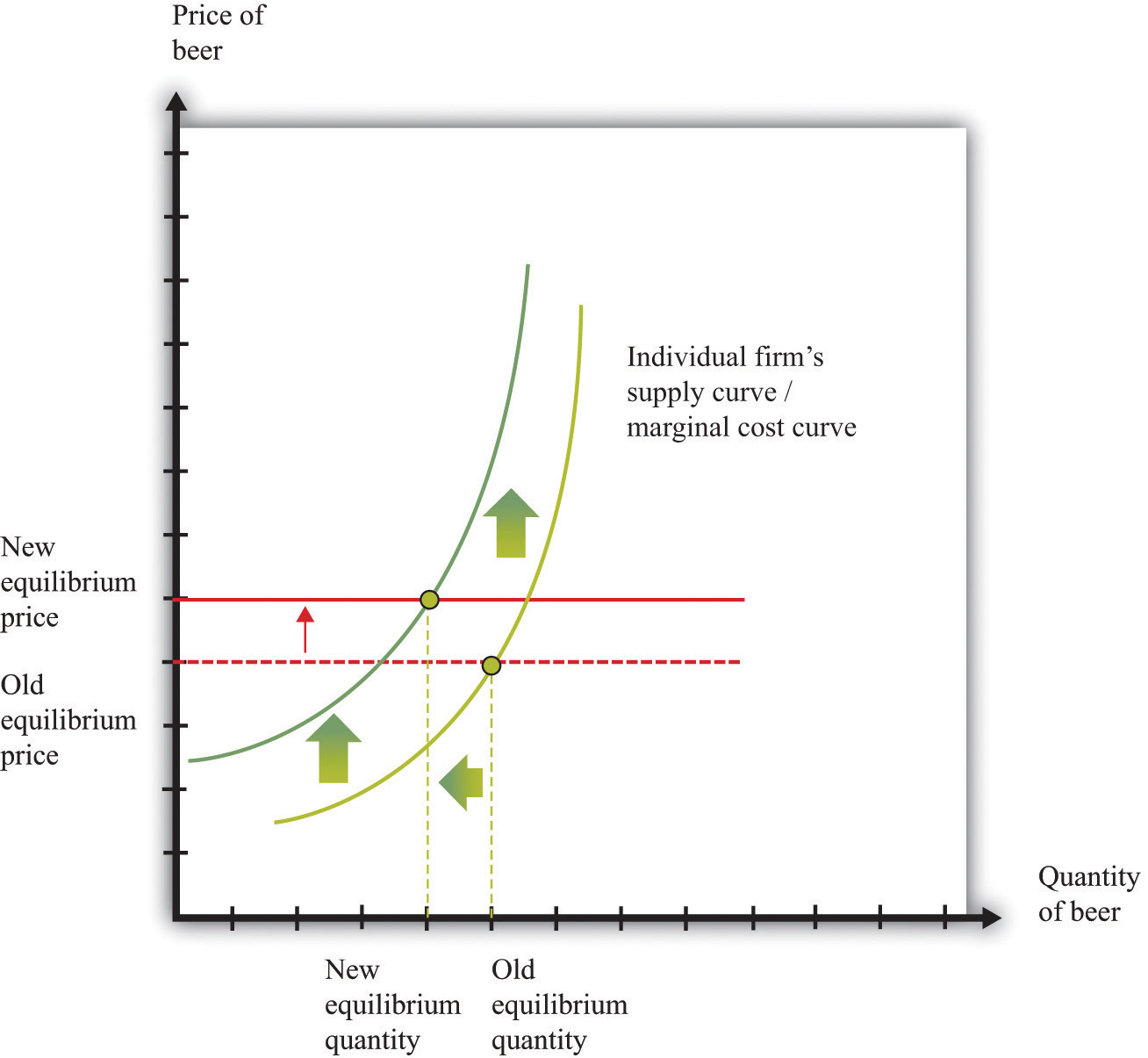
Yes it does (assuming they want to make more money). Maybe a picture will help:


Pretend the arrows pointed in the opposite direction (since my scenario is marginal cost going down, not up). The green MC line goes down/right, and the new equilibrium point goes down and right too. The horizontal scale is quantity produced. So yes, the equilibrium quantity does indeed increase. Even if that firm chose not to, another firm would gladly grab that additional area of profit for itself.
WHOOP!'91
How long do you want to ignore this user?
fixer said:

aTmAg said:

fixer said:

aTmAg said:

fixer said:

aTmAg said:

fixer said:

aTmAg said:

fixer said:

aTmAg said:

fixer said:

See my edit.


Supply just can't magically go up. The market forces seek to balance supply and demand. Prices reflect this.

Producers seek to maximize profit while consumers seek to reduce costs.

A producer is incentivized to make more by higher profits. One aspect is a higher selling cost. Another is lower cost input materials and resources.

Producers will make a certain amount of product for a certain price. Consumers buy a certain amount of a product at a certain price.

If supply goes above this equilibrium the prices tend to come down because it is an incentive for consumers.

The equilibrium aspect in supply and demand is missing in your assumption that a simple increase in supply ( apparently of all or most goods) will lower costs.
I never said supply would magically go up. I went out of my way to to say if we "double their production" to make it clear that I was talking philosophical. Of course, I do not think we can snap our fingers and double their production in an instant. Nor did I say that prices would go below equilibrium. The equilibrium price would become much lower.

If government stopped welfare then that would greatly reduce salary requirements since people who now refrain from working for any offers lower than X will get off their asses and work for vastly lower salaries in order to not starve. Since salaries are the top expense in most businesses, suddenly entire industries that are unsustainable in America now would become viable again. That would move the supply curve right lowering prices. In addition, since everybody would be paying lower salaries, competition would also push the supply curve down and prices lower until it reaches equilibrium.


Ok so I was with you on lower input costs for labor.

But if a company lowered their input costs they aren't going to simply ramp up production. There has to be a signal for increased demand.


When the supply curve moves down the equilibrium point moves right in addition to down. A more right equilibrium, point means a larger quantity. So if they don't want to lose money, then they better increase their production. If they do not, then somebody else will. Even if they have to enter the market to do so.


This is all true and is also not the same thing as " increasing production will lower prices".


I never said "production". I said "supply". For a guy who is tossing around "Econ 101" quips, you would think you would know the difference.

To argue that a larger supply does not push down prices is like arguing that the world is flat.


How does supply increase without increasing production ?
By additional suppliers/producers entering the market. Can you not see the difference between a firm declaring "let's produce more widgets to lower the price!" (which would not happen) and a firm being able to hire twice as many employees for the same money and producing more that way (which would happen)?


Throwing in " other suppliers entering the market" is not congruent with " all things equal ".


Uhhhh yeah it is. It doesn't matter how the supply curve moves right, just that it is the only thing that does.

Since you edited:

Quote:

Besides that...

there has to be a signal of demand. Companies arent going to enter a market just to out produce other companies for sport.

There has to be a competitive differentiation between companies and products.
Sure there is. A reduced cost of labor moves each firm's marginal cost curve down. That moves the equilibrium point down and to the right. If the firm doesn't increase production then they are leaving money on the table and other firms would take that market share. Either way supply increases.


Reducing input costs make the company more profitable. It doesn't automatically mean an increase in supply. If they increase production their costs will go up. The analysis is on the margins and what additional production will cost them.


I guess he is assuming infinite demand at some price point.
A & M, GIVE US ROOM!

aTmAg
How long do you want to ignore this user?
WHOOP!'91 said:

fixer said:

aTmAg said:

fixer said:

aTmAg said:

fixer said:

aTmAg said:

fixer said:

aTmAg said:

fixer said:

aTmAg said:

fixer said:

See my edit.


Supply just can't magically go up. The market forces seek to balance supply and demand. Prices reflect this.

Producers seek to maximize profit while consumers seek to reduce costs.

A producer is incentivized to make more by higher profits. One aspect is a higher selling cost. Another is lower cost input materials and resources.

Producers will make a certain amount of product for a certain price. Consumers buy a certain amount of a product at a certain price.

If supply goes above this equilibrium the prices tend to come down because it is an incentive for consumers.

The equilibrium aspect in supply and demand is missing in your assumption that a simple increase in supply ( apparently of all or most goods) will lower costs.
I never said supply would magically go up. I went out of my way to to say if we "double their production" to make it clear that I was talking philosophical. Of course, I do not think we can snap our fingers and double their production in an instant. Nor did I say that prices would go below equilibrium. The equilibrium price would become much lower.

If government stopped welfare then that would greatly reduce salary requirements since people who now refrain from working for any offers lower than X will get off their asses and work for vastly lower salaries in order to not starve. Since salaries are the top expense in most businesses, suddenly entire industries that are unsustainable in America now would become viable again. That would move the supply curve right lowering prices. In addition, since everybody would be paying lower salaries, competition would also push the supply curve down and prices lower until it reaches equilibrium.


Ok so I was with you on lower input costs for labor.

But if a company lowered their input costs they aren't going to simply ramp up production. There has to be a signal for increased demand.


When the supply curve moves down the equilibrium point moves right in addition to down. A more right equilibrium, point means a larger quantity. So if they don't want to lose money, then they better increase their production. If they do not, then somebody else will. Even if they have to enter the market to do so.


This is all true and is also not the same thing as " increasing production will lower prices".


I never said "production". I said "supply". For a guy who is tossing around "Econ 101" quips, you would think you would know the difference.

To argue that a larger supply does not push down prices is like arguing that the world is flat.


How does supply increase without increasing production ?
By additional suppliers/producers entering the market. Can you not see the difference between a firm declaring "let's produce more widgets to lower the price!" (which would not happen) and a firm being able to hire twice as many employees for the same money and producing more that way (which would happen)?


Throwing in " other suppliers entering the market" is not congruent with " all things equal ".


Uhhhh yeah it is. It doesn't matter how the supply curve moves right, just that it is the only thing that does.

Since you edited:

Quote:

Besides that...

there has to be a signal of demand. Companies arent going to enter a market just to out produce other companies for sport.

There has to be a competitive differentiation between companies and products.
Sure there is. A reduced cost of labor moves each firm's marginal cost curve down. That moves the equilibrium point down and to the right. If the firm doesn't increase production then they are leaving money on the table and other firms would take that market share. Either way supply increases.


Reducing input costs make the company more profitable. It doesn't automatically mean an increase in supply. If they increase production their costs will go up. The analysis is on the margins and what additional production will cost them.


I guess he is assuming infinite demand at some price point.
I'm not assuming that at all. I'm assuming normal conditions and economic laws apply.
fixer
How long do you want to ignore this user?
aTmAg said:

Yes it does (assuming they want to make more money). Maybe a picture will help:


Pretend the arrows pointed in the opposite direction (since my scenario is marginal cost going down, not up). The green MC line goes down/right, and the new equilibrium point goes down and right too. The horizontal scale is quantity produced. So yes, the equilibrium quantity does indeed increase. Even if that firm chose not to, another firm would gladly grab that additional area of profit for itself.
I agree the plot shows what you are indicating. I have no issue with that. What I am saying is the issue is not a simple matter of supply increase. The plot does not accurately show that MC curves have a minimum point on them that are critical.

MC, ATC, AVC are all based on cost of production, not realized sales price.

Further, these plots are looked at for the optimal point of production. Going above the optimal point, costs are higher, margins are smaller, less profit.

The objective is then for existing companies to evaluate how to lower their costs at higher production volumes due to competitive pressures. Taken to extreme points, MC, ATC, AVC costs always go up because at some point raw materials become prohibitively expensive to continue.

So...therefore...making more things doesn't necessarily make things cheaper.


aTmAg
How long do you want to ignore this user?
fixer said:

aTmAg said:

Yes it does (assuming they want to make more money). Maybe a picture will help:


Pretend the arrows pointed in the opposite direction (since my scenario is marginal cost going down, not up). The green MC line goes down/right, and the new equilibrium point goes down and right too. The horizontal scale is quantity produced. So yes, the equilibrium quantity does indeed increase. Even if that firm chose not to, another firm would gladly grab that additional area of profit for itself.
I agree the plot shows what you are indicating. I have no issue with that. What I am saying is the issue is not a simple matter of supply increase. The plot does not accurately show that MC curves have a minimum point on them that are critical.

MC, ATC, AVC are all based on cost of production, not realized sales price.

Further, these plots are looked at for the optimal point of production. Going above the optimal point, costs are higher, margins are smaller, less profit.

The objective is then for existing companies to evaluate how to lower their costs at higher production volumes due to competitive pressures. Taken to extreme points, MC, ATC, AVC costs always go up because at some point raw materials become prohibitively expensive to continue.
None of this is teaching me anything, and I'm not sure how any of this helps your point. You imply that I think MC is based on sales price. I never said that. The MC is is the supply curve for that particular firm. The industry wide supply curve is the sum of all the firms' MC/supply curves. The equilibrium/realized sales price is where that cumulative supply curve crosses the cumulative demand curve.

Quote:

So...therefore...making more things doesn't necessarily make things cheaper.
I'm still inclined to think you are not lying about my position but are merely misunderstand it. But I'm starting to wonder. For the gazillionth time, I never said "making more things makes them cheaper". You are claiming I made a claim that I never did.

You have my cause relationship reversed. I'm NOT saying that BECAUSE firms make more stuff, costs are down. I'm saying that BECAUSE costs are down, firms make more stuff.
fixer
How long do you want to ignore this user?
aTmAg said:


Quote:

So...therefore...making more things doesn't necessarily make things cheaper.
I'm still inclined to think you are not lying about my position but are merely misunderstand it. But I'm starting to wonder. For the gazillionth time, I never said "making more things makes them cheaper". You are claiming I made a claim that I never did.

You have my cause relationship reversed. I'm NOT saying that BECAUSE firms make more stuff, costs are down. I'm saying that BECAUSE costs are down, firms make more stuff.
Ok then we are good. That is exactly what I thought you were saying.

hahah wow.
aTmAg
How long do you want to ignore this user?
Maybe my long work day made me bad at getting my point across. I've slept since then.
fixer
How long do you want to ignore this user?
Same here . 6 weeks straight on a job . Multiple 15 hr days.

aTmAg
How long do you want to ignore this user?
fixer said:

Same here . 6 weeks straight on a job . Multiple 15 hr days.


I thought I was working a lot. Lots of 7 day weeks, but not 15 hours. Screw that.
 
×
subscribe Verify your student status
See Subscription Benefits
Trial only available to users who have never subscribed or participated in a previous trial.