
I don't see a debacle. Times might get a bit tough, but frankly we need that. Maybe it will force some people to gain perspective and finally grow up.Stat Monitor Repairman said:
Flu or not the flu ... its about to become real clear that we gleefully burned our lifeboats on this deal by voluntarily wrecking the economy.
I think we are going to see a run on meat this week and people losing their minds over food shortages / unavailability over the next months / years.
The shockwaves from this debacle are gonna take years to settle out.
So it is like the flu after all
27,076 Views |
149 Replies |
Last: 5 yr ago by TXAggie2011
Positions like this are why this is a lot of push back against the "doctor and scientist" viewpoint. The data is bad, we all know that. However, politicians, doctors, and scientist used bad data (which is all we had) to make some very far reaching lock down policy decisions. And many continue to double down on those decisions even though the data has changed.Ranger222 said:
You do realize this is a NOVEL coronavirus, yes? Something WE have not seen before, correct? All those stupid doctors and scientists making mistakes on something they don't even know what they are dealing with. Well gosh, shame on them. How ****ing could they. Must be so ****ing easy to get right the first time.
Such an idiotic and shameless response. Both the medical and scientific community have moved at speeds we couldn't have imagined before this began. Vaccine trials beginning against a pathogen we didn't even know existed four months ago? That's an incredible human achievement few, like yourself, realize. The medical community has come up with new guidelines on treatment in the span of weeks that improve survival once patients reach ICU. We have numerous trials ongoing of drug candidates to a disease we didn't know about at the beginning of the year.
Have there been failures? Science is 90% failure. Of course there is failure. That's how the scientific process works. We're working with a virus that causes a disease we don't even fully understand.
Whenever anyone brings up a counter argument to the current policy decisions, most are met with a few different responses.
1) It's not peer reviewed. The data is biased. Don't trust any of it.
2) You are not a doctor, scientist, etc... Why does your thought carry any value?
Yes, doctors and scientist are receiving crass and blunt feedback. I don't justify it but it's a product of the circumstances. We rushed with very bad data into a very extreme policy decision. Now that we are here, we are holding any new piece of data to a much higher level of scrutiny. I think it's very naive to expect the population to sit nicely in their homes while the scientific community picks and chooses what data to believe.
Well said
BenColderHere said:I don't see a debacle. Times might get a bit tough, but frankly we need that. Maybe it will force some people to gain perspective and finally grow up.Stat Monitor Repairman said:
Flu or not the flu ... its about to become real clear that we gleefully burned our lifeboats on this deal by voluntarily wrecking the economy.
I think we are going to see a run on meat this week and people losing their minds over food shortages / unavailability over the next months / years.
The shockwaves from this debacle are gonna take years to settle out.
Ya, putting people out of work, losing their businesses, and decimating their retirement accounts are ultimately good things to happen to learn a life lesson
4 pages in to your topic and this is all you have to add. I don't get it.
AeroAg2003 said:Positions like this are why this is a lot of push back against the "doctor and scientist" viewpoint. The data is bad, we all know that. However, politicians, doctors, and scientist used bad data (which is all we had) to make some very far reaching lock down policy decisions. And many continue to double down on those decisions even though the data has changed.Ranger222 said:
You do realize this is a NOVEL coronavirus, yes? Something WE have not seen before, correct? All those stupid doctors and scientists making mistakes on something they don't even know what they are dealing with. Well gosh, shame on them. How ****ing could they. Must be so ****ing easy to get right the first time.
Such an idiotic and shameless response. Both the medical and scientific community have moved at speeds we couldn't have imagined before this began. Vaccine trials beginning against a pathogen we didn't even know existed four months ago? That's an incredible human achievement few, like yourself, realize. The medical community has come up with new guidelines on treatment in the span of weeks that improve survival once patients reach ICU. We have numerous trials ongoing of drug candidates to a disease we didn't know about at the beginning of the year.
Have there been failures? Science is 90% failure. Of course there is failure. That's how the scientific process works. We're working with a virus that causes a disease we don't even fully understand.
Whenever anyone brings up a counter argument to the current policy decisions, most are met with a few different responses.
1) It's not peer reviewed. The data is biased. Don't trust any of it.
2) You are not a doctor, scientist, etc... Why does your thought carry any value?
Yes, doctors and scientist are receiving crass and blunt feedback. I don't justify it but it's a product of the circumstances. We rushed with very bad data into a very extreme policy decision. Now that we are here, we are holding any new piece of data to a much higher level of scrutiny. I think it's very naive to expect the population to sit nicely in their homes while the scientific community picks and chooses what data to believe.
I don't think you can try and compare the situation we were in the beginning of March to today. At that time when the original lockdown was ordered, all we had was data out of China, Italy and Spain. The data, at that time, showed high hospitalization and and mortality rates. Meanwhile here, we were beginning to see community spread in different regions of the country. Those decisions were made with the data and modeling built on that data. Yes it looks different today, but we made the best decision given what we knew at that time. If you play that scenario out 100 times, I'm sure we would enact the same polices a large percentage, if not 90% of the time.
You are also trying to combine epidemiological data with medical/scientific data which are two different beasts. Epidemiologists use models and the input data into those models can fluctuate. 538 had a great podcast interview with one of the leaders of the IMHE group who built the model that the WH always talks about. It wasn't their day job to build that model and that model was built on current numbers at the time and will continue to evolve as the numbers do. That is why there has a been a big flux in some of their initial numbers with what you are seeing now, and that should be expected as more data is coming in and more inputs are provided.
The peer reviewed data you talk about is different in that the data are what the data are and should be carefully examined before released to the public. We have made great advances in getting science to the public fast, not only for general knowledge but to accelerate research between groups. However, there have been some people that have taken advantage of that system. These studies that claimed the virus bound/lysed red blood cells or certain blood groups more susceptible -- all non-peer reviewed studies that I still see posted and discussed here daily when its bad science. The media and others jumped on them without fully understanding what was done. Same with treatments. We didn't know how to treat this thing and hydroxychlorquine was the first suggestion because that is what Korea was using. Sure use it because that is all we have, but we still needed blinded, controlled studies to show it is effective and data is coming in now that it is not (in terms of hospitalization usage). Same for all these companies that are trying to rush and produce serological tests to make a quick dollar -- that are not FDA approved and we don't know their false positive rate or sensitivity. They push them on you as the answer or worse just buy them from China and redistribute them without telling you and know we have anecdotal reports using these faulty kits that sway public opinion. We have to take time and understand all of these things before rushing out and trying to draw some conclusion, which I think has been the "blow back" from many here when these things are discussed.
I don't think you can say we "rushed in with bad data....". There was no data. Now, given time, we are slowly accumulating data and ideas to attack, while flattening the curve and keeping hospitalizations/deaths under control for now.
AeroAg2003 said:
We rushed with very bad data into a very extreme policy decision
So, with no good data - as you suggested - and seeing (at the time) Washington under fire and NYC getting hammered, not to mention Italy & Spain, what exactly course of action would you have thought appropriate?
Folks that govern will always lean towards the more "safety minded" approach in these situations and it seems a bit revisionist to pretend that the control we have seemingly gotten over this thing was a given when these calls were made.
It's no different than watching a 4th down play fail and insisting you would have done the opposite.
Most of the folks that blasted the shut down at the time said this wasn't anything other than the flu, and some of them still claim this despite all the data showing that simply isn't the case.
I get it if folks feel like we need to start opening up and they feel people are moving too slowly, but the notion that we should never have taken any action at all is one that is only even an option because you get the convenience of never actually having to see how such a choice could have played out.
Black Tooth Grin said:
4 pages in to your topic and this is all you have to add. I don't get it.
Don't get what? I posted a video to see what others thought..
Ranger222 said:AeroAg2003 said:Positions like this are why this is a lot of push back against the "doctor and scientist" viewpoint. The data is bad, we all know that. However, politicians, doctors, and scientist used bad data (which is all we had) to make some very far reaching lock down policy decisions. And many continue to double down on those decisions even though the data has changed.Ranger222 said:
You do realize this is a NOVEL coronavirus, yes? Something WE have not seen before, correct? All those stupid doctors and scientists making mistakes on something they don't even know what they are dealing with. Well gosh, shame on them. How ****ing could they. Must be so ****ing easy to get right the first time.
Such an idiotic and shameless response. Both the medical and scientific community have moved at speeds we couldn't have imagined before this began. Vaccine trials beginning against a pathogen we didn't even know existed four months ago? That's an incredible human achievement few, like yourself, realize. The medical community has come up with new guidelines on treatment in the span of weeks that improve survival once patients reach ICU. We have numerous trials ongoing of drug candidates to a disease we didn't know about at the beginning of the year.
Have there been failures? Science is 90% failure. Of course there is failure. That's how the scientific process works. We're working with a virus that causes a disease we don't even fully understand.
Whenever anyone brings up a counter argument to the current policy decisions, most are met with a few different responses.
1) It's not peer reviewed. The data is biased. Don't trust any of it.
2) You are not a doctor, scientist, etc... Why does your thought carry any value?
Yes, doctors and scientist are receiving crass and blunt feedback. I don't justify it but it's a product of the circumstances. We rushed with very bad data into a very extreme policy decision. Now that we are here, we are holding any new piece of data to a much higher level of scrutiny. I think it's very naive to expect the population to sit nicely in their homes while the scientific community picks and chooses what data to believe.
I don't think you can try and compare the situation we were in the beginning of March to today. At that time when the original lockdown was ordered, all we had was data out of China, Italy and Spain. The data, at that time, showed high hospitalization and and mortality rates. Meanwhile here, we were beginning to see community spread in different regions of the country. Those decisions were made with the data and modeling built on that data. Yes it looks different today, but we made the best decision given what we knew at that time. If you play that scenario out 100 times, I'm sure we would enact the same polices a large percentage, if not 90% of the time.
You are also trying to combine epidemiological data with medical/scientific data which are two different beasts. Epidemiologists use models and the input data into those models can fluctuate. 538 had a great podcast interview with one of the leaders of the IMHE group who built the model that the WH always talks about. It wasn't their day job to build that model and that model was built on current numbers at the time and will continue to evolve as the numbers do. That is why there has a been a big flux in some of their initial numbers with what you are seeing now, and that should be expected as more data is coming in and more inputs are provided.
The peer reviewed data you talk about is different in that the data are what the data are and should be carefully examined before released to the public. We have made great advances in getting science to the public fast, not only for general knowledge but to accelerate research between groups. However, there have been some people that have taken advantage of that system. These studies that claimed the virus bound/lysed red blood cells or certain blood groups more susceptible -- all non-peer reviewed studies that I still see posted and discussed here daily when its bad science. The media and others jumped on them without fully understanding what was done. Same with treatments. We didn't know how to treat this thing and hydroxychlorquine was the first suggestion because that is what Korea was using. Sure use it because that is all we have, but we still needed blinded, controlled studies to show it is effective and data is coming in now that it is not (in terms of hospitalization usage). Same for all these companies that are trying to rush and produce serological tests to make a quick dollar -- that are not FDA approved and we don't know their false positive rate or sensitivity. They push them on you as the answer or worse just buy them from China and redistribute them without telling you and know we have anecdotal reports using these faulty kits that sway public opinion. We have to take time and understand all of these things before rushing out and trying to draw some conclusion, which I think has been the "blow back" from many here when these things are discussed.
I don't think you can say we "rushed in with bad data....". There was no data. Now, given time, we are slowly accumulating data and ideas to attack, while flattening the curve and keeping hospitalizations/deaths under control for now.
Also, even thought the models had changed several times with new and shifting data, the early versions that existed when decisions were being made held up pretty well considering what they had to go on
https://pbs.twimg.com/media/EWoABZCWkAE-Iwh?format=jpg&name=large

Daily model comparison done by hotardag07
Add something... Validity of the video... Credentials of guys in the video... Don't be the guy who just throws an inflammatory title and a YouTube video without discussion or some perspective.
I guess I just saw it as disrespectful to the medical professionals that are just trying to help others. JMO.
I guess I just saw it as disrespectful to the medical professionals that are just trying to help others. JMO.
A few points:
1) I agree that a snap judgement had to be made. I would have shut the economy down given the data we had.
2) Regarding the IHME model: Given my limited research, it's a curve fitting model. Of course over time at the macro level it starts to follow historical trends. I'm not sure it really is a good predictor of underlying drivers of the data or what might be to come as our underlying behaviors change. It's also a horrible model in non urban areas.
3) To your last paragraph:
This is exactly the dynamic that I'm talking about. Two points:
A) This is not a science experiment any longer. You don't get to control the narrative and control what data is seen and what data isn't. The media is in the middle of all of this and driving the entire narrative (and most of the narrative of this "scientific COVID" board). As much as the scientist want to be the arbiter of what is seen and isn't seen, we are past that now. This is a 24 hour news cycle and you don't have the luxury of a full peer review.
B) To a broader point, comments like this really piss a lot of people off. It comes of as very preachy as if the vast population is dumb and cant figure things out. While I may not be a doctor or a scientist ( I have a BS Computer Engineering + a MBA), there other others (like me) that know you are normal humans. I went to school with you and I know that you are no smarter on average than most of the rest of the Texas A&M student population. Given that this is the board of one of the best universities in the country, you best keep in mind not to talk to down to people like a bunch of rubes. Yes, you may have domain knowledge, but you don't get to take over our lives without explanation.
However, your comments illustrates my point. The goal at the time was to flatten the curve. The curve is on the way to being pretty damn flat. Now that we are there, people are not going to wait for you to do your tests and peer reviews while the economy blows itself to bits.
1) I agree that a snap judgement had to be made. I would have shut the economy down given the data we had.
2) Regarding the IHME model: Given my limited research, it's a curve fitting model. Of course over time at the macro level it starts to follow historical trends. I'm not sure it really is a good predictor of underlying drivers of the data or what might be to come as our underlying behaviors change. It's also a horrible model in non urban areas.
3) To your last paragraph:
Quote:
The peer reviewed data you talk about is different in that the data are what the data are and should be carefully examined before released to the public. We have made great advances in getting science to the public fast, not only for general knowledge but to accelerate research between groups. However, there have been some people that have taken advantage of that system. These studies that claimed the virus bound/lysed red blood cells or certain blood groups more susceptible -- all non-peer reviewed studies that I still see posted and discussed here daily when its bad science. The media and others jumped on them without fully understanding what was done. Same with treatments. We didn't know how to treat this thing and hydroxychlorquine was the first suggestion because that is what Korea was using. Sure use it because that is all we have, but we still needed blinded, controlled studies to show it is effective and data is coming in now that it is not (in terms of hospitalization usage). Same for all these companies that are trying to rush and produce serological tests to make a quick dollar -- that are not FDA approved and we don't know their false positive rate or sensitivity. They push them on you as the answer or worse just buy them from China and redistribute them without telling you and know we have anecdotal reports using these faulty kits that sway public opinion. We have to take time and understand all of these things before rushing out and trying to draw some conclusion, which I think has been the "blow back" from many here when these things are discussed.
This is exactly the dynamic that I'm talking about. Two points:
A) This is not a science experiment any longer. You don't get to control the narrative and control what data is seen and what data isn't. The media is in the middle of all of this and driving the entire narrative (and most of the narrative of this "scientific COVID" board). As much as the scientist want to be the arbiter of what is seen and isn't seen, we are past that now. This is a 24 hour news cycle and you don't have the luxury of a full peer review.
B) To a broader point, comments like this really piss a lot of people off. It comes of as very preachy as if the vast population is dumb and cant figure things out. While I may not be a doctor or a scientist ( I have a BS Computer Engineering + a MBA), there other others (like me) that know you are normal humans. I went to school with you and I know that you are no smarter on average than most of the rest of the Texas A&M student population. Given that this is the board of one of the best universities in the country, you best keep in mind not to talk to down to people like a bunch of rubes. Yes, you may have domain knowledge, but you don't get to take over our lives without explanation.
Yes... we did. We made a snap judgement that I personally agreed with at the time.Quote:
I don't think you can say we "rushed in with bad data....". There was no data. Now, given time, we are slowly accumulating data and ideas to attack, while flattening the curve and keeping hospitalizations/deaths under control for now.
However, your comments illustrates my point. The goal at the time was to flatten the curve. The curve is on the way to being pretty damn flat. Now that we are there, people are not going to wait for you to do your tests and peer reviews while the economy blows itself to bits.
I don't get your point about "controlling the narrative" and "getting to choose what data is seen and isn't seen".
I agree with you that the media is in control and they need to GTFO because they don't know what they are doing. They have no clue what they are reporting on or implications of their reporting. This has caused a lot of bad information to float around. Or at least save it for the science reporters that are familiar with the space instead all of the rushing to become science reporters.
There is no narrative to control from the science end...the data are what the data are...regarding "control what is seen" that is part of the peer review process so bunk or bad data does not make it to the public or policy makers do drive incorrect decision making. There have been numerous misconceptions out there that have caused confusion and have incorrectly framed the issues...such as the discussed red blood cell issue or the numerous "strains" of virus out there which is incorrect. And it does harm the public as I've seen numerous people comment "well there are numerous strains and we must not have a bad one here" thinking they are not at risk when they carry equal risk as everyone else. Everyone wants solid data and quickly but peer review is meant to prevent the mishaps seen in releasing the SF and LA serological data. Instead of red flags being raised about the test used to generate the data, the math used, and how they recruited individuals before the data was released so they could comment and correct, we had to do it AFTER the results were already out there. That should never happen and it only caused confusion and differences of opinion on threads on this very forum. That's exactly what it's meant to stop. Instead of having thoughtful discussions on data interpretation and next steps, we were yelling about who was right, who was wrong and what side you lean politically.
Have tempers flared? Yes. One of the biggest failures has been communication to the broader public. But I'm tired of posting information and trying to discuss with everyone only to have personal antidotes, weird websites from strange sources or YouTube videos from weird people trump it and found more believable and setting the tone for the conversation. To hell with it at this point.
I agree with you that the media is in control and they need to GTFO because they don't know what they are doing. They have no clue what they are reporting on or implications of their reporting. This has caused a lot of bad information to float around. Or at least save it for the science reporters that are familiar with the space instead all of the rushing to become science reporters.
There is no narrative to control from the science end...the data are what the data are...regarding "control what is seen" that is part of the peer review process so bunk or bad data does not make it to the public or policy makers do drive incorrect decision making. There have been numerous misconceptions out there that have caused confusion and have incorrectly framed the issues...such as the discussed red blood cell issue or the numerous "strains" of virus out there which is incorrect. And it does harm the public as I've seen numerous people comment "well there are numerous strains and we must not have a bad one here" thinking they are not at risk when they carry equal risk as everyone else. Everyone wants solid data and quickly but peer review is meant to prevent the mishaps seen in releasing the SF and LA serological data. Instead of red flags being raised about the test used to generate the data, the math used, and how they recruited individuals before the data was released so they could comment and correct, we had to do it AFTER the results were already out there. That should never happen and it only caused confusion and differences of opinion on threads on this very forum. That's exactly what it's meant to stop. Instead of having thoughtful discussions on data interpretation and next steps, we were yelling about who was right, who was wrong and what side you lean politically.
Have tempers flared? Yes. One of the biggest failures has been communication to the broader public. But I'm tired of posting information and trying to discuss with everyone only to have personal antidotes, weird websites from strange sources or YouTube videos from weird people trump it and found more believable and setting the tone for the conversation. To hell with it at this point.
And nobody here is saying to "let us conduct all our tests and peer review" while everyone is lockdown. Don't know where that came from. But there is a middle ground from our current situation to "open it all back up" where we can do this gradually, backed by testing and data, to observe the population and make sure we are doing it as safely as possible without sparking more infection chains and a second overwhelming wave that will shut it all down again. That has always been the goal and is achievable and has nothing to do with current research ongoing
If the country is reopened quickly and nothing bad comes from it, all those which doubled down on the lock down will be proven wrong. And they just can't have that.
Our government is playing God, and nothing good ever comes from that.
-TK
-TK
My three things on this --
(and no I'm not Jason and this is not Friday, so dont @ me bro)
First, this should go without saying, but censorship to the degree of removing videos like this one is ridiculous, insane, out of line. How many "truths" can stand longer than a days time? Things are always changing. Very scary to think YouTube or any other social network can ban or remove stuff like this. Hopefully youtube in this case corrects this by letting it live online, whether or not it's accurate, that's not for them to determine (or it shouldn't be at least). Let people decide.
Second, it makes sense to say that this is like the flu in the sense that it's a virus. It's what people know and are familiar with. It gives the average person a base to talk and discuss around. Not everyone is an expert virologist and knows the differences between Inffluenza type A and B, much less Mers, Sars, Sars-2, Ebola, etc. In my mind saying it's like the flue but worse, isn't a bad or inaccurate statement. Most people will recover just like they do the flu, so from that stand point it is similar.
Third, the one argument not discussed from the video (before it was deleted) was the issue with sheltering, but while doing so going to the grocery story or hardware stores. These are in some cases crammed with people (drive by a Lowes on the weekend, wow). Is it really fair to say the same social distancing measures these companies and shoppers are taking can't be maintained at other retail stores? It's not like the same people buying the groceries don't also shop at the mall beside you. You're not mixing anymore than you already have by going to the grocery store each week. Of course masks, sanitizer, and being 6 ft apart should be well utilized, but I think it makes sense you can open stores up and maintain the same standard that's been held for the last 6 weeks. But perhaps I'm wrong (please do not delete)!
(and no I'm not Jason and this is not Friday, so dont @ me bro)
First, this should go without saying, but censorship to the degree of removing videos like this one is ridiculous, insane, out of line. How many "truths" can stand longer than a days time? Things are always changing. Very scary to think YouTube or any other social network can ban or remove stuff like this. Hopefully youtube in this case corrects this by letting it live online, whether or not it's accurate, that's not for them to determine (or it shouldn't be at least). Let people decide.
Second, it makes sense to say that this is like the flu in the sense that it's a virus. It's what people know and are familiar with. It gives the average person a base to talk and discuss around. Not everyone is an expert virologist and knows the differences between Inffluenza type A and B, much less Mers, Sars, Sars-2, Ebola, etc. In my mind saying it's like the flue but worse, isn't a bad or inaccurate statement. Most people will recover just like they do the flu, so from that stand point it is similar.
Third, the one argument not discussed from the video (before it was deleted) was the issue with sheltering, but while doing so going to the grocery story or hardware stores. These are in some cases crammed with people (drive by a Lowes on the weekend, wow). Is it really fair to say the same social distancing measures these companies and shoppers are taking can't be maintained at other retail stores? It's not like the same people buying the groceries don't also shop at the mall beside you. You're not mixing anymore than you already have by going to the grocery store each week. Of course masks, sanitizer, and being 6 ft apart should be well utilized, but I think it makes sense you can open stores up and maintain the same standard that's been held for the last 6 weeks. But perhaps I'm wrong (please do not delete)!
I don't know why YouTube took the video down, other than the generic statement of violating their terms of service. Is still available on Facebook.
It got sent to me before it went viral. I've been surprised at how viral it has gone. When I first watched it I thought the sky is not any kind of scientist and doesn't have any kind of the scientific background he claims. Just based on the errors of his arguments. And fallacies for that matter. I wondered where he went to school. When I figured that out that answered a lot of questions for me.
It got sent to me before it went viral. I've been surprised at how viral it has gone. When I first watched it I thought the sky is not any kind of scientist and doesn't have any kind of the scientific background he claims. Just based on the errors of his arguments. And fallacies for that matter. I wondered where he went to school. When I figured that out that answered a lot of questions for me.
whoa there. watch out. you don't want to sound like those doctors that got censored and removed from YouTube. This is blasphemy and damn near treason.SoupNazi2001 said:Ranger222 said:
And nobody here is saying to "let us conduct all our tests and peer review" while everyone is lockdown. Don't know where that came from. But there is a middle ground from our current situation to "open it all back up" where we can do this gradually, backed by testing and data, to observe the population and make sure we are doing it as safely as possible without sparking more infection chains and a second overwhelming wave that will shut it all down again. That has always been the goal and is achievable and has nothing to do with current research ongoing
You want data and stats. In Texas we have 26K cases and 690 deaths out of 29 million people. 75%+ of those deaths are people 65+. That is not justification to shut the state down.
Plus, if I am to believe the media, CORONA just kills healthy 30 and 40 year olds at random but those doctors, who are obviously in their late 40s, are asking to open up their practice and be in a room with random sick people all day.
They are suicidal then, correct? Something does not add up.
They are suicidal then, correct? Something does not add up.
The_Fox said:
Plus, if I am to believe the media, CORONA just kills healthy 30 and 40 year olds at random but those doctors, who are obviously in their late 40s, are asking to open up their practice and be in a room with random sick people all day.
They are suicidal then, correct? Something does not add up.
Not real doctors, they are just business people
Premium said:The_Fox said:
Plus, if I am to believe the media, CORONA just kills healthy 30 and 40 year olds at random but those doctors, who are obviously in their late 40s, are asking to open up their practice and be in a room with random sick people all day.
They are suicidal then, correct? Something does not add up.
Not real doctors, they are just business people
Yeah, that is like saying because I am the managing partner at my law firm, I'm not a real lawyer.
They are real doctors. They had to see clients to build their practice. And those doc in the box places run through patients like crazy. They will be exposed in short order. They obviously just believe they will be ok for some crazy reason even though they will catch the 2020 plague.
Well that's certainly not hyperbole at all.The_Fox said:
Plus, if I am to believe the media, CORONA just kills healthy 30 and 40 year olds at random but those doctors, who are obviously in their late 40s, are asking to open up their practice and be in a room with random sick people all day.
They are suicidal then, correct? Something does not add up.
The bottom line is they are not concerned with exposure to the virus. Period.MASAXET said:Well that's certainly not hyperbole at all.The_Fox said:
Plus, if I am to believe the media, CORONA just kills healthy 30 and 40 year olds at random but those doctors, who are obviously in their late 40s, are asking to open up their practice and be in a room with random sick people all day.
They are suicidal then, correct? Something does not add up.
This video has been taken off YouTube!
Doesn't mean they can't be right. They make a ton of great factual points.
https://www.acep.org/corona/COVID-19/covid-19-articles/acep-aaem-joint-statement-on-physician-misinformation/
No mincing of words there. Good on the ACEP.Quote:
The American College of Emergency Physicians (ACEP) and the American Academy of Emergency Medicine (AAEM) jointly and emphatically condemn the recent opinions released by Dr. Daniel Erickson and Dr. Artin Massihi. These reckless and untested musings do not speak for medical societies and are inconsistent with current science and epidemiology regarding COVID-19. As owners of local urgent care clinics, it appears these two individuals are releasing biased, non-peer reviewed data to advance their personal financial interests without regard for the public's health.
COVID-19 misinformation is widespread and dangerous. Members of ACEP and AAEM are first-hand witnesses to the human toll that COVID-19 is taking on our communities. ACEP and AAEM strongly advise against using any statements of Drs. Erickson and Massihi as a basis for policy and decision making.
Agree with that statement 100%.
SoupNazi2001 said:Ranger222 said:
And nobody here is saying to "let us conduct all our tests and peer review" while everyone is lockdown. Don't know where that came from. But there is a middle ground from our current situation to "open it all back up" where we can do this gradually, backed by testing and data, to observe the population and make sure we are doing it as safely as possible without sparking more infection chains and a second overwhelming wave that will shut it all down again. That has always been the goal and is achievable and has nothing to do with current research ongoing
You want data and stats. In Texas we have 26K cases and 690 deaths out of 29 million people. 75%+ of those deaths are people 65+. That is not justification to shut the state down.

So you're apparently already in the blue area.SoupNazi2001 said:Ranger222 said:SoupNazi2001 said:Ranger222 said:
And nobody here is saying to "let us conduct all our tests and peer review" while everyone is lockdown. Don't know where that came from. But there is a middle ground from our current situation to "open it all back up" where we can do this gradually, backed by testing and data, to observe the population and make sure we are doing it as safely as possible without sparking more infection chains and a second overwhelming wave that will shut it all down again. That has always been the goal and is achievable and has nothing to do with current research ongoing
You want data and stats. In Texas we have 26K cases and 690 deaths out of 29 million people. 75%+ of those deaths are people 65+. That is not justification to shut the state down.
Nice graph, keep telling yourself that to justify the dumb lockdown overreactions. One question no one is asking is total deaths this year are not even higher than 2019. Most people who die from Covid are old and already in poor health. How do we know they wouldn't have died for some other reason in the next 6 months. Old people in poor health die and people don't live in nursing homes very long.
All-cause deaths are up this year. They are especially up in the hard-hit areas. England just had their deadliest month in 50 years of keeping track. Can you source data for your statement?

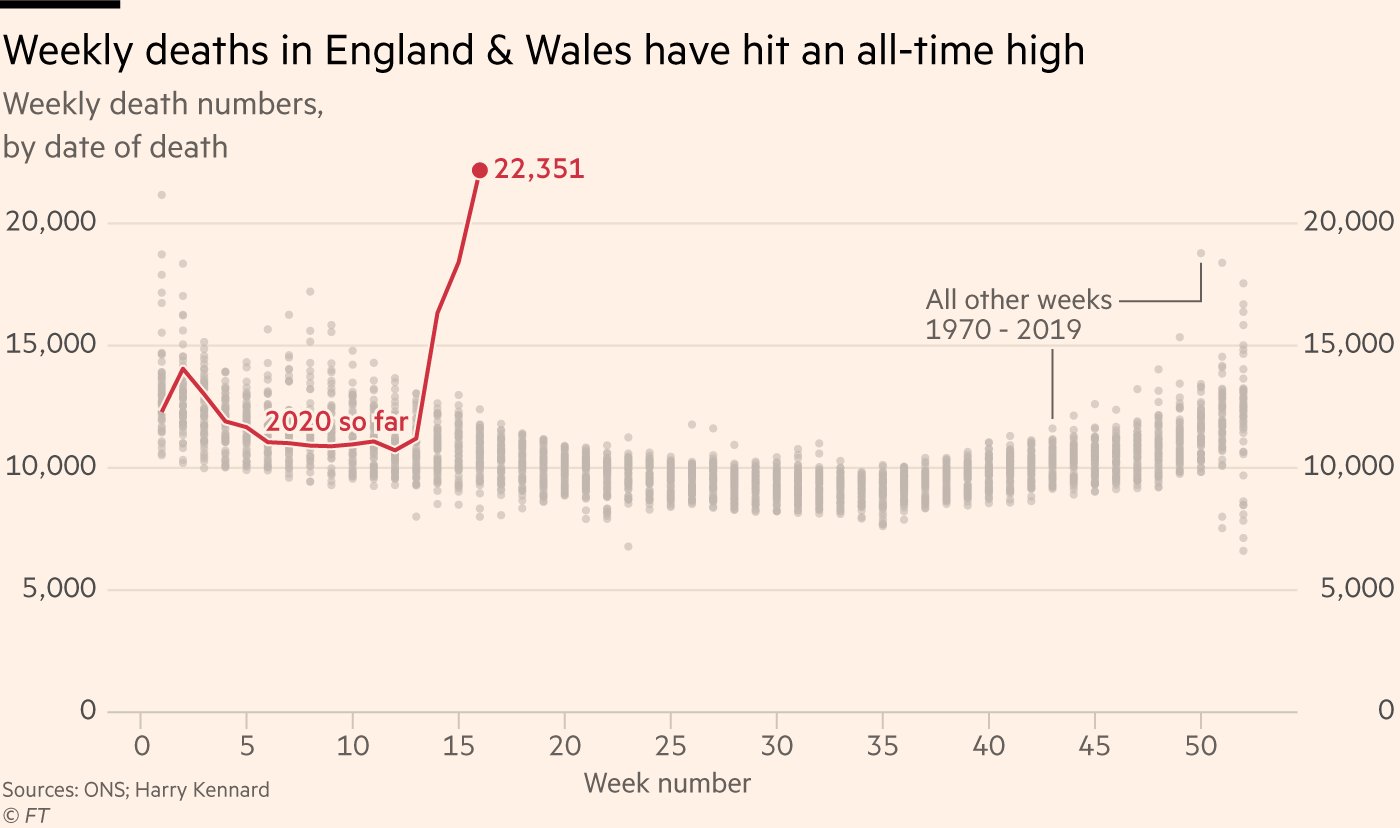
total deaths are higher esp in areas hit hard by COVID. Do you need the links, or can you find them yourself? This is the reason many people believe deaths are currently undercounted in terms of COVID.SoupNazi2001 said:Ranger222 said:SoupNazi2001 said:Ranger222 said:
And nobody here is saying to "let us conduct all our tests and peer review" while everyone is lockdown. Don't know where that came from. But there is a middle ground from our current situation to "open it all back up" where we can do this gradually, backed by testing and data, to observe the population and make sure we are doing it as safely as possible without sparking more infection chains and a second overwhelming wave that will shut it all down again. That has always been the goal and is achievable and has nothing to do with current research ongoing
You want data and stats. In Texas we have 26K cases and 690 deaths out of 29 million people. 75%+ of those deaths are people 65+. That is not justification to shut the state down.
Nice graph, keep telling yourself that to justify the dumb lockdown overreactions. One question no one is asking is total deaths this year are not even higher than 2019. Most people who die from Covid are old and already in poor health. How do we know they wouldn't have died for some other reason in the next 6 months. Old people in poor health die and people don't live in nursing homes very long.
ETFan said:
https://www.acep.org/corona/COVID-19/covid-19-articles/acep-aaem-joint-statement-on-physician-misinformation/No mincing of words there. Good on the ACEP.Quote:
The American College of Emergency Physicians (ACEP) and the American Academy of Emergency Medicine (AAEM) jointly and emphatically condemn the recent opinions released by Dr. Daniel Erickson and Dr. Artin Massihi. These reckless and untested musings do not speak for medical societies and are inconsistent with current science and epidemiology regarding COVID-19. As owners of local urgent care clinics, it appears these two individuals are releasing biased, non-peer reviewed data to advance their personal financial interests without regard for the public's health.
COVID-19 misinformation is widespread and dangerous. Members of ACEP and AAEM are first-hand witnesses to the human toll that COVID-19 is taking on our communities. ACEP and AAEM strongly advise against using any statements of Drs. Erickson and Massihi as a basis for policy and decision making.
SoupNazi2001 said:Ranger222 said:SoupNazi2001 said:Ranger222 said:
And nobody here is saying to "let us conduct all our tests and peer review" while everyone is lockdown. Don't know where that came from. But there is a middle ground from our current situation to "open it all back up" where we can do this gradually, backed by testing and data, to observe the population and make sure we are doing it as safely as possible without sparking more infection chains and a second overwhelming wave that will shut it all down again. That has always been the goal and is achievable and has nothing to do with current research ongoing
You want data and stats. In Texas we have 26K cases and 690 deaths out of 29 million people. 75%+ of those deaths are people 65+. That is not justification to shut the state down.
Nice graph, keep telling yourself that to justify the dumb lockdown overreactions. One question no one is asking is total deaths this year are not even higher than 2019. Most people who die from Covid are old and already in poor health. How do we know they wouldn't have died for some other reason in the next 6 months. Old people in poor health die and people don't live in nursing homes very long.
- Nice graph, keep telling yourself that to justify the dumb lockdown overreactions. *Lockdowns executed by nearly all city, county, state, federal, and worldwide governments are dumb and only select few not in power knew what to do is your point, and that you are one of those select few? Decisions were made worldwide based on information on hand and perceived threat, long term studies and analysis will tell us if it was the best way to proceed or not. Perhaps it was not for this event.
- One question no one is asking is total deaths this year are not even higher than 2019. *It's been asked and commented on for weeks, here and elsewhere. In areas of Covid 19 breakout, deaths this year over same months is much higher. In places where there are lockdowns but no Covid 19 outbreak, deaths are lower due to reduction in accidents and other causes.
- Most people who die from Covid are old and already in poor health. *Most are old. Many have other health issues that may lead to poor health, or may be completely manageable with good quality of life and life expectancy.
- How do we know they wouldn't have died for some other reason in the next 6 months. *We don't know. How do you know you or I won't die in the next 6 months? It's a somewhat pointless questions but reasonable to assume most would have enjoyed another 6 months - perhaps 6 years, perhaps longer - of life.
- Old people in poor health die and people don't live in nursing homes very long. *The first point is in line with the fact we all die, the second point is not well researched. In Hospice care? Not long. In nursing homes? Can be years. A Decade. It's subjective on your interpretation of "very long" I guess, but data would always back up empty statements.
Featured Stories
See All
6:03
17h ago
3.8k
The Loochador Podcast: Spring practice starts on Friday
by Billy Liucci
McMillan's vision comes to fruition with NCAA Tournament inclusion
by Olin Buchanan
Baseball Thoughts: Different questions pop up during Norman trip
by Ryan Brauninger
Five in Five: Offseason intel as spring ball begins
by Billy Liucci
Former A&M wideout Christian Kirk signs with San Francisco
by Richard Zane