Outdoors
Sponsored by

Powerlines. Big ones.

11,636 Views | 104 Replies | Last: 7 mo ago by Mas89
O.G.
How long do you want to ignore this user?
Here's my issue with it, the utility companys act A LOT like the government.

They never run out of money and they get to things when they get to things. It can be impossible to make them understand simple human issues and they will talk out of both sides of their mouth about "costs".

So, they say that "if we bury the lines the bills will go up", but they also spend dimes to me make nickels sometimes.
JB!98
How long do you want to ignore this user?
Just this morning, I approved a change order to switch from 1000' of UG three phase to 1000' of OH 3 phase. The cost savings is $2.4M. This is also in soil that is conducive to digging. You start running UG in Northwest and North San Antonio you are talking big $$ due to the rock.

Now I am paying for everything with no utility subsidization (CIAC), so those costs are reflective of actual labor and materials.
Gunny456
How long do you want to ignore this user?
I was being sarcastic txags92.
txags92
How long do you want to ignore this user?
Gunny456 said:


The point is I don't believe in the long run and all things considered, burying the lines is any more costly than running them miles in the air through folks property. They do it because they can make more money.
With that being said, I think property owners should get compensated for the electricity and or gas that transverses their property going to those markets…. and more so if they have to look at the lines and towers that destroy the aesthetics and value of their land ……and not just the minimum initial payment they have to fight for on the eminent domain BS.
But that's just my opinion.
That simply isn't true. Construction of the lines is generally going to be 10-15x more expensive. Operating costs may be lower, but there is a whole host of other things that can cause trouble with underground lines that make them expensive and difficult to manage as well. Just because they are not affected by hurricanes and ice storms doesn't mean they don't fail for other reasons, and when they do, 3 guys in a bucket truck or a helicopter can't just drive up and put it back together.

Asking companies to eat a capital cost of several billion dollars more for construction because they might save a few million maintenance dollars that they don't have to spend fixing lines once every 30 years when a hurricane hits is silly. If it made economic sense, they would be doing it. If it doesn't make economic sense, then we have no business trying to force them to do it using the power of government.
Gunny456
How long do you want to ignore this user?
This 1000 times.
txags92
How long do you want to ignore this user?
Gunny456 said:

I was being sarcastic txags92.
My apologies. I knew it didn't sound like you, but I figured maybe you had misunderstood what I was talking about.
Chef Elko
How long do you want to ignore this user?
Ah yes, the Permian region needs the largest transmission lines providing power from all across Texas. It's not like there was massive renewable buildout and the region produces the cheapest gas in the world with 20+ BCF/day of production. Stupid as hell
JB!98
How long do you want to ignore this user?
Chef Elko said:

Ah yes, the Permian region needs the largest transmission lines providing power from all across Texas. It's not like there was massive renewable buildout and the region produces the cheapest gas in the world with 20+ BCF/day of production. Stupid as hell
Believe it or not, even after all these years, we still have a hard time importing power from West Texas to the I-35 corridor and Houston. Some of this transmission work will allow for that through congestion relief, etc. The I-35 corridor is starving for capacity right now and will be until 2030.

The electrical realities and forecasts from 2010-2015 have been turned on their head. I think I have shared before that Oncor currently has 30GW, yes GW of load requests in their queue. Now, we all think that only about 10GW of those are real, that is still a absurd amount of capacity. To meet this demand, it will take a historic amount of transmission construction. It would be a good time to be a transmission contractor.

For scale, CPS Energy's service territory is about 5.5 - 6 GW. So Oncor needs to build 2 CPS Energy's to meet their capacity needs if the real number is 10-12GW.

The shortcut here that will not happen in time is modular nuclear reactors built at the load centers themselves.
Gunny456
How long do you want to ignore this user?
I get what you are saying. We just had tornadoes hit MO last week. Lots of hardships on folks. Lots of transmission lines and regular power lines down.Some folks without power for a week.
One section of the area had all buried power supplies. Those folks had some damage but still had their power.
They didn't need all the bucket trucks and power guys working 24/7 like the other folks did to get their power back.
I don't know about the hurricane once every thirty years deal. Some folks on areas of the Gulf Coast that have been hit 4/5 times in the last 6-8 years might disagree?
Just saying.
I just feel with the technology we have at our disposal with equipment, materials, etc that if we really wanted to, we could just as economically, in the long run, put utilities underground……maybe not. But we could at least look at it.
evestor1
How long do you want to ignore this user?
years ago highline powered was favored less than all other utility projects according to the INGAA foundation.


i wonder if that has changed over the years ... I am sure all those hill country ranches that hold out against pipelines are just begging for highlines.


Gunny456
How long do you want to ignore this user?
They already experienced the transmission lines scourge. All the lines running through the hill country coming from West Texas from the wind farms taking power to Austin, San Antonio, Houston…..and the massive loss of energy moving it that far.

But now West Texas needs the power so we are going to move it from there back to West Texas.

Why didn't they use the wind power to power West Texas to begin with? That's my dumb question.

I feel I can answer my own question……Obama did mandates on wind power. Massive amounts of taxpayer and utility user $$ subsidized all that wind farm and subsequent transmission line construction. Those projects have failed miserably in really helping the Texas electric needs. They were a massive mistake, that we, the taxpayers paid for.
Now they say they need massive electrical power in West Texas so billions will be spent transmitting power back there now?


rme
How long do you want to ignore this user?
Gunny456 said:

They already experienced the transmission lines scourge. All the lines running through the hill country coming from West Texas from the wind farms taking power to Austin, San Antonio, Houston…..and the massive loss of energy moving it that far.

But now West Texas needs the power so we are going to move it from there back to West Texas.

Why didn't they use the wind power to power West Texas to begin with? That's my dumb question.

I feel I can answer my own question……Obama did mandates on wind power. Massive amounts of taxpayer and utility user $$ subsidized all that wind farm and subsequent transmission line construction. Those projects have failed miserably in really helping the Texas electric needs. They were a massive mistake, that we, the taxpayers paid for.
Now they say they need massive electrical power in West Texas so billions will be spent transmitting power back there now?


Likely the load wasn't there at the time or projected to be there.
JD05AG
How long do you want to ignore this user?
schmellba99 said:

I still don't have an understanding as to what a "bitcoin mine" is.


50 acres full of computers powered by turbines
reineraggie09
How long do you want to ignore this user?
schmellba99 said:

Gunny456 said:

I have never understood why America insists on running all power lines in the air. Many European countries bury all transmission lines.
The excuse is " it's too expensive". But yet when hurricanes and tornadoes wipe them out there is always plenty of money to rebuild….. from taxpayers and rate hikes.
We can bury gas pipelines but not electrical lines. Seems it would prevent weather related power outages and be a lot more secure from military threats…. to say nothing of the aesthetics of not having all that crud sticking up in the air.
The larger kva you get, the more per lf increase in price.

It would cost around 10x-15x per linear foot to run 354kva underground versus overhead.

345kva runs ~ $1.5mm to $2.5mm per mile to run overhead. That same line would be in the general ballpark of $25mm per mile if you buried it. Take a 100 mile run - overhead it would be ~$250mm to construct whereas if you buried it that same cost would be ~$2.5 Billion. That is a significant difference in cost, and one that most utility providers simply cannot afford without having rates jump from $.15/kwh to $1.50/kwh or more. I doubt you or anybody would be all on board with their electric bill going from $200 per month to $2,000 per month.

Smaller lines can, and often are, run underground because it is far more cost effective in the short and long run to do. But you can't apply the same logic to everything because it doesn't work unfortunately.


I'll step in it and have the opportunity to look dumb. I don't understand why it's 10x more expensive in sparsely populated areas. I understand cities with navigating structures but not rural areas. The transmission line should be the same. You don't have the cost of the materials and labor with the poles (those can't be cheap). Instead you have the cost of the underground conduit. I would bet one pole would buy a decent amount of linear feet of conduit. Additionally, the labor should be comparable with the added cost of needing to do stuff in the air vs standing in the ground. Maybe some added cost in trenching. But I can't believe it actually costs 10x.

I'm not saying it isn't charged 10x just that it shouldn't cost that much. I'll shut up and take my medicine for my ignorance now.
rme
How long do you want to ignore this user?
reineraggie09 said:

schmellba99 said:

Gunny456 said:

I have never understood why America insists on running all power lines in the air. Many European countries bury all transmission lines.
The excuse is " it's too expensive". But yet when hurricanes and tornadoes wipe them out there is always plenty of money to rebuild….. from taxpayers and rate hikes.
We can bury gas pipelines but not electrical lines. Seems it would prevent weather related power outages and be a lot more secure from military threats…. to say nothing of the aesthetics of not having all that crud sticking up in the air.
The larger kva you get, the more per lf increase in price.

It would cost around 10x-15x per linear foot to run 354kva underground versus overhead.

345kva runs ~ $1.5mm to $2.5mm per mile to run overhead. That same line would be in the general ballpark of $25mm per mile if you buried it. Take a 100 mile run - overhead it would be ~$250mm to construct whereas if you buried it that same cost would be ~$2.5 Billion. That is a significant difference in cost, and one that most utility providers simply cannot afford without having rates jump from $.15/kwh to $1.50/kwh or more. I doubt you or anybody would be all on board with their electric bill going from $200 per month to $2,000 per month.

Smaller lines can, and often are, run underground because it is far more cost effective in the short and long run to do. But you can't apply the same logic to everything because it doesn't work unfortunately.


I'll step in it and have the opportunity to look dumb. I don't understand why it's 10x more expensive in sparsely populated areas. I understand cities with navigating structures but not rural areas. The transmission line should be the same. You don't have the cost of the materials and labor with the poles (those can't be cheap). Instead you have the cost of the underground conduit. I would bet one pole would buy a decent amount of linear feet of conduit. Additionally, the labor should be comparable with the added cost of needing to do stuff in the air vs standing in the ground. Maybe some added cost in trenching. But I can't believe it actually costs 10x.

I'm not saying it isn't charged 10x just that it shouldn't cost that much. I'll shut up and take my medicine for my ignorance now.
I don't have the technical details, but it's not exactly the same wire.
JB!98
How long do you want to ignore this user?
reineraggie09 said:

schmellba99 said:

Gunny456 said:

I have never understood why America insists on running all power lines in the air. Many European countries bury all transmission lines.
The excuse is " it's too expensive". But yet when hurricanes and tornadoes wipe them out there is always plenty of money to rebuild….. from taxpayers and rate hikes.
We can bury gas pipelines but not electrical lines. Seems it would prevent weather related power outages and be a lot more secure from military threats…. to say nothing of the aesthetics of not having all that crud sticking up in the air.
The larger kva you get, the more per lf increase in price.

It would cost around 10x-15x per linear foot to run 354kva underground versus overhead.

345kva runs ~ $1.5mm to $2.5mm per mile to run overhead. That same line would be in the general ballpark of $25mm per mile if you buried it. Take a 100 mile run - overhead it would be ~$250mm to construct whereas if you buried it that same cost would be ~$2.5 Billion. That is a significant difference in cost, and one that most utility providers simply cannot afford without having rates jump from $.15/kwh to $1.50/kwh or more. I doubt you or anybody would be all on board with their electric bill going from $200 per month to $2,000 per month.

Smaller lines can, and often are, run underground because it is far more cost effective in the short and long run to do. But you can't apply the same logic to everything because it doesn't work unfortunately.


I'll step in it and have the opportunity to look dumb. I don't understand why it's 10x more expensive in sparsely populated areas. I understand cities with navigating structures but not rural areas. The transmission line should be the same. You don't have the cost of the materials and labor with the poles (those can't be cheap). Instead you have the cost of the underground conduit. I would bet one pole would buy a decent amount of linear feet of conduit. Additionally, the labor should be comparable with the added cost of needing to do stuff in the air vs standing in the ground. Maybe some added cost in trenching. But I can't believe it actually costs 10x.

I'm not saying it isn't charged 10x just that it shouldn't cost that much. I'll shut up and take my medicine for my ignorance now.
  • Digging
  • Concrete
  • Conduit
  • Insulated conductor's vs bare wire
  • Larger easements in some areas due to thermal resistivity - for UG 34.5KV (medium voltage) I need a 125' easement in some areas when I am running a mile (This is for 200+MW though). The easement for that same 200MW in overhead would be 35'
  • Can you imagine the heat from even 138KV over the distances that transmission runs? A normal transmission easement is 150' for OH and can be shrunk to 75' for single circuit on a mono pole.
  • Labor intensive

I don't think you would want your transmission direct buried so if it is in duct bank, that is a hell of a lot of concrete and conduit. Priced concrete lately? I could be wrong as I have never dealt with buried transmission. I used a real-world example above of medium voltage OH vs UG to show the difference.

JB!98
How long do you want to ignore this user?
JD05AG said:

schmellba99 said:

I still don't have an understanding as to what a "bitcoin mine" is.


50 acres full of computers powered by turbines

A recent bitcoin development is that they can put the whole operation on wheels and go around like parasites looking for electrical capacity.
Gunny456
How long do you want to ignore this user?
When a utility's comp was trying to bring the 345KV line through our ranch by Harper few years back they wanted a 200' easement.
CanyonAg77
How long do you want to ignore this user?
What concrete for buried lines?
JB!98
How long do you want to ignore this user?
CanyonAg77 said:

What concrete for buried lines?
Duct bank. You take PVC conduit and then encase that in concrete to protect the line. If you direct bury, then you have a greater chance of somebody digging into it, even if it is in an easement.

JB!98
How long do you want to ignore this user?
Gunny456 said:

When a utility's comp was trying to bring the 345KV line through our ranch by Harper few years back they wanted a 200' easement.
Gunny, my frame of reference was 138KV. I would not doubt that 345KV is 200',
'
CanyonAg77
How long do you want to ignore this user?
Thanks, didn't know they laid concrete down the whole thing
JB!98
How long do you want to ignore this user?
CanyonAg77 said:

Thanks, didn't know they laid concrete down the whole thing
Again, I have never even seen transmission underground in my 30 years around this business. They may direct bury it, but that seems very unlikely to me. I have, however, built a lot of MV underground in duct bank.
mhnatt
How long do you want to ignore this user?
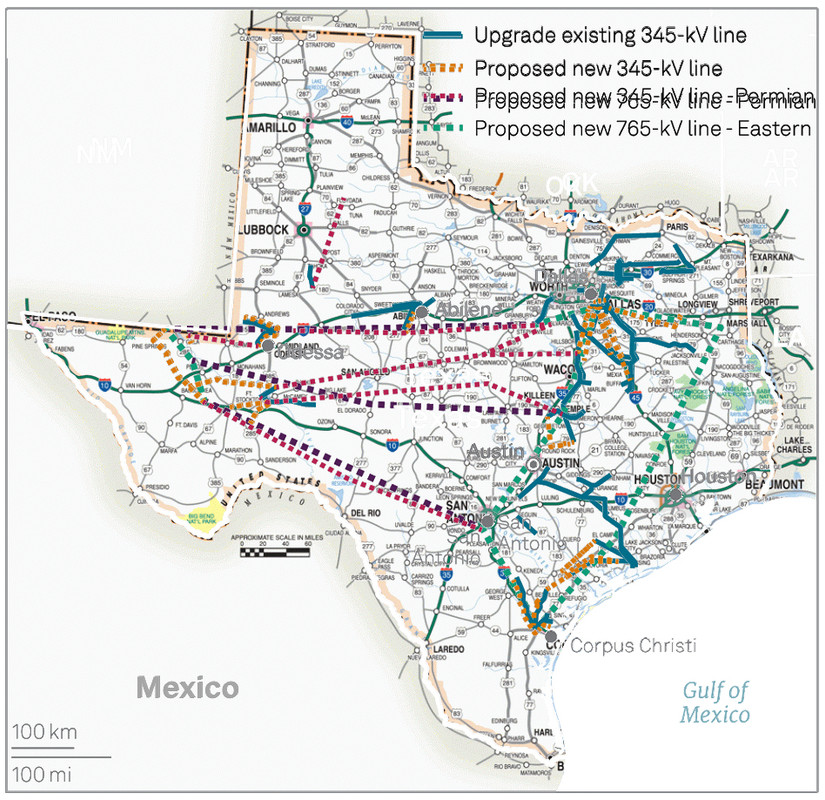
I tried to overlay the vague map with the best I could...

Gunny456
How long do you want to ignore this user?
91AggieLawyer
How long do you want to ignore this user?
Gunny456 said:

I have never understood why America insists on running all power lines in the air. Many European countries bury all transmission lines.
The excuse is " it's too expensive". But yet when hurricanes and tornadoes wipe them out there is always plenty of money to rebuild….. from taxpayers and rate hikes.
We can bury gas pipelines but not electrical lines. Seems it would prevent weather related power outages and be a lot more secure from military threats…. to say nothing of the aesthetics of not having all that crud sticking up in the air.

I've wondered this myself. However, how does ground moisture and live wires on/under the ground work in terms of current? Obviously, the overhead wires get wet but they don't stay wet. However, they ARE away from almost everyone and not affected by things like digging.

Wouldn't you basically have to bury those things under concrete with manhole type covers every hundred or so feet?
AW 1880
How long do you want to ignore this user?
345kV averages 150' ROW. Some utilities a little more, some a little less.
cheeky
How long do you want to ignore this user?
schmellba99 said:

Gunny456 said:

I have never understood why America insists on running all power lines in the air. Many European countries bury all transmission lines.
The excuse is " it's too expensive". But yet when hurricanes and tornadoes wipe them out there is always plenty of money to rebuild….. from taxpayers and rate hikes.
We can bury gas pipelines but not electrical lines. Seems it would prevent weather related power outages and be a lot more secure from military threats…. to say nothing of the aesthetics of not having all that crud sticking up in the air.
The larger kva you get, the more per lf increase in price.

It would cost around 10x-15x per linear foot to run 354kva underground versus overhead.

345kva runs ~ $1.5mm to $2.5mm per mile to run overhead. That same line would be in the general ballpark of $25mm per mile if you buried it. Take a 100 mile run - overhead it would be ~$250mm to construct whereas if you buried it that same cost would be ~$2.5 Billion. That is a significant difference in cost, and one that most utility providers simply cannot afford without having rates jump from $.15/kwh to $1.50/kwh or more. I doubt you or anybody would be all on board with their electric bill going from $200 per month to $2,000 per month.

Smaller lines can, and often are, run underground because it is far more cost effective in the short and long run to do. But you can't apply the same logic to everything because it doesn't work unfortunately.
Digging a trench seems a lot cheaper than building towers. What special costs go into burying a wire vs overhead. The easement expense should be the same. No?
EMY92
How long do you want to ignore this user?
It's been several years since I saw the show, it was one of the interesting engineering type shows and the question of overhead versus underground came up. They said that wires for underground need to be 3x larger due to heat. For overhead lines, the heat generated by the current flowing through the lines is easily transferred to the air. For underground lines, you need a much larger line to reduce the heat generated, because underground there is no where for the heat to go.
O.G.
How long do you want to ignore this user?
mhnatt said:

I tried to overlay the vague map with the best I could...


Thank you for doing that. I have heard in the wind that the exact route is being dicussed/worked on, so there isn't anything definite yet, but your map is probably going to be pretty close.
rme
How long do you want to ignore this user?
https://www.ercot.com/files/docs/2025/01/27/EHV%20765-kV%20ERCOT%20Workshop_01_27_2025.pdf
schmellba99
How long do you want to ignore this user?
txags92 said:

Aggietaco said:

schmellba99 said:

Gunny456 said:

I have never understood why America insists on running all power lines in the air. Many European countries bury all transmission lines.
The excuse is " it's too expensive". But yet when hurricanes and tornadoes wipe them out there is always plenty of money to rebuild….. from taxpayers and rate hikes.
We can bury gas pipelines but not electrical lines. Seems it would prevent weather related power outages and be a lot more secure from military threats…. to say nothing of the aesthetics of not having all that crud sticking up in the air.
The larger kva you get, the more per lf increase in price.

It would cost around 10x-15x per linear foot to run 354kva underground versus overhead.

345kva runs ~ $1.5mm to $2.5mm per mile to run overhead. That same line would be in the general ballpark of $25mm per mile if you buried it. Take a 100 mile run - overhead it would be ~$250mm to construct whereas if you buried it that same cost would be ~$2.5 Billion. That is a significant difference in cost, and one that most utility providers simply cannot afford without having rates jump from $.15/kwh to $1.50/kwh or more. I doubt you or anybody would be all on board with their electric bill going from $200 per month to $2,000 per month.

Smaller lines can, and often are, run underground because it is far more cost effective in the short and long run to do. But you can't apply the same logic to everything because it doesn't work unfortunately.
Not to mention the size and clearances required. I've only ever been directly involved in medium voltage duct banks, but even though are a pain to coordinate in anywhere but greenfield sites. I would imagine an undergound 765kV bank would be massive with some fairly extreme clearances to any neighboring utilities that would consume the adjacent right of way.
I would imagine the stray current and field effects from an underground 345kV or 765kV lines would play havoc with other underground and aboveground infrastructure along the path. So it isn't necessarily a slam dunk to just stick them in a pre-existing ROW with other lines or pipelines.
This would be another issue. Electricity does what electricity does, and it goes down the path of least resistance.

Imagine digging up a water line to repair and finding out it has been grounded through stray voltage to the duct bank next door. That would be so much fun. And it would make doing other types of subsurface utilities and construction significantly more expensive to not only build, but to maintain as well.
schmellba99
How long do you want to ignore this user?
Gunny456 said:

I get what you are saying. We just had tornadoes hit MO last week. Lots of hardships on folks. Lots of transmission lines and regular power lines down.Some folks without power for a week.
One section of the area had all buried power supplies. Those folks had some damage but still had their power.
They didn't need all the bucket trucks and power guys working 24/7 like the other folks did to get their power back.
I don't know about the hurricane once every thirty years deal. Some folks on areas of the Gulf Coast that have been hit 4/5 times in the last 6-8 years might disagree?
Just saying.
I just feel with the technology we have at our disposal with equipment, materials, etc that if we really wanted to, we could just as economically, in the long run, put utilities underground……maybe not. But we could at least look at it.
No, we simply cannot.

"Just put it underground" isn't an answer, and it doesn't address the plethora of issues associated with putting anything, much less large capacity electrical utilities, underground. Like I said before - if it were simply that easy, it would be done. But the hard fact of the matter is that it isn't just that easy and the up front costs to install are such a significant increase that no utility will ask their customers to pay 10x the current rates so they can afford projects to be built underground.
AgLA06
How long do you want to ignore this user?
I find this thread interesting and something getting much more common in professional fields these days.

Ignorance is getting to be a much larger problem since the internet and social media allow much more of the population to believe they have knowledge on highly complex issues they simply do not. It used to mean people realized they weren't versed in the topic and dropped it. Now there's grass root movements and petitions because of it.

So we get a lot of "I believe" or "I don't believe" or "if we really wanted to" that has nothing to do with reality. It's the same in O&G and commercial development and medicine or any other field that requires a high level degree and industry experience to be proficient. Yet Karen or Dale see something on Facebook and are now leading the crusade in the name of change for the greater good.
schmellba99
How long do you want to ignore this user?
reineraggie09 said:

schmellba99 said:

Gunny456 said:

I have never understood why America insists on running all power lines in the air. Many European countries bury all transmission lines.
The excuse is " it's too expensive". But yet when hurricanes and tornadoes wipe them out there is always plenty of money to rebuild….. from taxpayers and rate hikes.
We can bury gas pipelines but not electrical lines. Seems it would prevent weather related power outages and be a lot more secure from military threats…. to say nothing of the aesthetics of not having all that crud sticking up in the air.
The larger kva you get, the more per lf increase in price.

It would cost around 10x-15x per linear foot to run 354kva underground versus overhead.

345kva runs ~ $1.5mm to $2.5mm per mile to run overhead. That same line would be in the general ballpark of $25mm per mile if you buried it. Take a 100 mile run - overhead it would be ~$250mm to construct whereas if you buried it that same cost would be ~$2.5 Billion. That is a significant difference in cost, and one that most utility providers simply cannot afford without having rates jump from $.15/kwh to $1.50/kwh or more. I doubt you or anybody would be all on board with their electric bill going from $200 per month to $2,000 per month.

Smaller lines can, and often are, run underground because it is far more cost effective in the short and long run to do. But you can't apply the same logic to everything because it doesn't work unfortunately.


I'll step in it and have the opportunity to look dumb. I don't understand why it's 10x more expensive in sparsely populated areas. I understand cities with navigating structures but not rural areas. The transmission line should be the same. (1) You don't have the cost of the materials and labor with the poles (those can't be cheap). (2)Instead you have the cost of the underground conduit. I would bet one pole would buy a decent amount of linear feet of conduit. (3)Additionally, the labor should be comparable with the added cost of needing to do stuff in the air vs standing in the ground. Maybe some added cost in trenching. But I can't believe it actually costs 10x.

I'm not saying it isn't charged 10x just that it shouldn't cost that much. I'll shut up and take my medicine for my ignorance now.

1. The poles and/or the structural steel transmission towers aren't that expensive in the grand scheme of things to fabricate and construct. They are made from standard W, L, C and tube shapes that are readily available, easy to assemble and designs generally are already done. They can be fabricated and erected in a fairly short amount of time. Poles can be set even faster.

2. UG conduit - especially for a large load line like a 345kva or whatever, would be substantially large. Most of the time you are looking at 8" diameter HDPE. And it isn't just one conduit - you need ~8 conduits for a single circuit. Plus the access manholes, which would be large. Plus the excavaton costs, backfill costs, concrete encasement costs at various areas where protection would be paramount, plus the cost to weld the conduits since 8" HDPE would be in 40' joints. That would be 132 welds x 8, so 1056 welds per mile of transmission line (assuming no additional bends, fittings or surprises along the way), plus any tunnelling or boring that would be required, etc, etc, etc. Simply put - all of these things add up in costs to about 10x-15x per mile more expensive than running overhead. Oh, and the wire isn't the same wire either - UG wire is singificantly more expensive than overhead wire because it has to have better jacketing (some overhead wire doesn't have any jacketing at all). More costs on to of more costs.

3. Underground construction is significantly more expensive - in any industry - than above ground for a host of reasons. If it were a 1:1 exchange we'd have everything in the world underground. But it isn't - subsurface work has always been and at least for your and my lifetimes always will be more expensive because of the nature of the beast. It isn't as easy as just digging a hole or digging a trench and throwing stuff in the ground.

Page 2 of 3
 
×
subscribe Verify your student status
See Subscription Benefits
Trial only available to users who have never subscribed or participated in a previous trial.