

Outdoors
Sponsored by

Powerlines. Big ones.

11,577 Views | 104 Replies | Last: 6 mo ago by Mas89
O.G.
How long do you want to ignore this user?
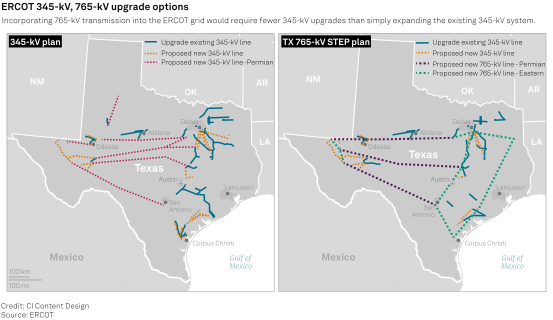
Just putting this information out there for any of you that may have property in or around the areas shown on the map. As I understand it, this will be the biggest powerline sytem ever built in Texas. I am also given to understand that there are currently no 765kv lines in Texas, so this will be new.

It is still in the review process but I do know that specific routes are beling looked at. Its still in the very prelim stage but once its approved it will go fast.

If you, or anyone that you know, receives a letter in the mail regarding this do not ignore it. It will not go away on its own. Some of the folks behind these projects are aggressive & operate from the perspective of a taller moral high horse than say, gas pipelines.

My best guess is that it will be 2026 before any real movement on this gets going, but I could be wrong.

Just from what I've seen in the 5 or so states that I've worked in on Right of Way, Politically speaking this will be approved. These things tend to get bi-partisan support, at the state level and in DC.

The first link below (Pioneer) is just for information about 765kv lines, I do not believe that Pioneer is involved in this project, I'm just grabbing their info. The next two links are relevant to Texas:

http://pnrtransmission.com/about/docs/Advantages-of-765kV.pdf

https://www.utilitydive.com/news/texas-regulators-approve-permian-basin-reliability-plan/728269/

https://www.rtoinsider.com/96979-765-kv-lines-texas-inch-closer-reality/
CanyonAg77
How long do you want to ignore this user?
The maps are pretty vague. Any better ones available, or is the route not decided yet?
O.G.
How long do you want to ignore this user?
CanyonAg77 said:

The maps are pretty vague. Any better ones available, or is the route not decided yet?
Thats the best one I've seen so far. I do realize that its vague at this point. My best guess is that they will try to follow existing road right of ways as much as they can, for ease of use etc.

Collaborating with all of the oil/gas pipeline companies out in west Texas will be fun for someone.
Caliber
How long do you want to ignore this user?
This one is a bit better detail, has a better Texas outline anyway...


Texas grid operator sees increased costs, benefits from 765-kV transmission | S&P Global
Jason_Roofer
How long do you want to ignore this user?
This seems about as good a thread as any to seek help. Particulary dealing with STEC and PUC. Does anyone have any recommendations for eminent domain attorneys that they have used and recommend in the state? Can PM me or respond here.
Houston-BCS-Austin-Dallas-San Antonio - Infinity Roofing - https://linqapp.com/jason_duke --- JasonDuke@InfinityRoofer.com --- https://infinityrooferjason.blogspot.com/
HTownAg98
How long do you want to ignore this user?
Where is the property impacted located?
Jason_Roofer
How long do you want to ignore this user?
San Antonio Area
Houston-BCS-Austin-Dallas-San Antonio - Infinity Roofing - https://linqapp.com/jason_duke --- JasonDuke@InfinityRoofer.com --- https://infinityrooferjason.blogspot.com/
HTownAg98
How long do you want to ignore this user?
Paul Barkhurst is in San Antonio. He's a very good advocate for landowners. I say that as someone that does appraisal work for the condemning authorities.
Jason_Roofer
How long do you want to ignore this user?
Thank you!
Houston-BCS-Austin-Dallas-San Antonio - Infinity Roofing - https://linqapp.com/jason_duke --- JasonDuke@InfinityRoofer.com --- https://infinityrooferjason.blogspot.com/
Gunny456
How long do you want to ignore this user?
I guess I'm dumb. ERCOT has spent millions to build wind power transmission lines all across the hill country over the last decade to move wind generated power located in West Texas to San Antonio, Austin, Houston.
Now they want to build more lines to transmit power to Midland/Odessa/ West Texas from Austin, San Antonio?
Am I understanding it wrong?
Col. Steve Austin
How long do you want to ignore this user?
Gunny456 said:

I guess I'm dumb. ERCOT has spent millions to build wind power transmission lines all across the hill country over the last decade to move wind generated power located in West Texas to San Antonio, Austin, Houston.
Now they want to build more lines to transmit power to Midland/Odessa/ West Texas from Austin, San Antonio?
Am I understanding it wrong?
They need the power for the oil and gas boom, particularly all the fracking equipment. There's a whole bunch of diesel generators and modular gas turbine powered generators on trailers out there providing power out in the oil fields. I haven't seen any financials on it, but I have to believe buying power from the grid will be a significant cost savings over the lease and maintenance costs for a fleet of modular generators. Not to mention the stability of the grid vs networked local generators. A buddy of mine was working until recently for a company that builds and leases gas turbine generator sets up to 35MW. He was providing remote tech support just for the control systems for those gen sets. They had 2 guys per shift providing support 24/7/365. Not sure what they had for the mechanical side and the electrical equipment like switchgear and such.
I am not the Six Million Dollar Man, but I might need that surgery. "We have the technology, we can rebuild him!"
rab79
How long do you want to ignore this user?
According to ERCOT figures on the spglobal website the Permian basin portion accounts for $13 billion of a $33 billion regional transmission plan.

https://www.spglobal.com/commodity-insights/en/news-research/latest-news/electric-power/012725-texas-grid-operator-sees-increased-costs-benefits-from-765-kv-transmission
JB!98
How long do you want to ignore this user?
Gonna be selfish here, we need to build 765KV rather than 345KV lines. The footprint is not much larger and we have to find a way to get more capacity to the I-35 corridor. Honestly, the 345KV line coming out of South Texas into the SA area needs to be 765KV rather than 345KV.

You can build all the generation capacity that you want, but without the wires to get it to the major load centers you are not accomplishing anything.

Electrical capacity is the next oil boom. It is not only my chosen career, but also manufacturing. You want tax revenue in Texas, we have to have an ample supple of electrical capacity. On shoring manufacturing will necessarily mean that this happens.
JB!98
How long do you want to ignore this user?
Jason_Roofer said:

This seems about as good a thread as any to seek help. Particulary dealing with STEC and PUC. Does anyone have any recommendations for eminent domain attorneys that they have used and recommend in the state? Can PM me or respond here.
JD05AG
How long do you want to ignore this user?
The subsidies that went to the wind companies to provide power to texas, that in fact now are only going to bitcoin mines should be repaid to the taxpayers by the bitcoin mines.
JB!98
How long do you want to ignore this user?
JD05AG said:

The subsidies that went to the wind companies to provide power to texas, that in fact now are only going to bitcoin mines should be repaid to the taxpayers by the bitcoin mines.
Bayou City
How long do you want to ignore this user?
[Stop trolling. -Staff]
schmellba99
How long do you want to ignore this user?
I still don't have an understanding as to what a "bitcoin mine" is.
CanyonAg77
How long do you want to ignore this user?
schmellba99 said:

I still don't have an understanding as to what a "bitcoin mine" is.
Computers running a program 24-7 that gives them Bitcoin in exchange. Since the return is miniscule, "miners" run huge banks of computers to "mine"

It takes an enormous amount of power to do this.

Detailed explanation here


https://www.cnet.com/personal-finance/crypto/bitcoin-mining-how-much-electricity-it-takes-and-why-people-are-worried/


Quote:

July 18, 2022 2:08 p.m. PT

The Digiconomist's Bitcoin Energy Consumption Index estimated that one bitcoin transaction takes 1,449 kWh to complete, or the equivalent of approximately 50 days of power for the average US household.


To put that into money terms, the average cost per kWh in the US is close to 12 cents. That means a bitcoin transaction would generate approximately an energy bill of $173.

Bitcoin mining uses around as much energy as Argentina, according to the Bitcoin Energy Consumption Index, and at that annualized level of 131.26 terawatt-hours, crypto mining would be in the top 30 of countries based on energy consumption.

Energy consumption for bitcoin mining was at its highest at the end of 2021 and the early months of 2022, consuming more than 200 terawatt-hours.


Imagine how bad it is now, three years later
Gunny456
How long do you want to ignore this user?
I have never understood why America insists on running all power lines in the air. Many European countries bury all transmission lines.
The excuse is " it's too expensive". But yet when hurricanes and tornadoes wipe them out there is always plenty of money to rebuild….. from taxpayers and rate hikes.
We can bury gas pipelines but not electrical lines. Seems it would prevent weather related power outages and be a lot more secure from military threats…. to say nothing of the aesthetics of not having all that crud sticking up in the air.
O.G.
How long do you want to ignore this user?
Gunny456 said:

I have never understood why America insists on running all power lines in the air. Many European countries bury all transmission lines.
The excuse is " it's too expensive". But yet when hurricanes and tornadoes wipe them out there is always plenty of money to rebuild….. from taxpayers and rate hikes.
We can bury gas pipelines but not electrical lines. Seems it would prevent weather related power outages and be a lot more secure from military threats…. to say nothing of the aesthetics of not having all that crud sticking up in the air.
This.

I'm in the business and I hear that excuse a lot. Major providers down to the local co-ops all say the same thing.

I get that it might take one hell of a conduit to run that much power through, but I'm all for burying them in and around urban areas at least.
schmellba99
How long do you want to ignore this user?
Gunny456 said:

I have never understood why America insists on running all power lines in the air. Many European countries bury all transmission lines.
The excuse is " it's too expensive". But yet when hurricanes and tornadoes wipe them out there is always plenty of money to rebuild….. from taxpayers and rate hikes.
We can bury gas pipelines but not electrical lines. Seems it would prevent weather related power outages and be a lot more secure from military threats…. to say nothing of the aesthetics of not having all that crud sticking up in the air.
The larger kva you get, the more per lf increase in price.

It would cost around 10x-15x per linear foot to run 354kva underground versus overhead.

345kva runs ~ $1.5mm to $2.5mm per mile to run overhead. That same line would be in the general ballpark of $25mm per mile if you buried it. Take a 100 mile run - overhead it would be ~$250mm to construct whereas if you buried it that same cost would be ~$2.5 Billion. That is a significant difference in cost, and one that most utility providers simply cannot afford without having rates jump from $.15/kwh to $1.50/kwh or more. I doubt you or anybody would be all on board with their electric bill going from $200 per month to $2,000 per month.

Smaller lines can, and often are, run underground because it is far more cost effective in the short and long run to do. But you can't apply the same logic to everything because it doesn't work unfortunately.
water turkey
How long do you want to ignore this user?
Gunny456 said:

I have never understood why America insists on running all power lines in the air. Many European countries bury all transmission lines.
The excuse is " it's too expensive". But yet when hurricanes and tornadoes wipe them out there is always plenty of money to rebuild….. from taxpayers and rate hikes.
We can bury gas pipelines but not electrical lines. Seems it would prevent weather related power outages and be a lot more secure from military threats…. to say nothing of the aesthetics of not having all that crud sticking up in the air.


There is a company (can't remember the name) that proposes using underwater trenching technology to install high power electrical lines underground, within the rights of ways of railroads.

Also PG&E is doing it for wildfire prevention.
Aggietaco
How long do you want to ignore this user?
schmellba99 said:

Gunny456 said:

I have never understood why America insists on running all power lines in the air. Many European countries bury all transmission lines.
The excuse is " it's too expensive". But yet when hurricanes and tornadoes wipe them out there is always plenty of money to rebuild….. from taxpayers and rate hikes.
We can bury gas pipelines but not electrical lines. Seems it would prevent weather related power outages and be a lot more secure from military threats…. to say nothing of the aesthetics of not having all that crud sticking up in the air.
The larger kva you get, the more per lf increase in price.

It would cost around 10x-15x per linear foot to run 354kva underground versus overhead.

345kva runs ~ $1.5mm to $2.5mm per mile to run overhead. That same line would be in the general ballpark of $25mm per mile if you buried it. Take a 100 mile run - overhead it would be ~$250mm to construct whereas if you buried it that same cost would be ~$2.5 Billion. That is a significant difference in cost, and one that most utility providers simply cannot afford without having rates jump from $.15/kwh to $1.50/kwh or more. I doubt you or anybody would be all on board with their electric bill going from $200 per month to $2,000 per month.

Smaller lines can, and often are, run underground because it is far more cost effective in the short and long run to do. But you can't apply the same logic to everything because it doesn't work unfortunately.
Not to mention the size and clearances required. I've only ever been directly involved in medium voltage duct banks, but even though are a pain to coordinate in anywhere but greenfield sites. I would imagine an undergound 765kV bank would be massive with some fairly extreme clearances to any neighboring utilities that would consume the adjacent right of way.
txags92
How long do you want to ignore this user?
Aggietaco said:

schmellba99 said:

Gunny456 said:

I have never understood why America insists on running all power lines in the air. Many European countries bury all transmission lines.
The excuse is " it's too expensive". But yet when hurricanes and tornadoes wipe them out there is always plenty of money to rebuild….. from taxpayers and rate hikes.
We can bury gas pipelines but not electrical lines. Seems it would prevent weather related power outages and be a lot more secure from military threats…. to say nothing of the aesthetics of not having all that crud sticking up in the air.
The larger kva you get, the more per lf increase in price.

It would cost around 10x-15x per linear foot to run 354kva underground versus overhead.

345kva runs ~ $1.5mm to $2.5mm per mile to run overhead. That same line would be in the general ballpark of $25mm per mile if you buried it. Take a 100 mile run - overhead it would be ~$250mm to construct whereas if you buried it that same cost would be ~$2.5 Billion. That is a significant difference in cost, and one that most utility providers simply cannot afford without having rates jump from $.15/kwh to $1.50/kwh or more. I doubt you or anybody would be all on board with their electric bill going from $200 per month to $2,000 per month.

Smaller lines can, and often are, run underground because it is far more cost effective in the short and long run to do. But you can't apply the same logic to everything because it doesn't work unfortunately.
Not to mention the size and clearances required. I've only ever been directly involved in medium voltage duct banks, but even though are a pain to coordinate in anywhere but greenfield sites. I would imagine an undergound 765kV bank would be massive with some fairly extreme clearances to any neighboring utilities that would consume the adjacent right of way.
I would imagine the stray current and field effects from an underground 345kV or 765kV lines would play havoc with other underground and aboveground infrastructure along the path. So it isn't necessarily a slam dunk to just stick them in a pre-existing ROW with other lines or pipelines.
Bonfire97
How long do you want to ignore this user?
Is there any way to know the routes being looked at?
Gunny456
How long do you want to ignore this user?
I don't buy into that. They run large KVA underground in Europe. Do those folks make more money than us and pay those large electric bills? My mom's boyfriend was a retired British Airways pilot that moved here from England. His main comment was how all our utilities are stuck in the air in America.
In my opinion it's done the cheapest way to make somebody a ton of money. It would seem that if you took total cost long term of cost of repairs after major storm events….. high wind damage like two weeks ago in north Texas, hurricanes, tornadoes, floods, fires, lightning strikes etc…and all the required maintenance due to the constant exposure …. it would make a difference….to say nothing of the cost of all the towers in steel, erecting them etc.
O.G.
How long do you want to ignore this user?
Aggietaco said:

schmellba99 said:

Gunny456 said:

I have never understood why America insists on running all power lines in the air. Many European countries bury all transmission lines.
The excuse is " it's too expensive". But yet when hurricanes and tornadoes wipe them out there is always plenty of money to rebuild….. from taxpayers and rate hikes.
We can bury gas pipelines but not electrical lines. Seems it would prevent weather related power outages and be a lot more secure from military threats…. to say nothing of the aesthetics of not having all that crud sticking up in the air.
The larger kva you get, the more per lf increase in price.

It would cost around 10x-15x per linear foot to run 354kva underground versus overhead.

345kva runs ~ $1.5mm to $2.5mm per mile to run overhead. That same line would be in the general ballpark of $25mm per mile if you buried it. Take a 100 mile run - overhead it would be ~$250mm to construct whereas if you buried it that same cost would be ~$2.5 Billion. That is a significant difference in cost, and one that most utility providers simply cannot afford without having rates jump from $.15/kwh to $1.50/kwh or more. I doubt you or anybody would be all on board with their electric bill going from $200 per month to $2,000 per month.

Smaller lines can, and often are, run underground because it is far more cost effective in the short and long run to do. But you can't apply the same logic to everything because it doesn't work unfortunately.
Not to mention the size and clearances required. I've only ever been directly involved in medium voltage duct banks, but even though are a pain to coordinate in anywhere but greenfield sites. I would imagine an undergound 765kV bank would be massive with some fairly extreme clearances to any neighboring utilities that would consume the adjacent right of way.
I get why the 345s and the 765s would be a severe pain to bury, it makes sense.

However, for the smaller more local transmission lines, some common sense could be used here and there.
I've had a co-op refuse to even consider it because of "costs" when I have seen them blatantly waste money in other areas. I'm not talking about burying it for miles either, I'm talking about less than an acre's distance for a church's play ground/driveway.

A little common sense and good will here and there would go a long way.
Gunny456
How long do you want to ignore this user?
But how can that be? When folks have claimed valid health concerns from effects of being around high voltage transmission lines the utility companies say there is no such radiation of electric fields or emissions from them.
O.G.
How long do you want to ignore this user?
Gunny456 said:

I don't buy into that. They run large KVA underground in Europe. Do those folks make more money than us and pay those large electric bills? My mom's boyfriend was a retired British Airways pilot that moved here from England. His main comment was how all our utilities are stuck in the air in America.
In my opinion it's done the cheapest way to make somebody a ton of money. It would seem that if you took total cost long term of cost of repairs after major storm events….. high wind damage like two weeks ago in north Texas, hurricanes, tornadoes, floods, fires, lightning strikes etc…and all the required maintenance due to the constant exposure …. it would make a difference….to say nothing of the cost of all the towers in steel, erecting them etc.

One defense I would have of that is the sheer distance that some of our lines go.

I've been on a project that went from Texas to California and another one from Kansas to IN. Most European countries don't have that kind of distance to cover.

That said, I wish they would try harder to bury what they could.
Gunny456
How long do you want to ignore this user?
It's because it's cheaper…. Nobody cares about the aesthetics as long as they make tons of money….and if they bury it they won't make as much money…
schmellba99
How long do you want to ignore this user?
Gunny456 said:

I don't buy into that. They run large KVA underground in Europe. Do those folks make more money than us and pay those large electric bills? My mom's boyfriend was a retired British Airways pilot that moved here from England. His main comment was how all our utilities are stuck in the air in America.
In my opinion it's done the cheapest way to make somebody a ton of money. It would seem that if you took total cost long term of cost of repairs after major storm events….. high wind damage like two weeks ago in north Texas, hurricanes, tornadoes, floods, fires, lightning strikes etc…and all the required maintenance due to the constant exposure …. it would make a difference….to say nothing of the cost of all the towers in steel, erecting them etc.

They pay 60% in taxes. I suppose if we gave well over half of our income to the government, we might be able to do things that the europeans do.

I also doubt they have near the tranmission distances we do here, but I cannot say that for certain. Given the size of most european countries though, it's a pretty safe bet.

They also pay a crap ton more for gas and diesel, have to import nat gas, most probably don't know what beef tastes like and few have anything approaching the lifestyle we do here.
schmellba99
How long do you want to ignore this user?
Gunny456 said:

It's because it's cheaper…. Nobody cares about the aesthetics as long as they make tons of money….and if they bury it they won't make as much money…

If only this were the sole cause.

Again - doubt you or your neighbors would cotton to a monthly electric bill that is 10x what you have now. The consumer always pays the tab.
Gunny456
How long do you want to ignore this user?

The point is I don't believe in the long run and all things considered, burying the lines is any more costly than running them miles in the air through folks property. They do it because they can make more money.
With that being said, I think property owners should get compensated for the electricity and or gas that transverses their property going to those markets…. and more so if they have to look at the lines and towers that destroy the aesthetics and value of their land ……and not just the minimum initial payment they have to fight for on the eminent domain BS.
But that's just my opinion.
txags92
How long do you want to ignore this user?
Gunny456 said:

But how can that be? When folks have claimed valid health concerns from effects of being around high voltage transmission lines the utility companies say there is no such radiation of electric fields or emissions from them.
There is a difference between the health effects and the impact on other infrastructure. There is very little evidence of long term health effects for humans from high voltage field effects. But the damage stray current or field current can do to building foundations, pipelines (particularly cathodic protection systems), communication (non-fiber), underground tanks, etc. is very real.
Last Page
Page 1 of 3
 
×
subscribe Verify your student status
See Subscription Benefits
Trial only available to users who have never subscribed or participated in a previous trial.