
Outdoors
Sponsored by

Single Action Only Semi-Automatic Pistols

4,187 Views | 60 Replies | Last: 16 yr ago by TexasRebel
Thomas Sowell, PhD
How long do you want to ignore this user?
I have never suggested lowering the hammer using the thumb. There is no de-cocking mechanism on the SAO P 220. If the hammer is back, the manual says to engage the thumb safety, drop the magazine, slide the back using the slide lock, and then remove the bullet.

The manual mentions any dropped pistol may fire. I suppose keeping it cocked and locked prevents this.

I do trust the thumb safety. Cocked & Locked does seem safer....I guess I just have to get used to seeing that hammer back.

It is more psychological. My first weapon was a single shot shotgun with no thumb lock and I got used to cracking the barrel or keeping the hammer down (yes I know that could mean a discharge if dropped.)

Again, putting a pistol with a cocked hammer in a holster just goes against my grain. The bottom line is 1) trust the thumb safety (it is rather stiff) 2) enjoy the speed of just worrying about taking the thumb safety off and not cocking before you shoot.

Not keeping a bullet in the chamber is even slower from the draw (even though safer). Of course if seconds count it would not be so useful to me therefore not truly "safe" because the time delay could prove costly.

Sometimes I wish I had gotten a DA/SA.


[This message has been edited by MensaAg (edited 8/25/2009 4:43a).]
MisterShipWreck
How long do you want to ignore this user?
For range use, I LOVE single action only (1911s, usually).

For carry, I prefer DA/SA - extra insurance to prevent an accident. Just my 2 cents.
Puryear Playboy
How long do you want to ignore this user?
TexasRebel has made me speechless yet again.

I now must admit that his grasp of the internal workings of the 1911 is simply beyond my ability to comprehend.

Figure 23 on page 43 of the manual you have shared with us will revolutionize the shooting world.

I'm grateful to have been here at its' inception.

[This message has been edited by Puryear Playboy (edited 8/25/2009 8:40a).]
Puryear Playboy
How long do you want to ignore this user?
MensaAG, you are half-way there. Never trust any mechanical safety. Believe in them, but never trust them.

Mechanical safeties can fail, remember Three Mile Island? The only safety you can absolutely trust is the one between your ears.

All things mechanical can fail. Thats why you have rules like "Never put your finger on the trigger until you are ready to fire." Putting your trust solely in any mechanical safety can lead to disaster.

Its a mindset you need to get into...this is why training, practising and shooting your pistol are so important. Mechanical safeties are important and there for a reason, but the most important safety of all is between your ears.

Your pistol is only as safe as you are. You should enjoy the fact that you own one of the pinnacles of handgun development. Its an experts firearm, and you can be an expert with it!
Thomas Sowell, PhD
How long do you want to ignore this user?
Thanks P P !
Neches21
How long do you want to ignore this user?
quote:
Never trust any mechanical safety


Did I miss something?
I thought you were just advocating carrying cocked and locked?

I dont consider those that are uncomfortable carrying cocked and locked to be the epitome of stupidity as you claim. Nor do I feel that they pose any threat to themselves or those around them.

Perhaps they should educate themselves on the pistol design and practice more, but you are rediculing folks even though they obviously have a basic notion of safety and are at least trying to carry in as safe a manner as they are educated to do.

[This message has been edited by Neches21 (edited 8/25/2009 12:21p).]
MasterAggie
How long do you want to ignore this user?
quote:
Figure 23 on page 43 of the manual you have shared with us will revolutionize the shooting world.


Now that is funny s*$#!!!!
TexasRebel
How long do you want to ignore this user?
PP,

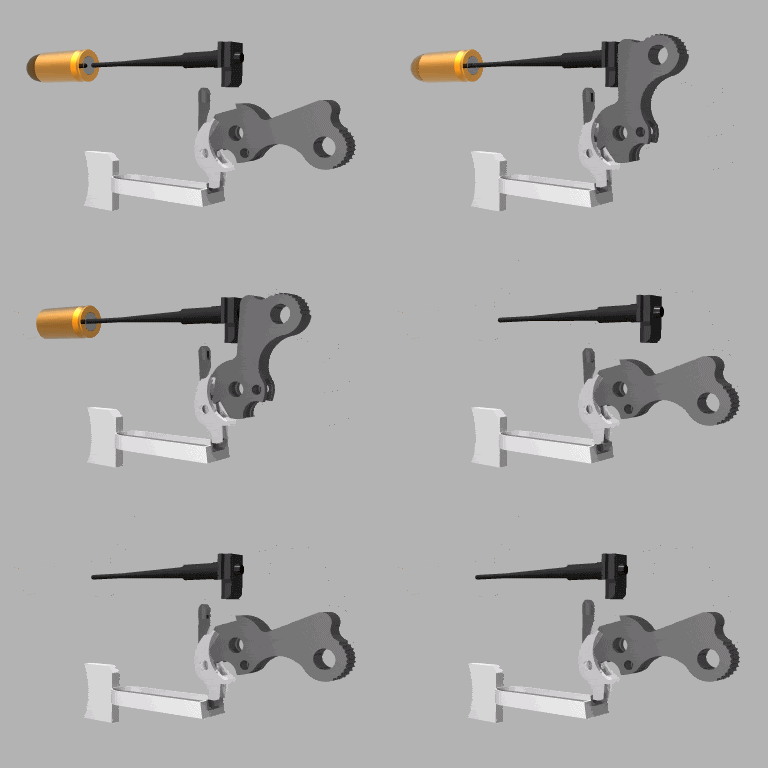
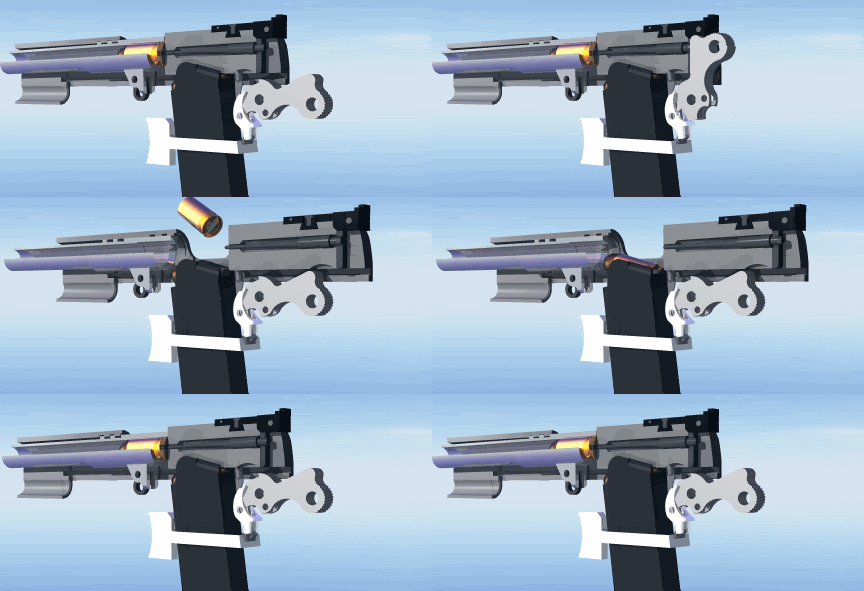
I have created a walkthrough on how the inertia pin block safety works

Enjoy
Puryear Playboy
How long do you want to ignore this user?
Those pictures are stunning. Thanks for sharing your brilliance on how to field strip a 1911 all the way down to that level. Unfortunatly, that all has nothing to do with the grip safety as you asserted earlier... Fail.

As for me assailing people for trying to be safe and not knowing how... Maybe so, I'll let everyone else decide.

But you dont get points for "trying" when it comes to gun safety. Either you get it Right, or someone or some thing gets a hole in it.

I am not interested in how hard anyone "Tried." There is no room at all for asshattery.
Puryear Playboy
How long do you want to ignore this user?
Neches, yes you did miss something...its called reading comprehension.

I said you dont ever Trust a mechanical safety...and thats why (as I said above) you dont run around with your finger on the trigger just because the thumb safety is engaged.

TexasRebel
How long do you want to ignore this user?
quote:
Unfortunatly, that all has nothing to do with the grip safety as you asserted earlier... Fail.


The grip safety disengages the inertia pin blocking plate. The pictures I took show every piece relevant to that mechanism. I guess I'm not comprehending how you don't understand this... either that or you're now just trolling.
KRamp90
How long do you want to ignore this user?
I am no expert, but PP does not troll...
TexasRebel
How long do you want to ignore this user?
that's kind of what I thought, too
MasterAggie
How long do you want to ignore this user?
Yeah hes not going to post bs just to get a rise out of someone. I certainly wont claim to be an expert or anything more than a novice. Hell itd probably take me half an hour to strip my 1911.
TexasRebel
How long do you want to ignore this user?
That is why I'm wondering why he is trying to insult me with the sarcasm in his posts...
Puryear Playboy
How long do you want to ignore this user?
This is really getting tedious...

Schroll half way down the page linked below. On the right side is a diagram that demostrates how the trigger bar...not the grip safety, disengages the firing pin block plunger.

http://www.m1911.org/partdesc.htm

Whenever you are ready, you can explain to me how the grip safety actually does this instead.

Take your time.

We will wait.

[This message has been edited by Puryear Playboy (edited 8/25/2009 10:01p).]
AgGunNut
How long do you want to ignore this user?
Aren't ya'll just going back and forth between the difference between a Series 70 and a Series 80 1911? Both of you are right it looks like...
Puryear Playboy
How long do you want to ignore this user?
Series 70 has no firing pin block.
AgGunNut
How long do you want to ignore this user?
Ok, you're right. Seems like the argument then is between a Series 80 (disengaged by the trigger) and a Kimber style (Swartz style safety) which is disengaged by the grip safety. Very old 1911's use this and newer (Most Kimbers, Springfields, etc.) 1911's use this style. Still seems to me like you are both right.
quote:
Regarding the "clone" guns (1911-pattern pistols made by manufacturers other than Colt), so far Para-Ordinance, SIG, Auto Ordnance, and Taurus have adopted Colt's Series 80 or a similar firing pin block system as well. Kimber's Series II pistols and the new S&W 1911s have a FP safety also, but it is a different system than Colt's and is disabled by depressing the grip safety. No manufacturers aside from Colt ever adopted the Series 70 barrel/bushing arrangement, so technically there are no "Series 70" clone guns. What this means is that design-wise most of them share commonality with the pre-Series 70 guns, using neither the firing pin block NOR the collet bushing. Because of this it is important to remember that only Colt Series 80 models, and a couple of "clone" 1911 makers use a firing pin block. Older Colts and most other clone guns lack a firing pin safety and can possibly discharge if there is a round in the chamber and the gun is dropped on a hard surface, or if struck a blow hard enough to allow the firing pin to jump forward and impact the primer of the loaded round. By the way, for the past few years Colt has been producing new pistols out of their Custom Shop that lack the S80 firing pin safety. These are the Gunsite and CCO models, WW1 and WW2 GI replicas, and a reintroduced original-style Series 70 in both blued and stainless steel that should appeal to 1911 purists. Interestingly, all of these use a solid barrel bushing, so mechanically they are more similar to the original pre-Series 70 models despite being advertised by Colt as having a "Series 70 firing system".


From:http://forums.1911forum.com/showthread.php?t=15201

Edit: FWIW, I carry a cocked and locked Nighthawk 1911 (Series 70 style) quite often, and have no worries. Like PP has said, the ultimate saftey is the trigger finger as well as the gray matter between your ears.


[This message has been edited by AgGunNut (edited 8/25/2009 11:58p).]
TexasRebel
How long do you want to ignore this user?
quote:
Whenever you are ready, you can explain to me how the grip safety actually does this instead


I already did, but you didn't care to read the descriptions of the images that I uploaded to photobucket.

The two 1911's I've had experience with (mine...a Llama Max-I 1911 replica that will interchange parts with a Colt 1911, and what was presented to me as an actual Colt 1911...I have no idea what series or year) both have the grip safety that disengages the firing pin block. If you have one that does not, by all means show it.

Maybe you already have... I haven't followed your link yet, but will right after I post this.

Without the pin block, I would actually second guess carrying the 1911 all together. If the firing pin was free floating (aside from the spring holding it back) I'm not exactly sure what would keep it from striking the primer of the new round when the slide stopped after the auto-loading cycle.

Without a pin block, the 1911 is a disaster waiting to happen... An inertia pin that has nothing to keep it from the primer... YIKES! That's why long gun actions have a transfer block that the trigger forces between the hammer and the firing pin...or a 2 piece firing pin that is misaligned before the trigger is pulled.

I have a single shot 12ga that has a transfer block that the trigger places between the hammer and the pin... it was my first firearm... I now hate that gun because of its design flaws (everyone is young and dumb once...right?) Since I've known better, I've limited myself to firearms that have a trigger that do nothing beseides slip the sear and drop the hammer.

I have an 870 Express that has no hammer, and it bugs me that I cannot relax the action... I've known for a while now that, the gun is designed that way, and if it isn't in use, I keep the action open. My only other arm that has no visible hammer is a SxS Sears Roebuck 12 Ga. (identical to a Stephens) but the actions on that shotgun can be relaxed by pulling the triggers before closing.

I guess you can say that my Marlin 883 has no hammer, but a glance at the bolt will tell you if the gun is cocked or not. Like any other bolt action, it is possible to relax the action by holdign the trigger before locking the bolt.

[This message has been edited by TexasRebel (edited 8/26/2009 3:45a).]
TexasRebel
How long do you want to ignore this user?
Just took a look at PP's link...

Check out the hammer (image 15), and look at the 2 positions that the sear can rest on...

the first is a notch that will lock the sear in place. With any normal force, the sear will not move, and will not drop the hammer. Excessive force, will break the hammer...like I said before, you can't overdesign for every new fool.

That notch is the half-cock position... an extremely safe position to keep the hammer with a round chambered because a) the sear will rest in the notch, and prevent the hammer from moving, and b) because the hammer, will not have enough stored energy to push the firing pin into the primer.

To end this stalemate of a thread hijack... Know the 1911 you have, and depending slightly on the internals, carry how you are comfortable. It doesn't matter if the pin block is activated by the grip safety or the trigger... if neither is pulled, the pin will be blocked. If your half-cock position isn't a notch that holds the sear in place like a lever action rifle, leaving the 1911 half-cock isn't the best idea...

what you can definately take away from this is that many 1911s that you'll find are very VERY redundantly safe firearms. Some of their safeties are even so passive that you may not realize that they exist.
GAC06
How long do you want to ignore this user?
quote:
what you can definately take away from this is that many 1911s that you'll find are very VERY redundantly safe firearms. Some of their safeties are even so passive that you may not realize that they exist.

Unless you are in the habit of pulling the trigger had depending on your thumb to ride the hammer and keep the weapon from discharging just because you are under the strange notion that it is easier to draw and cock the hammer than to draw and flip the safety as the weapon was designed to.

[This message has been edited by GAC06 (edited 8/26/2009 10:16a).]
schmellba99
How long do you want to ignore this user?
I'd say about 90% of the time, I carry my 1911 with a round in the chamber and the hammer down.

My grandfather did this for about 50 years - that's how he was taught at boot camp in the Marines to carry that sidearm.

I really don't see a problem with it either way personally. But I'm easy like that. And accident free to date as well. Go figure.
tx4guns
How long do you want to ignore this user?
goshdam this is a stupid thread. You guys know that I know a "little bit" about 1911s, and I dam sure know how to carry one and how the internals function. Series 80 additions were a marketing scam pretty much. They add small parts that are prone to malfunction, and I've seen them cause more problems in my Delta Elite than betterment of the design. I really don't like them, but unfortunatley Kimber and Colt use them in most of their pistols now, and there are ways to get good triggers with them in place if you know what you're doing.

Condition 1 (cocked and locked) is the ONLY way to properly carry a 1911. That's how it was designed, and EVERY expert on the subject will agree with me. It's safer and quicker to a self defense response. End of story on that.

As for your glorious "training manual" - it's the military manual to show newbies how to shoot and handle a 1911. One hand grip is for target shooting, not combat, unless you're wounded in one arm/hand/shoulder and can't use both hands. Double hand stance (Weaver or Modern) is tried and true proven in combat, competition, and self defence. It's more steady and more accurate, and if you shoot high thumbs, your thumb is on top of the safety lever to where it can never accidentally pop into place, preventing a fire. OK, that's enough on that.

As for the grip safety - it wasn't designed to be used to disengage a firing pin plunger or stop. It was designed to prevent the trigger bow from moving backwards far enough to hit the disconnector, engage the sear, and lastly causing the hammer to fall. The firing pin stop was added in there for idiots that kept dropping their pistols either on the muzzle or on the hammer, causing it to discharge.

OK, is that enough for you guys? Can we let this stupid thread die now? I'm tired of hearing all the uninformed BS.

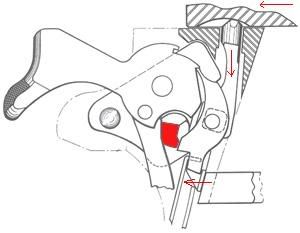
Here's a couple visual aids for those of you who don't know how a 1911 works.

Notice the very THIN hammer spur for the 1/2 cocked position? Told ya is was not much. Also, notice how the thumb safety prevents the SEAR from moving. That's its sole purpose.


[This message has been edited by tx4guns (edited 8/26/2009 4:46p).]

[This message has been edited by tx4guns (edited 8/26/2009 4:47p).]
TexasRebel
How long do you want to ignore this user?
quote:
If you MUST carry a semi-automatic pistol with a cartridge in the chamber, be sure the hammer is in the uncocked position. If your pistol has a hammer-lowering lever, use it rather than the trigger to lower the hammer. Also, if your pistol has a hammer-lowering lever, use it rather than the trigger to lower the hammer. Also, if your pistol has a manual safety, always leave the safety on when carrying the pistol with a cartridge in the chamber, until the gun is aimed at the target and you are ready to fire.


verbatim from the manual in my hands that came with my 1911 clone.

I'm not saying that you can't or shouldn't carry cocked & locked, simply that there is another option that is safe.

Forget the half cock notch, with an inertia pin, even with the hammer down the pin isn't on the primer.
tx4guns
How long do you want to ignore this user?
...and using the above quote tells me you don't truly know 1911s. You can't engage the thumb safety with the hammer down. Just tried it on my Series 1 Kimber to verify what I already knew. Inertia pin or not, you bump that hammer hard with a round in the chamber, get ready for a nasty surprise. Carry how you want, but those saying Condition 1 (cocked and locked) is the safest way to carry one are absolutely correct, and you're not gonna persuade anyone to the contrary, no matter how safe you "feel" with that hammer down. You really should consider a Sig, USP, or XD with a hammer drop. Switching to one of those might just save your life someday, really.
TexasRebel
How long do you want to ignore this user?
...Aaaaaand this is where the inertia pin block comes in and it's clear that you're not paying attention to my posts.

With the hammer down and a round in the chamber, the pin is physically prevented from striking the primer if the grip safety is not pressed (or trigger on some makes). If your make/model doesn't have a pin block, it really doesn't matter if the hammer is back and the safety is on, if you drop it right, it'll pop...it just won't cycle.

I am well aware that the safety cannot be used with the hammer down, that's why I don't use it.
Refresh
Page 2 of 2
 
×
subscribe Verify your student status
See Subscription Benefits
Trial only available to users who have never subscribed or participated in a previous trial.