Voting rights act 4D chess

4,536 Views | 42 Replies | Last: 5 mo ago by backintexas2013
itsyourboypookie
How long do you want to ignore this user?
Did Trump use Texas redrawing the congressional maps to bait the libs into suing to get the voting rights act tossed? If so will dems ever be able to win again if all the states redraw their maps? Will they redraw the maps every election cycle?

CDUB98
How long do you want to ignore this user?
A district gerrymandered solely by race should never have been allowed, no matter the skin color. PERIOD!!

txags92
How long do you want to ignore this user?
Here is an interesting question. How many of the black members of the House and Senate have been elected in non-minority majority districts? And how many of those are democrat vs republican? If the basis for the set aside districts was "white democrats won't vote for a black candidate", what does it say if they are willing to elect them in non-minority majority districts?
AgNav93
How long do you want to ignore this user?
Please let this happen. This could save our country.
Omperlodge
How long do you want to ignore this user?
The most shocking thing about the discussion was that if a district doesn't produce a black elected politician it is considered a violation of the voting rights act. So if you have a district that is 55% black and 45% white that elects a white politician that gets half the black vote it is racist.

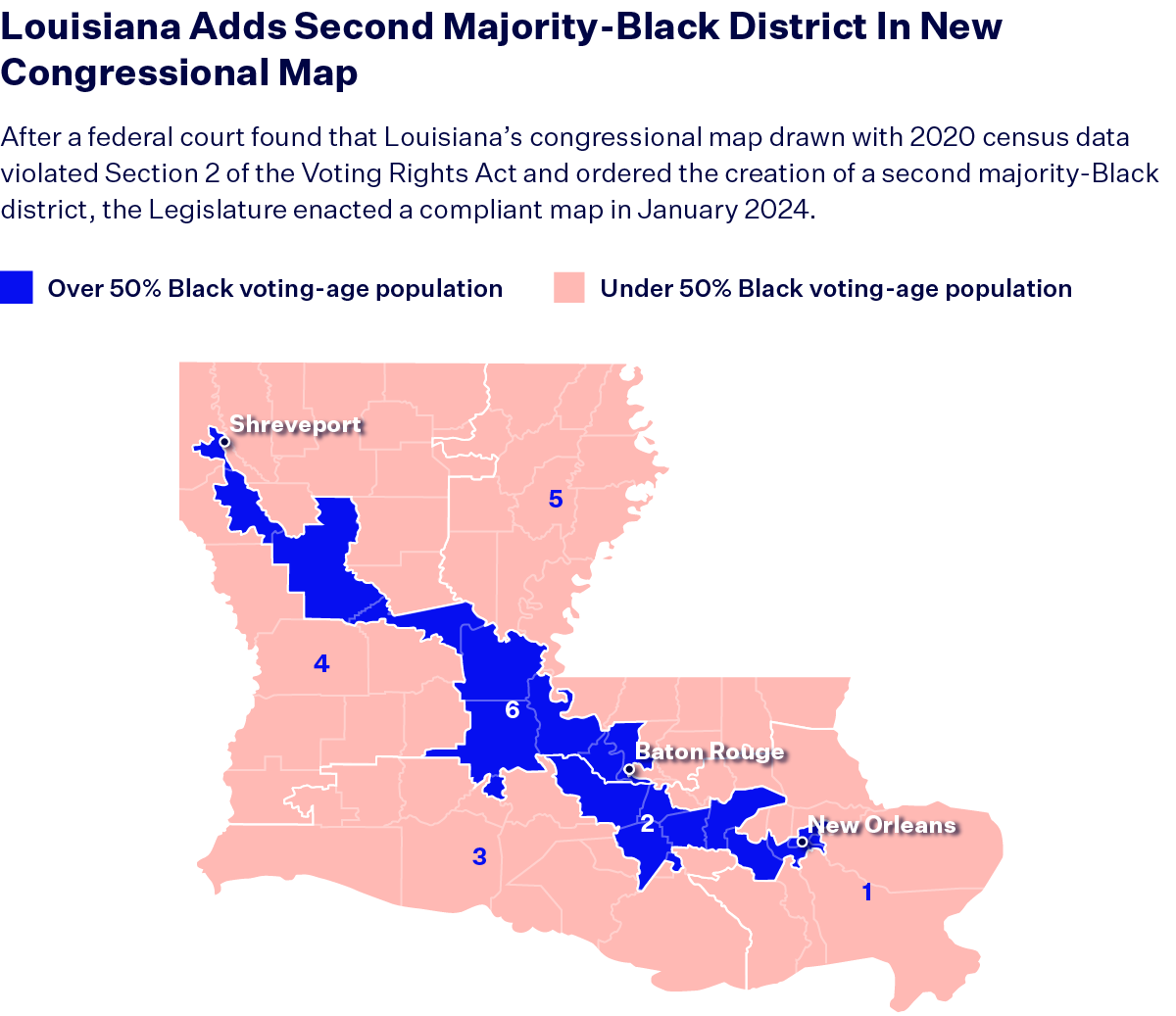
The Louisiana districts are way more equal in population than other states. The democrats want district 6 which runs diagonal through the state trying to bring Shreveport, Alexandria, Lafayette, and Baton Rogue together to give them a second seat. If any of these cities gets drawn into the surrounding areas, a democrat can't win but it would be close. This 6 district is like 80% democrat. The other democrat district is just over 50% democrats and the right candidate could make it in play.

At its face, Louisiana looks way more gerrymandered that other states. I think it is more a factor of the lack of huge cities to over run the surrounding areas like you have in Texas. There doesn't seem to be anything racist in the original map just more a factor of how the state lays out.
will25u
How long do you want to ignore this user?
If you favor one race, you are hindering other races. If you make a map based off african american race, who suffers? Whites, hispanics, asians, indians, etc etc.

Declaration of Independence said:

"We hold these truths to be self-evident, that all men are created equal, that they are endowed by their Creator with certain unalienable Rights, that among these are Life, Liberty and the pursuit of Happiness"


14th Amendment said:

No state shall make or enforce any law which shall abridge the privileges or immunities of citizens of the United States; nor shall any state deprive any person of life, liberty, or property, without due process of law; nor deny to any person within its jurisdiction the equal protection of the laws.


"We the people are the rightful masters of both Congress and the courts, not to overthrow the Constitution but to overthrow the men who pervert the Constitution."

- Abraham Lincoln
IIIHorn
How long do you want to ignore this user?
You should use the term 5D Chess.

A 3D chess board is not any harder to play than a regular chess board. The fourth component/dimension would be time.
will25u
How long do you want to ignore this user?
Doesn't seem to be geographically compact.

Quote:

In redistricting cases, courts consider whether a minority group is "sufficiently large and geographically compact" to constitute a majority in a single-member district.


"We the people are the rightful masters of both Congress and the courts, not to overthrow the Constitution but to overthrow the men who pervert the Constitution."

- Abraham Lincoln
Aglaw97
How long do you want to ignore this user?
Everyone is entitled to their own opinion. But I'll never understand people who espouse the evils of racism with every breath (which I agree with) and yet everything they do is focused on race. The ones pushing the agenda know exactly why they are doing it. Sadly a large part of the American public doesn't take the time to understand why they do it.
HollywoodBQ
How long do you want to ignore this user?
will25u said:

Doesn't seem to be geographically compact.

Quote:

In redistricting cases, courts consider whether a minority group is "sufficiently large and geographically compact" to constitute a majority in a single-member district.


That Louisiana map is ridiculous.

Textbook Gerrymandering
Sims
How long do you want to ignore this user?
Aglaw97 said:

Everyone is entitled to their own opinion. But I'll never understand people who espouse the evils of racism with every breath (which I agree with) and yet everything they do is focused on race. The ones pushing the agenda know exactly why they are doing it. Sadly a large part of the American public doesn't take the time to understand why they do it.

In the US those people tend not to be anti-racist per se, they're just anti personal responsibility and accountability.

They'll throw their own color (I use the word because that's what we're talking about at the base level) under the bus as soon as that person starts demanding responsibility and accountability from the group.
Trident 88
How long do you want to ignore this user?
Every state's districts should be the same shape with the size of each shape being determined by population.
Blackhorse83
How long do you want to ignore this user?
Dems can only win by cheating. Eliminate cheating and eliminate the Dems. I'm convinced they have not legitimately won an election in decades.
Scouts Out
txags92
How long do you want to ignore this user?
Trident 88 said:

Every state's districts should be the same shape with the size of each shape being determined by population.

That is nice in concept, but impossible due to vast differences in population density. It is far better to associate areas that have similar key issues and needs together into districts and forget about race. For instance, trying to take Houston's population and distribute it out to all of the surrounding areas in wedge shaped districts would result in the same shape and population, but what does coastal Galveston county have in common with the 3rd ward and EADO? They would likely be in the same wedge together. What does the area around Kelly AFB in San Antonio have in common with Hondo, Uvalde, and Bracketville? These are different areas with different concerns and their political representation should reflect that, without being drawn based on race.
BonfireNerd04
How long do you want to ignore this user?
I wonder if this case will end up ending the single-member district system altogether. Have states elect representatives statewide using some variant of STV.

That would solve the minority representation "problem" because any candidate who gets a quota of votes (which would be 2.56% of the vote here in Texas with 38 seats) gets elected. Probably including a Libertarian or Green Party candidate as well. And put an end to redistricting fights because there would be no districts (other than the states).
TheEternalOptimist
How long do you want to ignore this user?
will25u said:

Doesn't seem to be geographically compact.

Quote:

In redistricting cases, courts consider whether a minority group is "sufficiently large and geographically compact" to constitute a majority in a single-member district.


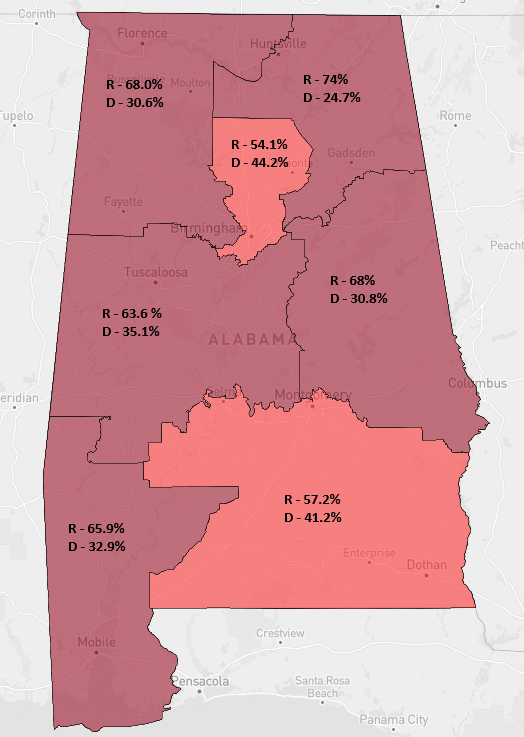
They did this in Alabama too.

The Alabama GOP supermajority initially left a majority black district in tact in the Birmingham area (left map). The Federal Courts insisted on a massively gerrymandered additional black majority district which resulted in the current map (on the right):


The Alabama GOP is in no mood for any more accommodation, and if Section 2 of the VRA is gone, there will likely be a redraw eliminating ALL Democrat controlled districts with very little gerrymandering necessary, and that follows county lines largely:


AColunga07
How long do you want to ignore this user?
That's probably the best solution I have heard to this mess. What an interesting concept.
RedHand
How long do you want to ignore this user?
BonfireNerd04 said:

I wonder if this case will end up ending the single-member district system altogether. Have states elect representatives statewide using some variant of STV.

That would solve the minority representation "problem" because any candidate who gets a quota of votes (which would be 2.56% of the vote here in Texas with 38 seats) gets elected. Probably including a Libertarian or Green Party candidate as well. And put an end to redistricting fights because there would be no districts (other than the states).

How is this different than a Senate seat? The point of the House is to have a representative that is more local to your community to represent you on the federal level. Am I looking at this wrong?
IDaggie06
How long do you want to ignore this user?
Never underestimate the power of liberals to find a shady way to block the redistributing. No way they allow this to happen even if the Supreme Court votes to repeal it.
txags92
How long do you want to ignore this user?
RedHand said:

BonfireNerd04 said:

I wonder if this case will end up ending the single-member district system altogether. Have states elect representatives statewide using some variant of STV.

That would solve the minority representation "problem" because any candidate who gets a quota of votes (which would be 2.56% of the vote here in Texas with 38 seats) gets elected. Probably including a Libertarian or Green Party candidate as well. And put an end to redistricting fights because there would be no districts (other than the states).

How is this different than a Senate seat? The point of the House is to have a representative that is more local to your community to represent you on the federal level. Am I looking at this wrong?

You are not looking at it wrong. It sounds very similar to proportional representation schemes or parlimentary elections. It would result in some areas of the state effectively having nobody to represent them because the system would demand that all of the candidates appeal to and campaign for the areas with the largest populations of potential voters in order to ensure the best chance of getting elected.
one MEEN Ag
How long do you want to ignore this user?
Districts should have some perimeter to area ratios that cannot be exceeded. This would prevent districts from being long, stringy messes.

Of course the immediate questions that pop up are:
-How much is too much of a ratio? When does it become foul play?
-Land perimeter is technically countably infinite as you decrease the size of measuring stick so you'd have to agree that you'd measure perimeter and area with a unit stick of a set length like 1 mile resolution (i.e you can't follow the winds of a river as that would increase your perimeter metric).

But implicitly, this metric would give land and proximity a say in voting. Most people don't like thinking like that in modern terms, but proximity has always been a thing in voting set ups.
K2Ag97
How long do you want to ignore this user?
I find this situation really odd. It's predicated on the outcome that skin color determines how you vote.

Which is frankly ridiculous when you stop and think about it.
redcrayon
How long do you want to ignore this user?
txags92 said:

Here is an interesting question. How many of the black members of the House and Senate have been elected in non-minority majority districts? And how many of those are democrat vs republican? If the basis for the set aside districts was "white democrats won't vote for a black candidate", what does it say if they are willing to elect them in non-minority majority districts?

The Senate doesn't have districts. Am I misunderstanding your question?
TheEternalOptimist
How long do you want to ignore this user?
From Grok --- Getting rid of Sec 2 of VRA means both :

1. LESS Gerrymandering

2. MORE GOP House seats.

-----------------------

Impact of Removing Section 2 of the VRAWithout Section 2's mandate, states would no longer be required to create majority-minority districts, allowing mapmakers to prioritize only geographic compactness and community cohesion (e.g., keeping counties/towns whole, equal population). This would likely amplify the GOP's advantage in affected states, as Black voters (a reliably Democratic bloc) could be distributed more evenly across districts, diluting their electoral impact. Let's break it down:Affected States and Districts
  • Louisiana:

    • Current (VRA-Compliant): After 2024's court-ordered map, Louisiana has 2 Black-majority districts (2nd, 6th; ~5153% Black voting-age population), both solidly Democratic (e.g., 6th flipped to D in 2024). The state's 6 districts split 4R2D, despite a ~55% GOP statewide vote share.
    • No VRA: Compact maps without majority-Black districts would likely disperse Black voters (concentrated in New Orleans and Baton Rouge) across 23 districts. Simulations (e.g., PlanScore's neutral maps) suggest this could yield 5R1D or even 6R0D, as Black voters (~30% of the state) would no longer anchor Democratic seats. The GOP's rural/suburban dominance would prevail in compact districts.
  • Alabama:

    • Current: Post-Milligan, Alabama's 7th District (~55% Black) is a Democratic lock, with the state at 6R1D. The GOP's ~60% statewide vote share is overrepresented due to packing Black voters into the 7th.
    • No VRA: Distributing Black voters (~25% of the state) across compact districts could eliminate the Democratic seat, yielding 7R0D or 6R1D with a competitive seat (e.g., Mobile-based district ~45% Democratic). Compactness favors GOP-leaning rural areas.
  • Other States: Similar dynamics apply in Georgia (23 majority-Black districts), South Carolina (1), Mississippi (1), and North Carolina (1). Without VRA mandates, 57 Democratic-leaning majority-Black districts across the South could flip to GOP or become competitive, as Black voters (1530% per state) are spread into GOP-leaning suburban/rural districts.
Quantitative Impact
  • Seat Shift: Simulations from redistricting models (e.g., Districtr, Dave's Redistricting) estimate that removing VRA Section 2 could cost Democrats ~48 seats nationwide in a compact-map scenario. In the South, where ~10 majority-Black districts exist, ~35 could flip to GOP or become toss-ups. For example:

    • Louisiana: +1 or 2 GOP seats.
    • Alabama: +1 GOP seat.
    • Georgia: +1 or 2 GOP seats (e.g., Atlanta-area districts become competitive).
    • Others (SC, MS, NC): +1 or 2 GOP seats total.
  • National House Impact: Starting from the projected 225230 GOP seats under compact maps with VRA compliance, removing Section 2 could push the GOP to 230235 seats (Democrats: 200205). The GOP's 23% popular vote edge would translate more efficiently, as Democratic voters lose concentrated strongholds.
  • Efficiency Gap: Without VRA, the "wasted vote" gap (a measure of partisan bias) would widen slightly in GOP favor. Current maps have a ~12% pro-GOP bias; removing VRA could add ~0.51% by diluting Democratic votes in the South.
Why the GOP Gains
  • Voter Geography: Black voters are often concentrated in urban areas (e.g., New Orleans, Birmingham), making VRA districts highly Democratic but "packing" voters inefficiently. Without VRA, compact districts align more with statewide partisan leans, which favor Republicans in Southern states (e.g., Louisiana 55% GOP, Alabama 60%).
  • 2024 Trends: The GOP's gains among non-college-educated and rural voters (including some Black and Hispanic voters) mean compact, community-based districts in the South would often lean GOP, especially without mandated minority districts.
  • No Counterbalancing Loss: In non-Southern states, VRA's impact is smaller (fewer majority-minority districts), so Democrats gain little from its removal, while Republicans lose no strongholds.
Caveats
  • Legal/Political Limits: Even without Section 2, courts might strike down maps that blatantly dilute minority voting power under the 14th Amendment or state constitutions. However, compactness rules would likely pass muster if applied consistently.
  • Competitive Districts: Neutral maps increase competitiveness (~2025% of districts vs. 10% now). Some diluted Democratic voters could create new swing seats (e.g., in Georgia), but 2024's GOP turnout edge suggests they'd win most.
  • Data Gaps: Exact seat projections vary by state and algorithm. My estimate (230235 GOP seats) draws from 2024 vote data and neutral-map simulations, but local turnout shifts could alter outcomes.
ConclusionWithout Section 2 of the VRA, compact, community-preserving maps in 2024 would likely amplify the GOP's House majority to 230235 seats (vs. 225230 with VRA), as Democratic-leaning Black voters in states like Louisiana and Alabama are dispersed, flipping ~48 Southern seats to the GOP or making them competitive. The GOP's national popular vote win and geographic advantage in rural/suburban areas drive this edge, with minimal Democratic offset elsewhere. This aligns with analyses from redistricting scholars (e.g., MGGG, Brennan Center) showing VRA's current structure can paradoxically boost GOP seat shares by concentrating Democratic voters.
IDaggie06
How long do you want to ignore this user?
K2Ag97 said:

I find this situation really odd. It's predicated on the outcome that skin color determines how you vote.

Which is frankly ridiculous when you stop and think about it.


Practically every liberal idea is frankly ridiculous when you stop and think about it
txags92
How long do you want to ignore this user?
redcrayon said:

txags92 said:

Here is an interesting question. How many of the black members of the House and Senate have been elected in non-minority majority districts? And how many of those are democrat vs republican? If the basis for the set aside districts was "white democrats won't vote for a black candidate", what does it say if they are willing to elect them in non-minority majority districts?

The Senate doesn't have districts. Am I misunderstanding your question?

That was a little bit of the point. If we have democratic senators getting elected in both democratic and republican leaning states, and there are black house reps being elected in majority white districts (ie Wesley Hunt), it proves that one of the things cited as the basis for the need for Section 2 is false. White voters will vote for black representatives and senators, so we don't need to set aside special districts for them.
Aglaw97
How long do you want to ignore this user?
Sims said:

Aglaw97 said:

Everyone is entitled to their own opinion. But I'll never understand people who espouse the evils of racism with every breath (which I agree with) and yet everything they do is focused on race. The ones pushing the agenda know exactly why they are doing it. Sadly a large part of the American public doesn't take the time to understand why they do it.

In the US those people tend not to be anti-racist per se, they're just anti personal responsibility and accountability.

They'll throw their own color (I use the word because that's what we're talking about at the base level) under the bus as soon as that person starts demanding responsibility and accountability from the group.

In a lot of cases, it's about the $$$. Don't forget that every good cause begins as a movement, becomes a business and eventually degenerates into a racket.
BonfireNerd04
How long do you want to ignore this user?
txags92 said:

RedHand said:

BonfireNerd04 said:

I wonder if this case will end up ending the single-member district system altogether. Have states elect representatives statewide using some variant of STV.

That would solve the minority representation "problem" because any candidate who gets a quota of votes (which would be 2.56% of the vote here in Texas with 38 seats) gets elected. Probably including a Libertarian or Green Party candidate as well. And put an end to redistricting fights because there would be no districts (other than the states).

How is this different than a Senate seat? The point of the House is to have a representative that is more local to your community to represent you on the federal level. Am I looking at this wrong?

You are not looking at it wrong. It sounds very similar to proportional representation schemes or parlimentary elections. It would result in some areas of the state effectively having nobody to represent them because the system would demand that all of the candidates appeal to and campaign for the areas with the largest populations of potential voters in order to ensure the best chance of getting elected.


But we already have that now with statewide elections like Senator and Governor. And with gerrymandered House districts that arbitrarily group rural areas with urban ones.
BusterAg
How long do you want to ignore this user?
BonfireNerd04 said:

txags92 said:

RedHand said:

BonfireNerd04 said:

I wonder if this case will end up ending the single-member district system altogether. Have states elect representatives statewide using some variant of STV.

That would solve the minority representation "problem" because any candidate who gets a quota of votes (which would be 2.56% of the vote here in Texas with 38 seats) gets elected. Probably including a Libertarian or Green Party candidate as well. And put an end to redistricting fights because there would be no districts (other than the states).

How is this different than a Senate seat? The point of the House is to have a representative that is more local to your community to represent you on the federal level. Am I looking at this wrong?

You are not looking at it wrong. It sounds very similar to proportional representation schemes or parlimentary elections. It would result in some areas of the state effectively having nobody to represent them because the system would demand that all of the candidates appeal to and campaign for the areas with the largest populations of potential voters in order to ensure the best chance of getting elected.


But we already have that now with statewide elections like Senator and Governor. And with gerrymandered House districts that arbitrarily group rural areas with urban ones.

But you don't have local representation at the federal level without a House Rep. This is a major problem.

I would be OK with having the House be elected state-wide of senators were selected by state legislatures again, but I don't see that happening, either.

Keeping gerrymandering but throwing out the requirement for minority-majority districts seems like the best way to go.
txags92
How long do you want to ignore this user?
BonfireNerd04 said:

txags92 said:

RedHand said:

BonfireNerd04 said:

I wonder if this case will end up ending the single-member district system altogether. Have states elect representatives statewide using some variant of STV.

That would solve the minority representation "problem" because any candidate who gets a quota of votes (which would be 2.56% of the vote here in Texas with 38 seats) gets elected. Probably including a Libertarian or Green Party candidate as well. And put an end to redistricting fights because there would be no districts (other than the states).

How is this different than a Senate seat? The point of the House is to have a representative that is more local to your community to represent you on the federal level. Am I looking at this wrong?

You are not looking at it wrong. It sounds very similar to proportional representation schemes or parlimentary elections. It would result in some areas of the state effectively having nobody to represent them because the system would demand that all of the candidates appeal to and campaign for the areas with the largest populations of potential voters in order to ensure the best chance of getting elected.


But we already have that now with statewide elections like Senator and Governor. And with gerrymandered House districts that arbitrarily group rural areas with urban ones.

The solution to that is stop gerrymandering house districts, not to make house seats statewide elections.
American Hardwood
How long do you want to ignore this user?
RedHand said:

BonfireNerd04 said:

I wonder if this case will end up ending the single-member district system altogether. Have states elect representatives statewide using some variant of STV.

That would solve the minority representation "problem" because any candidate who gets a quota of votes (which would be 2.56% of the vote here in Texas with 38 seats) gets elected. Probably including a Libertarian or Green Party candidate as well. And put an end to redistricting fights because there would be no districts (other than the states).

How is this different than a Senate seat? The point of the House is to have a representative that is more local to your community to represent you on the federal level. Am I looking at this wrong?

This is exactly the problem with this idea. It would work somewhat okay in some smaller monolithic states that don't have competing interests within the borders and a fairly even distributed population base. But in a state like Texas it would be awful.

We've already seen that even with the system we have. At one time, my district ran from San Pat Country all the way down to the valley in this ridiculous sliver across empty ranch land just to get more democrats in the district. This objective placed two competing ports in the same district with the same representative who had to play favorites. The interests of the border town had very little in common with an energy port far to the north.

You expand this idea statewide and you will absolutely get under representation of vast areas and conflicts of interest abounding for representatives.
The best way to keep evil men from wielding great power is to not create great power in the first place.
TexasAggie_97
How long do you want to ignore this user?
CDUB98 said:

A district gerrymandered solely by race should never have been allowed, no matter the skin color. PERIOD!!


HEY! Stop being such a racist by saying the democrats cannot use race to decide on voting districts.
jacketman03
How long do you want to ignore this user?
txags92 said:

Here is an interesting question. How many of the black members of the House and Senate have been elected in non-minority majority districts? And how many of those are democrat vs republican? If the basis for the set aside districts was "white democrats won't vote for a black candidate", what does it say if they are willing to elect them in non-minority majority districts?

Seeing as Louisiana v. Callais is focused on Louisiana, I'll give you the answer to this question in Louisiana. Louisiana has never elected a black man or woman to statewide office, and in the history of the state, has had 5 black members of Congress. 1 was during Reconstruction, and the other 4 have all been since 1990, and all 4 of those from majority black districts.

So it looks like white people in Louisiana will vote for white men, white women, Asian men, but not black people.
txags92
How long do you want to ignore this user?
jacketman03 said:

txags92 said:

Here is an interesting question. How many of the black members of the House and Senate have been elected in non-minority majority districts? And how many of those are democrat vs republican? If the basis for the set aside districts was "white democrats won't vote for a black candidate", what does it say if they are willing to elect them in non-minority majority districts?

Seeing as Louisiana v. Callais is focused on Louisiana, I'll give you the answer to this question in Louisiana. Louisiana has never elected a black man or woman to statewide office, and in the history of the state, has had 5 black members of Congress. 1 was during Reconstruction, and the other 4 have all been since 1990, and all 4 of those from majority black districts.

So it looks like white people in Louisiana will vote for white men, white women, Asian men, but not black people.

But since 1990 haven't nearly all of the black majority precincts been grouped into those two districts? So we have no idea if things have changed in the last 35 years such that putting those districts back into play might still end up with a black representative. Doesn't matter anyway because it is racist and illegal discrimination to assume that a non-black person is incapable of fairly representing a black person.
BonfireNerd04
How long do you want to ignore this user?
K2Ag97 said:

I find this situation really odd. It's predicated on the outcome that skin color determines how you vote.

Which is frankly ridiculous when you stop and think about it.


But it's pretty much true for Black people, who consistently vote about 90% Democrat in every election.

No other voting bloc is as anywhere near as monolithic. Not Latinos (who are split around 70-30). Not LGBTs. Not atheists. Not Asians. Not unmarried women. Not Jews.
Page 1 of 2
 
×
subscribe Verify your student status
See Subscription Benefits
Trial only available to users who have never subscribed or participated in a previous trial.