NA -
You forgot the 'F'
You forgot the 'F'
quote:
Astronauts Piers Sellers and Mike Fossum will make two spacewalks and possibly a third, which would add a day to what is planned to be a 12- day mission.

quote:
Fossum born to be an astronaut
July 01,2006
Marc B. Geller
Monitor Staff Writer
McALLEN — Mike Fossum grew up in the Space Age with the dream of some day flying for NASA.
Born Dec. 19, 1957, in Sioux Falls, S.D., the now 48-year-old married father of four was about five months away from his 12th birthday when he watched the Apollo 11 moon landing on July 20, 1969 — arguably the greatest technological feat human beings have ever achieved.
Friends recall the young Fossum gazing heavenward into the night sky during camping trips — and pledging like thousands of other young people that he would eventually travel into space. Unlike most, though, Fossum never completely gave up on that dream, even when he came of that precarious age when the realism of adulthood often threatens the idealism of childhood.
His tenacity is about to pay off, as the 1976 graduate of McAllen High School and former member of Boy Scout Troop 7 embarks on the ride of his life as one of seven crew members of the NASA space shuttle Discovery.
Launch from Kennedy Space Center near Cape Canaveral, Fla., is scheduled for 2:49 p.m. Saturday.
"Dad thought that the space program was an important thing," Fossum said of his late father, Merlyn E. Fossum, during a March telephone interview.
"He followed it closely and would get us up in the middle of the night to watch moon landings and things like that, and he just kind of had this excitement about it. …
"That was back in the days of the Vietnam War and things like that, but he still thought that this was important, and I kind of caught that fever like every other 12-year-old kid in the country back then — that this was something that was worthwhile, it was a worthy goal, and something that would be great to be a part of."
The first of three children — all boys — born to Merlyn and Pat Fossum, Mike spent the first several years of his life in South Dakota.
The family lived in Pierre, S.D., for a couple of those years, according to the Pierre Capital Journal. Mike’s great-great-grandfather, Paul Mikkelson Fossum, came from Norway in 1874 to homestead near Canton, S.D., about 20 miles south of Sioux Falls. His maternal grandfather, Martin Davis, also homesteaded near Watertown, S.D., about 100 miles north of Sioux Falls.
Mike is mindful of that pioneering legacy as he prepares to do his part to explore the "final frontier."
"We’re a nation of explorers and pioneers," he said, according to the NASA transcript of his Feb. 21 preflight interview. "My ancestors came from Norway, Ireland, and Germany, to seek out new lands and new opportunities.
There was risk and peril for them in that day, and there’s risk and peril with exploring today."
Merlyn and Pat Fossum moved their family to Mission in 1962, when Mike was about 4 years old, and then two years later moved to McAllen. Mike spent his formative years in the City of Palms. His mother, Pat, still lives in McAllen. His brothers, Greg and Terry, live in Corpus Christi and Spokane, Wash., respectively, with their families.
Mike’s father, Merlyn, worked for the U.S. Department of Agriculture at Moore Air Base as part of the screwworm eradication program that began in 1962 under the direction of the Agricultural Research Service labs in Kerrville and in Mission.
Born on Nov. 10, 1929 — within weeks of the stock market crash that marked the start of the Great Depression — Merlyn died Feb. 27, 1981, when the private aircraft in which he was a passenger crashed in El Paso. He was 51.
Mike was 23 at the time and had just married Melanie London — his wife now of more than 25 years — five months earlier in her hometown of Corsicana.
He had also recently completed his bachelor of science degree at Texas A&M University.
"It was pretty tough," said Mike’s longtime friend, Charlie Ward.
"His dad taught him how to use tools," Ward said, adding that Mike developed some of the basic engineering skills he will use in space while working on his old Datsun hatchback growing up in McAllen.
"I’m sure the Datsun had something to do with it," Ward said, chuckling at the memory of the old beater. "To this day, Mike can fix stuff around the house and comes home and does things at his mom’s house — heavy-duty things — and he’s never afraid to jump right in."
But the aspiration of becoming an astronaut diminished somewhat in high school as the pragmatism of adulthood began to set in with him.
"I figured that wasn’t a job that real people had the opportunity to do," Mike said in the NASA preflight interview. "And so I kind of shifted more to wanting to get into engineering, where I could design and build new things."
Former McHi physics teacher Ruperto Gonzalez — affectionately known to students as Mr. G — remembers Mike being active in the school’s chapter of the Junior Engineering Technical Society.
"Mike was a very courteous, quiet young man. He was real sharp in my physics class — hardly ever said anything unless he was asking a legitimate question about what was going on in class. He was very well dressed, very well behaved, very well mannered. I guess if you put it in a nutshell, he was the ideal student."
Through the JETS program, Mike other students visited the campus of Texas A&M University and received exposure to engineers from various disciplines within the field and was introduced to the world of computers during the era of the "dumb terminals" that gave rise to personal computers.
Mike and several of his buddies also earned their Eagle rank around that same time.
Ball described his friend at that time as being a "straight arrow" but not a "pencase-in-your-pocket-type of guy."
"Mike rode a motorcycle," Ball said. "He fit in in high school back in the ’70s more than I did — I looked more like Elvis Costello — but he looked like a normal kid with long hair and blue jeans with the knees worn out and motorcycle boots. …
"He wasn’t wild. We all played around but he wasn’t a disruptive or rebellious guy."
When not busy with Scouts, school or hanging out with his pals, Mike worked a variety of jobs here in the Valley: in a bicycle repair shop, as a church janitor, on orange-picking crews and for an insulation construction company one summer.
As senior patrol leader in Boy Scout Troop 7, he also was responsible for planning and leading trips, including a six-day, 65-mile canoe trip on the Guadalupe River.
After graduating from McHi in 1976, the young Bulldog went on to become an Aggie and pursue a B.S. in mechanical engineering. However, in what Fossum described in his NASA preflight interview as a "strange quirk," the dorms were full and the apartments too expensive.
"My only option for getting a dorm was to join the Corps of Cadets, join the ROTC program," he said. "There I was exposed to the Air Force and the opportunities for engineers in the Air Force."
Mike spent four years in the Corps of Cadets at Texas A&M and was commanding officer of Squadron 3 his senior year there. He received his commission in the U.S. Air Force from Texas A&M in May 1980 and left the university as a Distinguished Military Graduate.
Married just a few months later, on Sept. 21, 1980, at the age of 22, Mike went on to pursue graduate studies at the Air Force Institute of Technology at Wright-Patterson Air Force Base, near Fairborn and Beavercreek, Ohio.
After receiving his master’s degree in systems engineering from there in 1981, Mike was assigned to NASA-Johnson Space Center where he supported space shuttle flight operations.
While there, he worked down the hall from the Astronaut Office and got to know several of the astronauts, including, much to his good fortune, Jerry Ross and Ellison Onizuka, two flight test engineers who had been through the Air Force Test Pilot School at Edwards Air Force Base in California.
Onizuka, in particular, rekindled Mike’s dream of becoming an astronaut, and the two astronauts encouraged him to apply to the flight test engineer program at Test Pilot School. Mike followed their advice and was selected for the program, where he graduated in 1985.
After graduation, he served at Edwards AFB as a flight test engineer in the F-16 test squadron. From 1989 to 1992, he served as a flight test manager at the Air Force Flight Test Center.
Mike resigned from active duty in 1992 in order to work for NASA and is currently hold the rank of colonel in the U.S. Air Force Reserves. He spent his early days at the space agency as a systems engineer, primarily evaluating the Russian Soyuz spacecraft for use as an emergency escape vehicle for the new space station.
Later in 1993, he was selected to represent the Flight Crew Operations Directorate in an extensive redesign of the International Space Station.
After that, he continued work for the crew office and Mission Operations Directorate in the area of assembly operations.
In 1996, he supported the Astronaut Office as a technical assistant for the space shuttle, supporting design and management reviews. The following year, in 1997, he served as a flight test engineer on the X-38, a prototype crew escape vehicle for the new space station.
Also that year, Mike received his second graduate degree — an M.S. in physical science with a concentration in space science — from University of Houston-Clear Lake.
Time after time during those years, he applied to the astronaut program. And time after time, he was turned down but told to keep trying.
"It took him a long time getting into the Astronaut Corps," Ball recalled.
"He started applying (in 1985) and he never gave up. They always told him that he was that close, try again, and he tried again. And he kept at it until they finally let him in."
After applying seven times over those 13 years, NASA finally opened the door for Mike to realize his dream.
Selected by the space agency in June 1998, he reported for astronaut training in August 1998. Mike and 24 others named to that year’s astronaut candidate list were chosen from among 3,000 to 4,000 applicants. His good friend Ken Cockrell, then chief of the Astronaut Office, gave Mike the momentous news by phone June 3, 1998.
"He told me, ‘We think we’re ready to have an Aggie in the Astronaut Office,’" Mike said in an interview with The Monitor less than a week after he got the word.
"I was completely in shock," he said at the time. "I fell to my knees on the phone. Then I said, ‘I guess I should go through with it after all this trouble.’"
Astronaut candidate training included orientation briefings and tours, numerous scientific And technical briefings, intensive instruction in shuttle and International Space Station systems, physiological training and ground school to prepare for T-38 flight training.
And as if his years of high adventure with the Scouts hadn’t been enough preparation, NASA also put him through training in water and wilderness survival techniques.
Since being selected, Mike has served as the Astronaut Office lead for space station flight software development. As a capsule communicator (CAPCOM) in mission control, he supported several flights, including as lead CAPCOM for Space Station Expedition-6.
Along the way, he and wife Melanie, had four children together: Carrie, a Rice University senior and former Girl Scout; Mitch, an Eagle Scout and student at the U.S. Air Force Academy; and John and Kenny, who, like their older siblings, have been active with their dad in the Scouting program.
The family makes its home in Houston.
Even after being admitted to the Astronaut Corps, though, Mike’s long wait to go up in space was far from over.
On Feb. 1, 2003, the space shuttle Columbia and its crew of seven — friends of his — disintegrated over Texas as the spacecraft was undergoing re-entry.
Nevertheless, eight months later — five years after joining the Astronaut Corps — Mike finally got his flight assignment, for the STS-121 mission that is scheduled for launch today.
"That was a day I’ll never forget," he said in his NASA preflight interview. "I actually got the call on Columbus Day 2003. It was a federal holiday. I was at home. The rest of my family was at school. I was working in the garage, working on cars, cleaning the garage. I was greasy from head to toe and drenched in sweat, and the phone rings.
"It’s Kent Rominger, the chief of the Astronaut Office. He says, ‘Mike, you ready to go fly in space?’"
After a quick affirmative, Mike hung up the phone and fell to his knees, thanked God, and sat there on the floor of the garage in stunned disbelief for what felt like 20 minutes.
Only the second NASA human spaceflight since the Columbia disaster, STS-121 has been dubbed a "return-to-flight test mission." And although
Mike has logged over 1,000 hours in 34 different aircraft, this will be an entirely new experience for the "rookie."
Ongoing problems with "foam liberation" — the same shedding of insulation from the external tank that doomed Columbia — further delayed Mike’s first space adventure. NASA postponed the trip indefinitely in July last year, after the problem resurfaced that month during the first shuttle launch since the Columbia disaster.
Much of the mission will be dedicated to testing the tools and techniques for inspecting the shuttle and conducting needed repairs in orbit. Part of that assignment will include Mike and fellow mission specialist Piers Sellers making two, and possibly three, spacewalks over the course of the 12 days.
The busy schedule also will include a rendezvous with the International Space Station to deliver not only supplies but also crew member Thomas Reiter, who is catching a ride with Discovery and will remain on the station for the next several months.
Even with his long-awaited dream so close he can taste it, Mike hasn’t stopped dreaming big. With NASA’s presidential mandate to return humans to the moon — and eventually send them on to Mars — the guy who still gets down to McAllen regularly to visit mom or have a few beers with old friends at Sofie’s Double S Saloon hopes he’ll be part of it all.
"I’ll dream that we move expeditiously on those plans and I get the chance to take part in it, personally planting my own boots on those heavenly bodies."
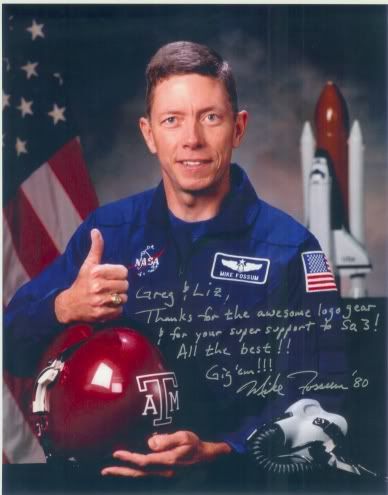
quote:
It's looking pretty good out there today!
We start suit-up in 15 minutes.
Let's light this bottle rocket!
Whoop!!
-mike'80


quote:
Astronaut Mike Fossum gave a thumbs up and called out: "Hi mom! I love you!"

quote:
In this image from NASA TV, astronaut Mike Fossum, left, gets astronaut Piers Sellers to smile before they board the shuttle.


quote:
What are your duties on this mission? Give me a big picture of what it is that you're going to be doing.
Well, my duties on this mission start off on ascent. I'll be sitting on the flight deck. I'll be, designation is Mission Specialist No.1. That means I'll [be] assisting the, the commander and pilot, and MS-2 with basically operations of the Space Shuttle systems. That's a very busy time in the simulators, when the trainers like to throw lots of problems our way and we have the challenge of sorting through them all. For a nominal ascent, which we fully expect, it won't be nearly as busy as it, as it is while we're in training. But it's really overseeing the Shuttle systems and helping work any problems, any system failures that might occur while we're going uphill. Once we get to space, I'm just one of the team that will help activate and turn the Space Shuttle from a rocket ship into the orbiting workshop as we get ready for docking with the Space Station. There are a lot of things – opening up the payload bay doors, activating the rest of the comm system, and, getting ready for the rendezvous in a couple of days. The most unique part of my job during the mission will be doing the three spacewalks while we're attached to the Space Station. My designation there is EV-2, which basically means I'm the rookie. I'm very excited about the spacewalks or EVAs, extravehicular activities, in NASA-speak. An EVA is a very challenging activity, but it's one we've spent a lot of time training for. I'm really looking forward to those. As we prepare for coming home, I'll be responsible for kind of orchestrating the crew's activities during deorbit preparations. I'll have the roadmap for that and help direct that show. And, I'll be coming home, downstairs, on the middeck of the Shuttle for the return flight.
quote:
Astronaut Mike Fossum sent Mission Control video showing him, pilot Mark Kelly and specialist Lisa Nowak in the flight deck during Tuesday's launch.
First-time fliers Nowak and Fossum gave each other a gloved congratulatory handshake and thumbs up during the ascent. Once in orbit, Nowak, serving as flight engineer, took notes while Fossum and specialist Stephanie Wilson unstrapped themselves to photograph the external fuel tank as it fell away from the shuttle.
quote:
Mission specialist Michael Fossum
Age: 48
Hometown: Born in Sioux Falls, S.D., but grew up in McAllen, Texas
Family: Married, four children
Fossum became the first Aggie in space.
The Texas A&M graduate was bringing to the space station a university flag which he will bring back for his alma mater. But he may want to hide it from fellow crew mate Stephanie Wilson, who went to graduate school at the University of Texas.
"I kind of wish I was the third Aggie in space," said Fossum, who has master's degrees in systems engineering and space science. "It's not like me to make a big fuss about this."
Fossum not only is flying for the first time in space, but he is making his first spacewalk. The rookie will make at least two excursions outside the space station with Sellers to test inspection and repair techniques on the shuttle. A third spacewalk is possible.
Fossum has been an astronaut for eight years but his service with NASA stretches back to the early 1980s when he went to work at Johnson Space Center after completing graduate work at the Air Force Institute of Technology. It took him several tries to join the astronaut corps.
As a child, he cherished a book on the Apollo program and wrote in it, "I too am going to the stars." He rediscovered the book a few years ago in a box of childhood items and thought, "My goodness. Look what you wrote!"
quote:
In the very first hours of the flight you’re already going to be working on some of these test objectives, to confirm some aspects of redesign of the external tank. Tell me what’s involved in getting all this new data that you gather in the first couple of hours back down to the ground, data from, from new sensors and cameras.
We’re going to be, as we said back in the Air Force flying days, “blowin’ and goin’” from the time the main engines cut off. I’ll be jumping out of my seat to, grabbing a camcorder to take video of the external tank as it separates from us, using that as another source of information. As soon as that’s complete, about 15 minutes’ worth of video there, Stephanie Wilson’s going to be taking still photos at the same time with a digital camera. Then we start configuring the space shuttle and getting it ready for on-orbit ops. The first thing we’ll do is start setting up a computer network. That’s important because that computer network is going to be our method to get the video and photographs downlinked to the ground. The leading edge sensors will be downlinking using actually a radio link to the sensors that are in the wings, setting antennas up in the window connected to a laptop to reach out and tap those and get the data out of those and start bringing them in so the ground can downlink it. We have cameras that are on the belly of the shuttle that will be taking close-up pictures of the external tank as we fall away. They’ll be taking pictures as we’re going by the tank. We have to go out and electronically get those out of the camera and bring them on board to where the ground can grab them and then we’ll be downlinking the hand-held still camera and video camera information.
And all of that’s on the first day.
Oh, yeah.
The second day of the mission, you’re going to become the second crew to conduct a, an inspection of the exterior of the orbiter. Give me a brief description of this Orbiter Boom Sensor System and how it can examine the shuttle’s thermal protection system for damage.
The Orbiter Boom Sensing System, the OBSS as we call it, is about 50 feet long, and we’ll carry it up over on the right side of the payload bay of the shuttle. That forms an extension for the shuttle’s external arm, or robot arm, which is about 50 feet long. So we’ll use the shuttle’s arm to reach over and grab this boom—it’s sitting in the payload bay—and then lift it up, and on the end of the boom we have several sensors: a video camera and a laser camera system. We’ll be able to use that boom on the end of the arm. We’ll be able to get all the way out to the tips of both wings and, and we will literally scan back and forth, very carefully, collecting data from the various sensors on the boom, to get close-up views to make sure there’s not, not any kind of damage to the biggest thing. The boom on the end of the arm is a very, it’s very cumbersome. It’s very large. The 114 crew proved that you can do this safely. Most of it you cannot see through the windows well enough to make sure you don’t run it into something So we’ve got to trust camera views from different angles. We don’t have as many camera views from as many angles as we would wish. They broke the ground here on proving that you can move a big, cumbersome contraption like this all around the shuttle. You don’t want to hit anything—it’s very important that we don’t because this boom could cause, could cause significant damage itself. So it’s a very delicate operation that’s going to take up a good part of the second day of our mission.
Additional inspections of the shuttle are going to continue on the third day, right into the, the final phases of docking to the, to the space station. Tell us a little bit about the plan to inspect the upper surfaces of the orbiter and, and then later to give the, the station crew and their cameras a chance to take a look.
We’ll use the shuttle’s robot arm first to take kind of a quick look around the upper part of the crew cabin and the, the portions that we can see. The big change that we’re doing now, that 114 did before us and that we’ll be doing also, is as we come up to the space station, from below, at about 600 to 800 feet below the space station, we’ll do something we don’t like to do much—we’ll have to take our eyes off of it. Normally, as we’re coming up, we’re looking out the overhead windows so we can keep our eyes on the station and, as we fly around it. What we’re going to do there is pause just a, a short while and do a pitch maneuver, where we’ll flip the shuttle around and the two crewmembers on the station will have telephoto lenses and be snapping away and, and doing a, just a complete survey of parts of the shuttle that we cannot see as clearly – some we can’t really see at all, some that we can’t see as well – and get a lot of pictures. It makes everybody a little nervous. We practice it a lot in the simulators and we’re not particularly worried about it. But you train to never take your eyes off of the space station. It’s just like if you’re flying in formation with another aircraft you don’t your eyes off of it. And while we’re doing this we'll have to just trust that everything stays stable. Eileen [Collins] and the 114 crew did a great job of that. It looked just like the simulator, so we’re looking forward to doing it again.
quote:
You and Piers have three spacewalks planned for this mission. One at a time, tell me what you’ve got planned for EVA 1.
EVA 1’s going to be very different from what people have done in the past. We’re excited about the chance to do it. We’re going to take that OBSS, the orbiter boom sensing system, that we used for inspections early in the flight and test the OBSS as a platform to get us out to a place on the wing or somewhere on the shuttle that needed to be repaired. The problem with doing spacewalk repairs on the wing of the shuttle is there’s nothing to hang on to. You’re on that slippery ice and no way to stabilize yourself. And so we’ll have a foot restraint that we will put onto the, the end of the boom, and then we’ll climb into that. Piers will be the first one to do it. He will get his feet latched into this foot restraint and they’ll lift him up out of the payload bay where we set this up, and he’ll first practice just doing some, putting some motion into the boom—it’ll be swaying back and forth, bouncing in it, and doing things to it—just to evaluate, what that does to the combination 50-foot boom and 50-foot shuttle arm. Do the joints slip? How steady is it? Those kind of things. We’ll do that at a couple of different positions with just Piers on the boom. Then we’ll come back down to the payload bay, and we’ll swap positions. I’ll get into the foot restraint and Piers will be hanging on to a tool stanchion, which is also out there with us that we’ll be installing. He’ll hang on to that. Then we’ll do some more testing. The reason we do that is we think most repairs will probably require two people. One is going to have his head kind of in the job, be up close to it working on the repair site. A second person will be literally working like a surgical assistant, handing him tools, repair materials, different tools and things like that. You’ve got to be careful you, you don’t cause any more damage to the patient while you’re in there. The two of us will go up into free space, we’ll do some of this—I call it bouncing on the boom—and then they’re going to drive us in close to the space station truss. So there will be some actual structure there that they’ll drive me up close to, and I’ll practice putting different inputs in. As if the structure’s here I’ll be pushing on it and simulating some various repair kind of techniques—some of the scraping-type of actions and putty-type actions that will simulate some of the repair materials. As I push on this, this boom and arm are flexible so it, I’m going to be pushed away from it and we’ve got to determine if it’s stable enough for us to effect a good repair so that we can do good repairs, and not cause more damage while we’re at it.
The second spacewalk really got a wholesale change on you at the end of last year when the station’s Trailing Umbilical System cable, one of them, got severed. Give me a, an overview of what is now planned for EVA 2.
As it stands right now for EVA 2, we’ll be carrying a pump module up in the payload bay of the space shuttle. We’ll go unbolt the Pump Module, get it ready to go, and then use the space station’s robot arm to actually lift it up and hold it. The arm will grab it, and then they’ll move it over to the space station where we’ll install it on an external stowage platform where it’ll stay for future use. Then we’ll get onto the Trailing Umbilical System. It will also be carried up. The replacement part, it’s, it’s big—it’s about the size of a refrigerator—and it’ll be carried up in the back of the payload bay. We’ll have to do a similar thing with it, except when we get it unbolted and ready to go there’s no way to grab it with the arm, and so, one of us will ride the arm, again on one of these foot restraints like we used on the boom, and then, we’ll hand the Trailing Umbilical System, the TUS, this replacement unit, to the guy on the arm, who will then manhandle it, take it over to where we’ll, we’ll remove the old one and install the new one on the space station. Once we get it all bolted in, there’s kind of a ribbon cable that has power, data, and video all in this one cable, and we’ll have to stretch that out and, and get that part installed too.
So, the replacement that you’re doing is, is one large component to replace the cable that was severed and the hardware that was accompanying it?
Yes, the cable itself is a fairly small thing. It’s about 1¼ or 1½ -inch-half wide and about an eighth of an inch thick, but it’s a very complicated mechanism that is used by the Mobile Transporter as it goes up and down the truss of the space station. This is used to provide power and data while we’re moving it to different work locations. Unfortunately, the take-up reel—and this is similar to the kind of extension cord you might have mounted to the ceiling of your garage, but it’s actually a very, very high tech cable. It's not just a power line to run a work light. Again it’s got the power, data, and video all running through the same thing. And it's got to maintain the proper tensions, in the very harsh environment of space. It’s a pretty complicated, cumbersome system.
So, rather than try to replace the cable you’re going to replace the whole apparatus.
We don’t believe that replacing the cable is a viable option. We've got to swap out the whole reel.
The third scheduled spacewalk on this mission is again devoted to some tests of techniques that are being developed for repairs to the shuttle’s thermal protection system.
We’ll be the repair guys on EVA 3. The worksite here will be a box in the back of the payload bay of the shuttle that we’ll carry up that has samples of damaged, reinforced carbon-carbon, similar to the leading edge of the shuttle. We’ll open the box up, and there’s 15 different panels that’ll be in this box. We'll be testing our ability to use the, the NOAX material—it’s a, it’s a black goo that looks very much like roofing tar, except when you squirt some out of what looks a lot like a normal caulking gun out there in zero gravity vacuum, the stuff boils. It’s very eye-opening to see this, occurring in a vacuum chamber here on Earth, and there’s a lot of solvents in it and, and so it starts literally boiling. And so we have to work that stuff down to get it to settle down; it loses some of the solvents—the volatiles boil off—and becomes more well behaved. Then we can start to do the actual repair work. This can vary anywhere from small scratches that we want to just put an extra coating on, to make sure that, that there’s no extra damage from the re-entry heating, to filling larger cracks and, and maybe even small holes that might be in the, the RCC leading edge of the shuttle. The reason for so many samples is that it’s not a science. It really is an art to know when the material is ready to start doing the repair. It has it settled down enough to do the repair, because bubbles in the repair are a bad thing. We’ll do a number of different samples at different temperatures using slightly different techniques. When we get those back on the ground those will all be exposed to the high temperatures to simulate re-entry and see how they stand up Then we’ll know if we have a, good repair for the leading edge or not.



quote:
The space shuttle crew awoke Saturday to "God of Wonders," a popular Christian music recording chosen by Fossum's family.
"I do think it's particularly appropriate as I prepare to step outside for about 4 1/2-trips around this chunk of creation we call Earth," Fossum radioed Houston.

quote:
As he looked down at the Caspian Sea several minutes later, Fossum said, "Ha, ha, ha. This is a good view. I'm in a dream; nobody wake me up."
quote:
"The most challenging thing tomorrow is going to be just the choreography, going back and forth in the payload bay," astronaut Mike Fossum said Sunday. "It's quite a ballet."


quote:
Astronaut Piers Sellers came out of the hatch first, followed by astronaut Mike Fossum, as the space station and Discovery passed about 220 miles above Spain.
"Everyone can hear you scream," said Fossum, in a twist on the tag line from the movie "Alien."
Sellers retorted: "About the time I get outside, I'll put on my alien costume."
quote:
"This is going to be like trying to work in my garage," said Fossum, referring to the many tools needed for the job.
