Lockdown Effectiveness: Much More Than You Wanted To Know

2,815 Views | 31 Replies | Last: 4 yr ago by HowdyTexasAggies
Zobel
How long do you want to ignore this user?
Pretty thorough review. If you're not familiar with this site, this guy is one of the best critical thinkers I've found when it comes to research and publications.

https://astralcodexten.substack.com/p/lockdown-effectiveness-much-more

Summarized conclusion:

Quote:

1: Various policies lumped together as "lockdowns" probably significantly decreased R. Full-blown stay-at home orders were less important than targeted policies like school closures and banning large gatherings.

2: If Sweden had a stronger lockdown more like those of other European countries, it probably could have reduced its death rate by 50-80%, saving 2,500+ lives.

3: On a very naive comparison, US states with stricter lockdowns had about 20% lower death rates than states with weaker ones, and about 0.6% more GDP decline. There are high error bars on both those estimates.

4: Judging lockdowns by traditional measures of economic significance, moving from a US red-state level of lockdown to a US blue-state level of lockdown is in the range normally associated with interventions that are debatably cost-effective/utility-positive, with error bars including "obviously good" and "pretty bad".

5: It's harder to justify strict lockdowns in terms of the non-economic suffering produced. Even assumptions skewed to be maximally pro-strict-lockdown suggest that it would have taken dozens of months of somewhat stricter lockdown to save one month of healthy life.

6: Plausibly, really fast and well-targeted lockdowns could have been better along every dimension than either strong-lockdown areas' strong lockdowns or weak-lockdown areas' weak lockdowns. We should celebrate the countries that successfully pulled this off, and support the people trying to figure out how to make this easier to pull off next time.

7: All of this is very speculative and affected by a lot of factors, and the error bars are very wide.


Worth the read.
thenational
How long do you want to ignore this user?
you summarized, didn't need to. Are you not for lockdowns?
Zobel
How long do you want to ignore this user?
In fairness nothing you wrote gave any indication that you read the summary either.

This isn't an argument for or against lockdowns. It's trying to answer the question - "do lockdowns work?" With a side of "are they worth the economic and human cost?"

It's not a simple question, and the author does a pretty good job of ferreting it the difficulties both in framing the question in an answerable way, and evaluating the available published evidence.

The answer to the first question seems to be "somewhat yes" and the second is "probably not worth it."
Phat32
How long do you want to ignore this user?
This poster has been running around with the official narrative for a bit now.
Gilligan
How long do you want to ignore this user?
Fear Mongers!
Zobel
How long do you want to ignore this user?
What official narrative is that exactly? That lockdowns aren't worth the human an economic cost and are probably significantly preempted by individual action? Or maybe that they could be beneficial but governments lack the competence to pull it off?

Read the article, it'll do you good.
KingofHazor
How long do you want to ignore this user?
Thanks, Zobel. You are at least one person who is trying to approach this analytically and trying to understand the situation and its implications.

On the other hand, the responses such as "Fear Mongers" or "Weak Ass Virus" are so informative and convincing. /sarcasm
lead
How long do you want to ignore this user?
Skimmed it. Waste of time. Conclusion is "we can't conclude anything". But that should've been obvious before starting the endeavor. Unfortunately, COVID is politics, not science.
Zobel
How long do you want to ignore this user?
I disagree. I think there's a lot to be gained by spending a moment looking at this beyond the red meat / political / superficial level. Even if the case is that after doing our best to control for potential confounding influences we find an inconclusive result - that is in itself meaningful, because it implies the case for intervention isnt very strong.

What's more if you're going to recommend or oppose something, it's better to do so from a position supported by evidence rather than conjecture or emotion.

So think it's actually very important to take the time to consider what "lockdown" actually means, since so many different things were tried. And to take a moment to try to understand what these various interventions did - good and bad.

It seems obvious that there *is* an optimum set of actions along the economic - human cost/benefit spectrum. COVID was a marginally dangerous disease, which makes it more difficult to actually see the signal hidden in the noise. The next pandemic - which will come, one day or another - may not be so mild. By taking a moment to engage people (in this case smart, tough, educated, pragmatic Aggies and Texans) perhaps the next time the topic comes up we can make better decisions and have better opinions than we did last March.
ORAggieFan
How long do you want to ignore this user?
With all of this information and various forms of lockdowns, if we can't conclude anything then we can conclude they were a waste.
Zobel
How long do you want to ignore this user?
I agree with the sentiment but not with the initial assumption. I don't think we can't conclude anything. We can conclude that you actually can slow progression down in a meaningful way, but that comes at an economic and human cost. This is quite different than the "lockdowns don't work" conclusion. And it's a starting point to say - ok, since this can work, should we? And if we do..what's the best way?

The Pareto frontier to me is one of the most interesting concepts here because it shows that ultimately these are a set of choices that present a range of efficient outcomes, and that it is an optimum boundary. So you can find a desired efficient trade off between economic suffering and lives saved, but you can also completely and totally foul that up.
ORAggieFan
How long do you want to ignore this user?
The biggest problem we had was throwing out 20 years of pandemic research and planning for knee jerk reactions based on what China supposedly did to eliminate the virus.
Zobel
How long do you want to ignore this user?
What do you base that on? I went back and read some early 2000s CDC documents about NPIs for flu last year, and they all basically pointed to what we did. Even the (in)famous Imperial College paper was based on research and modeling done in the early 2000s to evaluate the benefit of various interventions.
ORAggieFan
How long do you want to ignore this user?


According to the CDC we'd be in the low to moderate pandemic.
Post removed:
by user
ORAggieFan
How long do you want to ignore this user?
SoupNazi2001 said:

Here is the crazy facts. Our messaging says an unhealthy, obese, elderly vaccinated individual is at lower risk than a healthy, unvaccinated, in-shape, 0-50 year old. That is patently false. If either get Covid, the healthy young unvaccinated person has much better odds and we know people who get the vaccine can still get it. The messaging should have always focused on the higher risk people getting the vaccine.

No, they both have e very low odds, but the vaccinated is less at risk. There is a reason 99.5% of deaths occurring are in the unvaccinated.
Post removed:
by user
Zobel
How long do you want to ignore this user?
I agree that a high risk individual who gets sick after being vaccinated is probably at a higher risk than a low-risk, unvaccinated individual. But based on the evidence we have the likelihood that the vaccinated person will get sick in the first place is much lower. (Clinically sick, not subclinical infected but detectable by PCR).
ORAggieFan
How long do you want to ignore this user?
And the more we have vaccinated the less likely the higher risk get sick.
GAC06
How long do you want to ignore this user?
Lock downs killed people. He should have spent time on that.

Schools being closed robbed millions of children of their future, especially underprivileged children. But we "needed" to do it to protect the oldest and fattest in our society.

Of course we could have isolated those people and lived more or less normally
KingofHazor
How long do you want to ignore this user?
I have not read the article in detail in its entirety, but he did allude to that in his Conclusion #5:

Quote:

5: It's harder to justify strict lockdowns in terms of the non-economic suffering produced. Even assumptions skewed to be maximally pro-strict-lockdown, eg where strict lockdowns would have prevented every single coronavirus case, suggest that it would have taken dozens of months of somewhat stricter lockdown to save one month of healthy life.
Zobel
How long do you want to ignore this user?
Do you have any papers to share on the secondary effects of lockdowns? I wouldn't mind reading them.

He addresses the issue of schools, and the point is exactly what you're saying - there is a cost and a benefit to closing schools.

Your third sentence is a counterfactual that isn't necessarily supportable. It's unlikely that selective isolation would have been very effective, primarily because people simply can't isolate themselves from necessities (groceries etc).

The whole purpose of the exercise is to try to separate out evidence from unsubstantiated opinion. Until you do that - like agreeing on loaded concepts like what society "needs" - everyone brings their own facts and talks past each other with emotional arguments.
GAC06
How long do you want to ignore this user?
People weren't getting infected at the grocery store, despite the mandated masquerade
KingofHazor
How long do you want to ignore this user?
GAC06 said:

People weren't getting infected at the grocery store, despite the mandated masquerade
What does that have to do with the study/article Zobel posted?
Sully Dog
How long do you want to ignore this user?
Quote:

3: On a very naive comparison, US states with stricter lockdowns had about 20% lower death rates than states with weaker ones, and about 0.6% more GDP decline. There are high error bars on both those estimates.
BS
Deplorable Neanderthal Clinger
Zobel
How long do you want to ignore this user?
Again, facts not in evidence. The vast majority of transmissions occur in the home or close, sustained proximity, yes. But just by inspection the fact that transmission also occurs home-to-home and group-to-group shows that it also occurs in other places. Reducing those contacts reduces chances to spread. You're putting forward an idea that we don't know will work or not. That's fine, but it is incorrect to say it would work, or even that it would have worked better. It might have, it might not.

Doesn't even begin to address the idea of what "works" means, and where we should aim as far as lives saved vs economic impact, which was a big chunk of the article.
GAC06
How long do you want to ignore this user?
Jabin said:

GAC06 said:

People weren't getting infected at the grocery store, despite the mandated masquerade
What does that have to do with the study/article Zobel posted?


Read the post I replied to. First time on the internet?
GAC06
How long do you want to ignore this user?
Zobel said:

Again, facts not in evidence. The vast majority of transmissions occur in the home or close, sustained proximity, yes. But just by inspection the fact that transmission also occurs home-to-home and group-to-group shows that it also occurs in other places. Reducing those contacts reduces chances to spread. You're putting forward an idea that we don't know will work or not. That's fine, but it is incorrect to say it would work, or even that it would have worked better. It might have, it might not.


Plenty of studies showing that transmission wasn't happening in settings like grocery stores
Zobel
How long do you want to ignore this user?
I wouldn't mind reading them. Please share. But the point remains, it's a counter factual that may not be supported by evidence. Is there a country that has policy to selectively isolate by age only? That would be a useful comparison.

Also, there is a review in the paper of an economic analysis that suggests lockdowns caused more deaths than they saved. Things are rarely black and white.

I think you should read the article.
KingofHazor
How long do you want to ignore this user?
I did. Zobel said nothing about people getting infected at the grocery store.

He merely mentioned grocery stores.

The article discusses all kinds of lock downs, including targeted lockdowns and ones initiated spontaneously by people on their own. You're acting like the article is simply a defense of what was done, when it is exactly the opposite. The article is trying to determine what worked and what didn't work, and admits that there is a very large margin of error.

As a pilot, I'd think that you'd be interested in looking at hard data. It's surprising that you're so resistant to it. You seem to have your mind made up and "let the facts be damned."
Zobel
How long do you want to ignore this user?
Show your work?

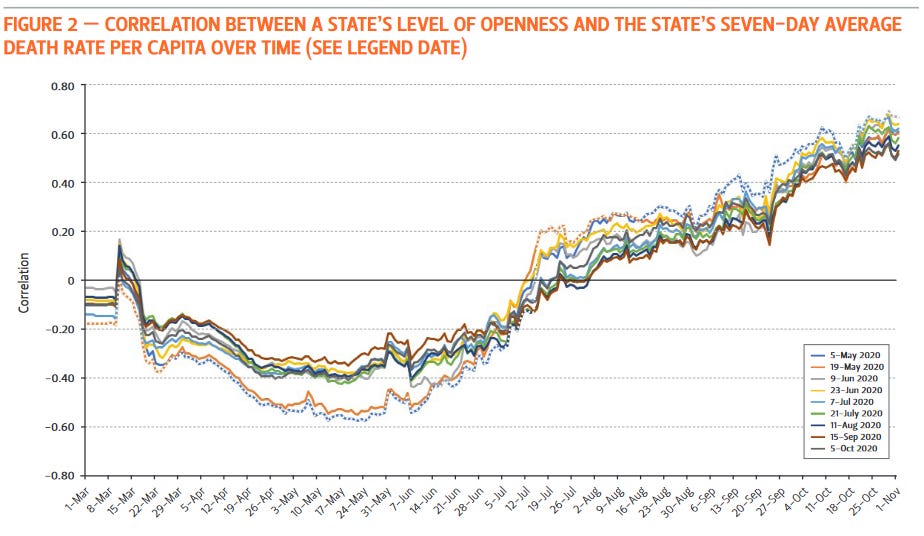
Here's a relevant portion.


Quote:

This is an absolutely beautiful graph. It's showing how lockdown strictness (as of May 5) correlates with death rate over time. We find that early in the epidemic, the stricter your lockdown, the worse you're doing. This is the endogeneity - places (like NYC) that are doing really badly institute strict lockdowns to try to save themselves. Later in the epidemic, the stricter your lockdown, the better you're doing - probably because the strict lockdown is giving good results.

This is a victory for lockdowns insofar as the correlation is significant, but strong proponents might be surprised by how small the effect was. A few small isolated northern states like Vermont did very well. But most states - from California and New York to Florida and Texas - clustered in a band between 80,000 and 120,000 cases per million. States at the 75th percentile of lockdown strictness had about 17.5% fewer cases per million than states at the 25th percentile.

Why didn't lockdowns help more? Part of the answer must be that even weak-lockdown states had lots of voluntary behavior change, and even strong-lockdown states had lots of people ignore the lockdowns. But I think the main answer is that in every state, people panicked and tightened up when cases got bad, then relaxed and got careless once cases dropped again, making it hard for lockdowns to have too much effect - once a lockdown "succeeded", it just made people go back to being careless.


If you'll actually spend a moment, you might find the article provides support to your current beliefs. Or it may challenge them. Who knows?
GAC06
How long do you want to ignore this user?
Jabin said:

I did. Zobel said nothing about people getting infected at the grocery store.

He merely mentioned grocery stores.

The article discusses all kinds of lock downs, including targeted lockdowns and ones initiated spontaneously by people on their own. You're acting like the article is simply a defense of what was done, when it is exactly the opposite. The article is trying to determine what worked and what didn't work, and admits that there is a very large margin of error.

As a pilot, I'd think that you'd be interested in looking at hard data. It's surprising that you're so resistant to it. You seem to have your mind made up and "let the facts be damned."


Bless your heart. Not worth responding other than that
HowdyTexasAggies
How long do you want to ignore this user?
Zobel said:

In fairness nothing you wrote gave any indication that you read the summary either.

This isn't an argument for or against lockdowns. It's trying to answer the question - "do lockdowns work?" With a side of "are they worth the economic and human cost?"

It's not a simple question, and the author does a pretty good job of ferreting it the difficulties both in framing the question in an answerable way, and evaluating the available published evidence.

The answer to the first question seems to be "somewhat yes" and the second is "probably not worth it."


" The answer to the first question seems to be "somewhat yes" and the second is "probably not worth it."

History already told us this, yet "let the facts be damned".
Refresh
Page 1 of 1
 
×
subscribe Verify your student status
See Subscription Benefits
Trial only available to users who have never subscribed or participated in a previous trial.