Complete Idiot said:
The home ownership graph below is contrary to my perception of the past, specifically before 1960 or so. I thought that back in those times even, say, a cook in a local diner could afford to buy a house. And now of course it would be difficult in a major city for someone running the kitchen shift at Chili's to buy a home. However, that graph says my perception would be incorrect. I also thought that prior to 1950 or so more Americans lived in small towns, what we would say is rural now, and there has been a been migration to urban areas. I would assume that would hurt affordability for average households, but again the graph doesn't support my perception.
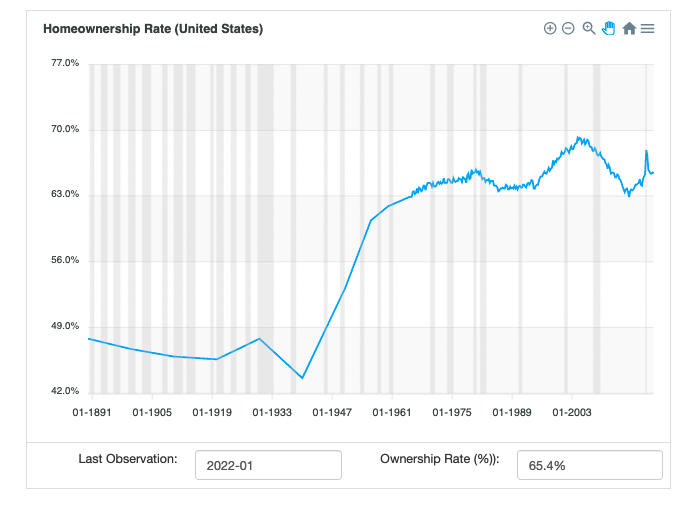

Interesting data. Thanks for posting.
As an anecdotal data point, my grandparents (who were in the generation that preceded the "Greatest Generation"), almost always lived in rented, furnished homes. One set never bought their own home, even though they could easily have afforded it, and the other purchased only when the permanently retired and moved back to Texas.
Home ownership as the norm for most people is a relatively recent phenomenon known mainly in the US. In Europe, most people rent other than own.
Also, a Dallas realtor told me a few years back that prior to WW II, home values tended to decline over time just as with cars today. People wanted a new home, not a used home.
Apparently, what changed everything after World War 2 was the adoption of the GI Bill that subsidized mortgages for veterans (millions of men) and the creation of the 30-year mortgage with low down payments.

