I wrote some of this a week ago and posted it in Premium. After the news broke this week, I decided to finish it and post here. If I missed anything I needed to update, keep in mind that timing.
Setup
I decided to look back at how Kingsbury used the short passing game since Spavital does not utilize it very often. To determine this, I decided it would be a good comparison to chart the pass plays from the 2012 and 2015 Bama games. Specifically, I logged 2 stats:
1) How long did it take to throw the ball after the ball was snapped (seconds)?
2) How many yards downfield was the WR when the ball arrived?
I stopped after 3 quarters of the 2012 game because a pattern had been established. For 2015, I stopped after 14 plays because a conclusion could be reached.
Notable Stats
Let's look at a few examples of how Kliff used the short passing game both early in the game to gain some easy yards and later in the game as a decoy.
Short Passing Game
In 2012, we threw this stop to Swope 4 times in the 1st 3 drives Snap to pass was between 1.3-1.6 seconds. Pretty much anytime Bama had 6 in the box, we threw a pass like this. Swope turned and dove for as many yards as he could get and rushed back to line up. He made attempt to juke a defender. Tempo seemed the priority over maximum yards.


A natural assumption is that Bama has learned from that and would never allow it this season. That assumption is wrong. This is the 1st play from scrimmage. They are giving the 3 yard stop to Kirk. Instead, we roll-out Allen and throw a 18 yard out that is nearly intercepted. The roll-out is important so make note of it for future plays.


Timing Issues - Part 1
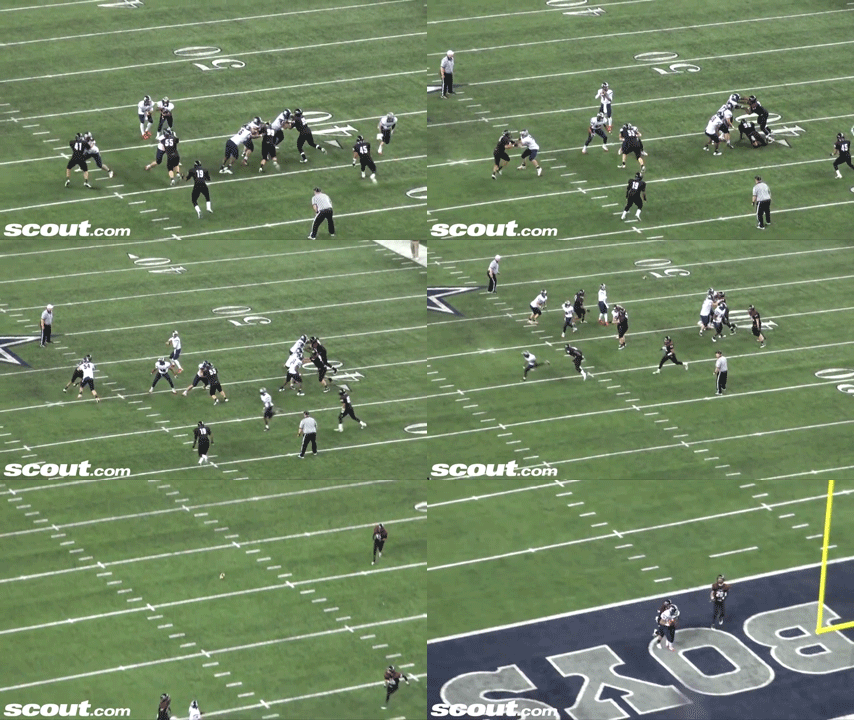
On the following play, we need a 1st down on a 3rd and 3. Bama has walked a LB out to stop the quick throw to Kirk so that's not an option. The play here is a good idea but has one flaw. The route is good and Kirk is open. Whether due to QB play or play design, the timing is off. When Kirk turns around, Kyle is still holding the ball. He should be releasing the ball so it arrives before the safety can break up the pass.
I tend to believe the timing issue is due to play design because Allen throws the ball just after his drop. I have another reason to believe it's play design and I'll get to that in a minute. Regardless, the safety got there in time and broke up the pass.


The Offensive Line
After watching film closely, I have to question Christensen's coaching. I saved this screenshot from above for this point. Note that Bama is running a stunt with their DT and LB. The DT pushes outside to try and get the guard to follow and the LB cuts inside. This is a very common stunt. I played left guard in High School in a Run & Shoot offense and it's not hard to recognize with some practice.
On this play, while he does recover enough to make contact, Stuckey gave chase too long and is off-balance so the LB blows through pretty fast. The problem here is primarily his feet. They should not be that close even if he is playing left tackle and chasing a DE outside. You can see the result of this mistake in the 2nd and 3rd screenshots above. Love him or hate him, I bet Jim Turner would have had this fixed by game 3 (if not in fall camp). He used to get upset about feet being an inch too close, much less the more than 6+ inches shown here.

Timing Issues - Part 2
(confession: I am stealing some of this from Toaggie08 who clarified a previous post I made about this play)
Both of these plays are both based on a common Spread route combination using a curl/rail or in/rail. Live, I thought this play looked very similar to the JFF to Swope pass vs. Bama in 2012. I figured Spav wised up and copied Kingsbury's playbook. As Corso would say, "Not so fast my friend."
The Game Plan - 2012:
The Game Plan - 2015:
The Play Design - 2012:
Kliff used Evans on the curl route. Being Johnny's favorite target, he's a good decoy to distract the defense from the rail. Swope runs a short stop and then heads to the flats before running what essentially becomes a wheel route. By running across the safeties line of site, Kliff "froze the safety". He has deep responsibility but at first, it appears to be a short route (redundancy). This "pause" in Swope heading deep is also important as it helps time the route with Johnny's sprint out. Without the delay, Swope would have been much further downfield and it would have been a more difficult throw and allowed the backside safety to arrive in time to break up the pass.
The Play Design - 2015:
Kirk only jogs slightly to the right before heading downfield. Spav has used the basic routes but has also used a sprint out. Reynolds runs the curl. Note that he runs it more like a stop whereas Evans turned in. Reynolds does not cross the face of the safety either. A pause and post would have been genius here and could have ended up as a TD.
While Reynolds could be a good decoy if we threw to him enough, he's not enough to distract from Kirk, the first WR the safety will certainly watch if he heads deep. If you watch closely, the safety turns his attention from Kyler to Kirk as soon as Kirk passes Reynolds. Without a "pause" in the rail route, Kirk is 17 yards downfield when Kyler finishes the sprint out as opposed to the 10 yards Swope was downfield when Johnny finished the sprint out.
Finally, Kirk's route is also an "option" route. He was supposed to read the safety deep and run the "in" or read the safety biting on the curl and run the "rail". The QB then reads the WR and throws to him. Kirk slows down but does not run the "in" or commit to the "rail". As best the QB can tell, Kirk is headed deep. The QB should still check the safety and adjust the pass, but I want to focus on the play design not execution.
These option routes are common in the Spread and requires a lot of reps for the QB and WR to be on the same page. Leach would sometimes have the QBs and WRs work on one option route for an entire practice. He would throw different coverages at them to make sure they could execute it "in their sleep". With the complexity of our offense, there is no way our QB and WR got anywhere close to those reps in. Considering we used our backup QB, it's just a poor play call all around.
Both plays use a backside drag route but it ends up not being a factor in the outcome.
The Result - 2012:
The safety is 13 yards deep at the snap and runs horizontally towards Swope. When the ball is thrown, the safety is 11 yards deep and Swope ends up wide open behind the safety. The pass hits Swope 30 yards downfield and the backside safety makes the tackle.

The Result - 2015:
The safety is 14-15 yards deep when the ball is snapped and backpedals immediately at the snap. He is 26 yards deep when the ball is thrown. The safety is in position behind Kirk and closing on the ball. Because his body is open towards Kirk (great technique), the safety can break on even a hard thrown ball and might arrive at the same time or shortly thereafter. If there is no sprint out, the ball could have been thrown sooner and on a line and been completed. With the sprint out, it is a much longer throw than the one Johnny made in 2012. The result of the multifaceted failure is an INT.

Flooding the Zone vs. The Spread
In the play below, Spav rolls the pocket and is "flooding the zone" (as this concept is commonly called) with 2 intermediate routes and a short route. The backside WR runs a drag into the middle of the field. Bama only has to defend a space that is 20 yards wide and 10 yards deep. The D knows we are not going to throw to the backside WR as he is in the "no fly zone" (between the hashes).
This is a play Sherman would have run with Tanny but rolled him out to his right (naturally). Note that I am saying Sherman would run it. It's a NFL level play and requires that accuracy. Kyle may have it one day but does not now. Tanny did and it worked. The QB can throw either level (Caden Smith and RSJ) but as we found our, any bad miss is an INT. This was pick-6 #1. There's no reason to run this in college. They were giving us much easier throws.
So forget Sutherland getting blown up. (Note that there is a perfectly good pocket if we are not rolling Allen out.) The pick-6 is not on Sutherland, nor is it primarily on Allen. The pick-6 is the result of Spavital not knowing his personnel. He got too cute and the result was ugly.


Conclusion
The tendency when watching these plays live is to focus on failed player execution. And yes, on their INTs, Allen made a bad throw and Kyler made a bad throw, whereas Johnny made a perfect throw on his completed pass to Swope. However, Kliff used the game plan, play design, and personnel to setup Johnny for success. Not only did Spavital fail to setup Allen and Murray for success, he actually set them up for failure. Kliff is an offensive genius and had a masterful game plan. That will be hard to replicate but we can do much better than what we have seen in 2015.
Setup
I decided to look back at how Kingsbury used the short passing game since Spavital does not utilize it very often. To determine this, I decided it would be a good comparison to chart the pass plays from the 2012 and 2015 Bama games. Specifically, I logged 2 stats:
1) How long did it take to throw the ball after the ball was snapped (seconds)?
2) How many yards downfield was the WR when the ball arrived?
I stopped after 3 quarters of the 2012 game because a pattern had been established. For 2015, I stopped after 14 plays because a conclusion could be reached.
Notable Stats
- 1.8 vs. 2.6 - average time (seconds) from snap to pass in 2012 vs. 2015 (excluding 5 plays on which Johnny ran around
- 36 vs. 13 - the number of plays it took for us to throw 5 passes over 5 yards in 2012 vs 2015
Let's look at a few examples of how Kliff used the short passing game both early in the game to gain some easy yards and later in the game as a decoy.
Short Passing Game
In 2012, we threw this stop to Swope 4 times in the 1st 3 drives Snap to pass was between 1.3-1.6 seconds. Pretty much anytime Bama had 6 in the box, we threw a pass like this. Swope turned and dove for as many yards as he could get and rushed back to line up. He made attempt to juke a defender. Tempo seemed the priority over maximum yards.
A natural assumption is that Bama has learned from that and would never allow it this season. That assumption is wrong. This is the 1st play from scrimmage. They are giving the 3 yard stop to Kirk. Instead, we roll-out Allen and throw a 18 yard out that is nearly intercepted. The roll-out is important so make note of it for future plays.
Timing Issues - Part 1
On the following play, we need a 1st down on a 3rd and 3. Bama has walked a LB out to stop the quick throw to Kirk so that's not an option. The play here is a good idea but has one flaw. The route is good and Kirk is open. Whether due to QB play or play design, the timing is off. When Kirk turns around, Kyle is still holding the ball. He should be releasing the ball so it arrives before the safety can break up the pass.
I tend to believe the timing issue is due to play design because Allen throws the ball just after his drop. I have another reason to believe it's play design and I'll get to that in a minute. Regardless, the safety got there in time and broke up the pass.
The Offensive Line
After watching film closely, I have to question Christensen's coaching. I saved this screenshot from above for this point. Note that Bama is running a stunt with their DT and LB. The DT pushes outside to try and get the guard to follow and the LB cuts inside. This is a very common stunt. I played left guard in High School in a Run & Shoot offense and it's not hard to recognize with some practice.
On this play, while he does recover enough to make contact, Stuckey gave chase too long and is off-balance so the LB blows through pretty fast. The problem here is primarily his feet. They should not be that close even if he is playing left tackle and chasing a DE outside. You can see the result of this mistake in the 2nd and 3rd screenshots above. Love him or hate him, I bet Jim Turner would have had this fixed by game 3 (if not in fall camp). He used to get upset about feet being an inch too close, much less the more than 6+ inches shown here.
Timing Issues - Part 2
(confession: I am stealing some of this from Toaggie08 who clarified a previous post I made about this play)
Both of these plays are both based on a common Spread route combination using a curl/rail or in/rail. Live, I thought this play looked very similar to the JFF to Swope pass vs. Bama in 2012. I figured Spav wised up and copied Kingsbury's playbook. As Corso would say, "Not so fast my friend."
The Game Plan - 2012:
- Manziel had burned them running the ball so the safeties were shallow to stop the run.
- Kliff had also used the short passing game quite a bit so this ensured they would be shallow (before the snap). (I noticed Kliff would often build in redundancy like this when he wanted the defense to react a certain way.)
- The secondary was also playing man-to-man, which gave Swope an opportunity to get behind them.
The Game Plan - 2015:
- Kyler had not run the ball one time.
- Spav had not used the short passing game very much (almost not at all) so the safeties were deep.
- The defense is in a zone scheme and since the safety is deep. Kirk is almost certainly going to run the "in" instead of the "rail". (More on that below.)
The Play Design - 2012:
Kliff used Evans on the curl route. Being Johnny's favorite target, he's a good decoy to distract the defense from the rail. Swope runs a short stop and then heads to the flats before running what essentially becomes a wheel route. By running across the safeties line of site, Kliff "froze the safety". He has deep responsibility but at first, it appears to be a short route (redundancy). This "pause" in Swope heading deep is also important as it helps time the route with Johnny's sprint out. Without the delay, Swope would have been much further downfield and it would have been a more difficult throw and allowed the backside safety to arrive in time to break up the pass.
The Play Design - 2015:
Kirk only jogs slightly to the right before heading downfield. Spav has used the basic routes but has also used a sprint out. Reynolds runs the curl. Note that he runs it more like a stop whereas Evans turned in. Reynolds does not cross the face of the safety either. A pause and post would have been genius here and could have ended up as a TD.
While Reynolds could be a good decoy if we threw to him enough, he's not enough to distract from Kirk, the first WR the safety will certainly watch if he heads deep. If you watch closely, the safety turns his attention from Kyler to Kirk as soon as Kirk passes Reynolds. Without a "pause" in the rail route, Kirk is 17 yards downfield when Kyler finishes the sprint out as opposed to the 10 yards Swope was downfield when Johnny finished the sprint out.
Finally, Kirk's route is also an "option" route. He was supposed to read the safety deep and run the "in" or read the safety biting on the curl and run the "rail". The QB then reads the WR and throws to him. Kirk slows down but does not run the "in" or commit to the "rail". As best the QB can tell, Kirk is headed deep. The QB should still check the safety and adjust the pass, but I want to focus on the play design not execution.
These option routes are common in the Spread and requires a lot of reps for the QB and WR to be on the same page. Leach would sometimes have the QBs and WRs work on one option route for an entire practice. He would throw different coverages at them to make sure they could execute it "in their sleep". With the complexity of our offense, there is no way our QB and WR got anywhere close to those reps in. Considering we used our backup QB, it's just a poor play call all around.
Both plays use a backside drag route but it ends up not being a factor in the outcome.
The Result - 2012:
The safety is 13 yards deep at the snap and runs horizontally towards Swope. When the ball is thrown, the safety is 11 yards deep and Swope ends up wide open behind the safety. The pass hits Swope 30 yards downfield and the backside safety makes the tackle.
The Result - 2015:
The safety is 14-15 yards deep when the ball is snapped and backpedals immediately at the snap. He is 26 yards deep when the ball is thrown. The safety is in position behind Kirk and closing on the ball. Because his body is open towards Kirk (great technique), the safety can break on even a hard thrown ball and might arrive at the same time or shortly thereafter. If there is no sprint out, the ball could have been thrown sooner and on a line and been completed. With the sprint out, it is a much longer throw than the one Johnny made in 2012. The result of the multifaceted failure is an INT.
Flooding the Zone vs. The Spread
In the play below, Spav rolls the pocket and is "flooding the zone" (as this concept is commonly called) with 2 intermediate routes and a short route. The backside WR runs a drag into the middle of the field. Bama only has to defend a space that is 20 yards wide and 10 yards deep. The D knows we are not going to throw to the backside WR as he is in the "no fly zone" (between the hashes).
This is a play Sherman would have run with Tanny but rolled him out to his right (naturally). Note that I am saying Sherman would run it. It's a NFL level play and requires that accuracy. Kyle may have it one day but does not now. Tanny did and it worked. The QB can throw either level (Caden Smith and RSJ) but as we found our, any bad miss is an INT. This was pick-6 #1. There's no reason to run this in college. They were giving us much easier throws.
So forget Sutherland getting blown up. (Note that there is a perfectly good pocket if we are not rolling Allen out.) The pick-6 is not on Sutherland, nor is it primarily on Allen. The pick-6 is the result of Spavital not knowing his personnel. He got too cute and the result was ugly.
Conclusion
The tendency when watching these plays live is to focus on failed player execution. And yes, on their INTs, Allen made a bad throw and Kyler made a bad throw, whereas Johnny made a perfect throw on his completed pass to Swope. However, Kliff used the game plan, play design, and personnel to setup Johnny for success. Not only did Spavital fail to setup Allen and Murray for success, he actually set them up for failure. Kliff is an offensive genius and had a masterful game plan. That will be hard to replicate but we can do much better than what we have seen in 2015.