
so i have a 1953 ford golden jubilee the was converted to propane by the previous owner. The tractor ran for years but then sat in a field for about 6 years. now the motor turns over, the points are correct, and the regulator/vaporizer is brand new, and i have compression in all cylinders. the problem is it will not fire up it just spins but never fires off cylinders, any suggestions guys? Also i was told that the carburetor because it was propane it didn't need to be connected to the breather is this true?
Post Reply
1 of 1
1953 ford golden jubilee starting issue
5,277 Views |
4 Replies |
Last: 7 yr ago by CanyonAg77
When you say the points are correct, you mean you have spark at the plug or you have spark when the contacts break in the distributor? If you haven't already.... pull a plug and hold it to ground to make sure you have spark. Make sure your firing order is right while you're at it. Mixing up spark plug wires can cause a lot of misunderstood diagnosis'.
I presume what someone meant by 'didn't need to be hooked to the breather' is that the engine will run without the vacuum restriction that help a gasoline engine draw fuel from the bowl. I guess that is right... but I wouldn't be operating it while bypassing the air cleaner; I doubt that's what you intend to do.
Get a can of starting fluid and see if you can get it to hit on that. If it won't hit on starting fluid you have a spark issue; either no spark or spark out of time. If you can get it to reliably hit on starting fluid then let's see what we need to work out the fuel issue.
I presume what someone meant by 'didn't need to be hooked to the breather' is that the engine will run without the vacuum restriction that help a gasoline engine draw fuel from the bowl. I guess that is right... but I wouldn't be operating it while bypassing the air cleaner; I doubt that's what you intend to do.
Get a can of starting fluid and see if you can get it to hit on that. If it won't hit on starting fluid you have a spark issue; either no spark or spark out of time. If you can get it to reliably hit on starting fluid then let's see what we need to work out the fuel issue.

Hey I just had a thought. I'm not sure about that deal of it not being hooked to the breather. The regulator has a large diaphragm that controls the flow of LP into the carb. There has to be some tiny level of vacuum present to crack that diaphragm and let the vapor flow. That's what keeps the LP from escaping when the engine isn't running; otherwise it would just sit there and run and run like your fish fryer will - the tractor won't do that. I'd guess whoever told you that assumed it's a pressure fed system - but that's not exactly right. There is high pressure in the tank, but it has to be 'drawn' off through the regulator. If the breather is disconnected and the carb intake is completely open... I'm not sure that there will ever be any fuel released. There is usually a button, at least on most factory LP setups on the backside of the regulator you can push that will allow some vapor to escape. You can hear it quietly hiss when you push that button.... that's the equivalent to priming the carb.
If you have the spark - hook the breather up. I find most of my lp tractors start better on vapor and switch to liquid when warm it under load... I'd try to start it on vapor if your tank has both vapor and liquid valves.
If you have the spark - hook the breather up. I find most of my lp tractors start better on vapor and switch to liquid when warm it under load... I'd try to start it on vapor if your tank has both vapor and liquid valves.
I'm sure CanyonAg 77 will be along soon because I thought he's owned propane models before. Or maybe that was a truck.
We ran a crapton of butane/propane/natural gas engines back in the day.
Like Centerpole, I have no idea what "not hooked to the breather" means.
Will echo above, sounds like you have compression, next step is fire. We would pull off a sparkplug boot, stick a phillips screwdriver in it, and hold the metal part while standing in a puddle of water on the steel platform.
Wait, never mind. That's what you would try to talk your friends into doing. Me, I would hold the insulated handle, hold the metal of the shaft against a good ground, preferably bare metal on the engine, and crank the tractor. If the ignition system is working, you should get a strong spark.
Crank = hold key in "start" while starter rotates the engine.
If you don't have fire, then check the points, rotor, timing, coil, fuses, etc. Maybe replace the starting ballast if it has one.
If you're down to fuel, start on vapor, as Cenerpole says. Sometimes the vaporizer has a "prime" button, that lets you send a shot of propane into the intake. Try that, and see if it starts.
What about the diaphragm? It is the one moving part of the propane carb. It should look something like this
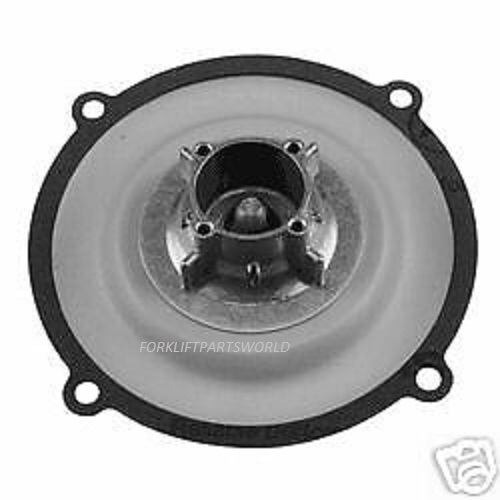
This is the bottom of it. There will be a seat in the carb, right below this needle, and a spring. The diaphragm should be flexible and without holes. Airflow through the carb lifts the diaphragm needle off the seat, allowing propane to flow through the needle/seat.
As long as this tractor has been sitting up, I'd consider disassembling the diaphragm, and cleaning the needle/seat area with WD-40. It may simply be stuck, and not allowing the needle to rise off the seat.
With our natural gas carbs, we would carefully pry against the diaphragm to break it loose and let a little propane flow through. Make sure you're against the metal protector, not the rubber diaphragm
Like Centerpole, I have no idea what "not hooked to the breather" means.
Will echo above, sounds like you have compression, next step is fire. We would pull off a sparkplug boot, stick a phillips screwdriver in it, and
Wait, never mind. That's what you would try to talk your friends into doing. Me, I would hold the insulated handle, hold the metal of the shaft against a good ground, preferably bare metal on the engine, and crank the tractor. If the ignition system is working, you should get a strong spark.
Crank = hold key in "start" while starter rotates the engine.
If you don't have fire, then check the points, rotor, timing, coil, fuses, etc. Maybe replace the starting ballast if it has one.
If you're down to fuel, start on vapor, as Cenerpole says. Sometimes the vaporizer has a "prime" button, that lets you send a shot of propane into the intake. Try that, and see if it starts.
What about the diaphragm? It is the one moving part of the propane carb. It should look something like this
This is the bottom of it. There will be a seat in the carb, right below this needle, and a spring. The diaphragm should be flexible and without holes. Airflow through the carb lifts the diaphragm needle off the seat, allowing propane to flow through the needle/seat.
As long as this tractor has been sitting up, I'd consider disassembling the diaphragm, and cleaning the needle/seat area with WD-40. It may simply be stuck, and not allowing the needle to rise off the seat.
With our natural gas carbs, we would carefully pry against the diaphragm to break it loose and let a little propane flow through. Make sure you're against the metal protector, not the rubber diaphragm
Featured Stories
See All
Rashaun Agee named Southeastern Conference Co-Player of the Week
by Richard Zane
5:16
18h ago
4.3k
Father's memory motivates Gold Glove infielder Tallen Edwards
by Emily Dreger
6:09
14h ago
1.1k
13:26
7h ago
1.4k
Upset-minded Aggies fall short vs. No. 3 Gamecocks
by Justin Paez
96AgGrad
Breaking: Florida State OC Gus Malzahn announced his retirement Monday morning.
in Billy Liucci's TexAgs Premium
8