

Ackshually... that's not a great argument because the big bullet that pencils through is taking a lot of that energy out the other side and not transferring it to the animal
Worth the watch. Long range hunting related.
4,957 Views |
56 Replies |
Last: 1 yr ago by agsalaska
WRONG. i saw Keith Warren kill a doe with a 50 cal that didn't even hit the deer. the concussive wave killed it.schmellba99 said:
Hydrostatic shock is also an overrated metric.
I've seen deer get knocked on their ass at 115 yards with a .30-06 that got up and ran off to not be recovered. Because even though that projo had a crap ton of energy and hit the buck with a lot of hydostatic shock, the round unfortunately didn't hit vitals. The shock wore off pretty quick and boom - running deer.
Bottom line, no matter what you are shooting - bow, atlatl, .223, .416 Rigby - doesn't matter if you don't hit vitals. Lungs, heart ,brachial nerve, brain - those put deer down. All of the other stuff is pomp and fluff and things that everybody wants to talk about to sound knowledgeable and technical.
Every round has limitations, and usually those limitations far exceed the shooter. And because you have certain limitations doesn't mean that everybody has the same ones. There are a few posters here that I am quite certain could probably drop a white tail with a friggin .22 LR at some obscene range because they have the capabilities.
I'll also comment on the video, without watching it… ooops! but I'm sure it's like all the rest, milk jug whatever, 700 yard 22LR, blah blah. It's people who overestimate their abilities and don't really practice with their gear.
1 MOA in field conditions is a tall order. But the typical NRL Hunter match target is 2 MOA. So you get a white-tailed vital size target out to 500 yards. Those matches are done on the clock by very skilled shooters, with dialed in guns, and the winners drop single digit points.
I shot about 75% of the possible points in the finale last weekend with a 6 CM that's just over 9lbs without the bipod, so not a gamer gun. And I'm not really a good shooter either, I just practice and know my equipment.
Nobody's going to put good marksmen in these challenges because it wouldn't be entertaining, and the good shooters show they're good and capable every week at comps.
1 MOA in field conditions is a tall order. But the typical NRL Hunter match target is 2 MOA. So you get a white-tailed vital size target out to 500 yards. Those matches are done on the clock by very skilled shooters, with dialed in guns, and the winners drop single digit points.
I shot about 75% of the possible points in the finale last weekend with a 6 CM that's just over 9lbs without the bipod, so not a gamer gun. And I'm not really a good shooter either, I just practice and know my equipment.
Nobody's going to put good marksmen in these challenges because it wouldn't be entertaining, and the good shooters show they're good and capable every week at comps.
In other words, hydrostatic shock is only a metric if vitals are hit, and even if vitals are hit hydrostatic shock does not always have an effect on deer. Sometimes but not always.schmellba99 said:
Hydrostatic shock is also an overrated metric.
I've seen deer get knocked on their ass at 115 yards with a .30-06 that got up and ran off to not be recovered. Because even though that projo had a crap ton of energy and hit the buck with a lot of hydostatic shock, the round unfortunately didn't hit vitals. The shock wore off pretty quick and boom - running deer.
Bottom line, no matter what you are shooting - bow, atlatl, .223, .416 Rigby - doesn't matter if you don't hit vitals. Lungs, heart ,brachial nerve, brain - those put deer down. All of the other stuff is pomp and fluff and things that everybody wants to talk about to sound knowledgeable and technical.
Every round has limitations, and usually those limitations far exceed the shooter. And because you have certain limitations doesn't mean that everybody has the same ones. There are a few posters here that I am quite certain could probably drop a white tail with a friggin .22 LR at some obscene range because they have the capabilities.
Just last year I saw three deer get shot with the same .243 bullet from 60-190 yards. All three shots destroyed vitals. One deer ran 30 yards and fell, one about 20 and fell, and one was DRT. The year before, with the same type bullet, both deer fell DRT No rhyme or reason to why those two last year lived five more seconds than the other four. It just happens.
So, to pull this back to the OP, at 500 yards its about hitting vitals, not hydrostatic shock. And requiring 1moa a 500 to justify the shot at 500 yards is just stupid.
Nope. It really wasn;t like all the rest. It seemed to be a PETA show about ethical killing of deer.
Next time watch something before commenting.
Next time watch something before commenting.
i'd suggest watching the video. these seem like decent marksman for the most part. several say shoot PRS matches. maybe they were trash. again, I don't believe Cortina was trying to make everyone look stupid.
Yall are making this way harder than it has to be. Tissue destruction is what matters. Once you get to "enough" you are not served by going to a larger (powder charge/bullet weight/bullet diameter) cartridge than needed.
Energy doesn't tell you what a bullet will do in tissue, properly done gel tests and velocity do.
This thread drift all started because some posters mentioned/asked if a given bullet at a given range was ethical, or if match bullets are appropriate for hunting. Hornady will tell you an ELDM isn't meant for hunting, but if you look at their LE ammo page, they seem to think it's fine for people.
Energy doesn't tell you what a bullet will do in tissue, properly done gel tests and velocity do.
This thread drift all started because some posters mentioned/asked if a given bullet at a given range was ethical, or if match bullets are appropriate for hunting. Hornady will tell you an ELDM isn't meant for hunting, but if you look at their LE ammo page, they seem to think it's fine for people.
To your last paragraph, that was me that asked that and you are the first one, I think, that has addressed it.NRH ag 10 said:
Yall are making this way harder than it has to be. Tissue destruction is what matters. Once you get to "enough" you are not served by going to a larger (powder charge/bullet weight/bullet diameter) cartridge than needed.
Energy doesn't tell you what a bullet will do in tissue, properly done gel tests and velocity do.
This thread drift all started because some posters mentioned/asked if a given bullet at a given range was ethical, or if match bullets are appropriate for hunting. Hornady will tell you an ELDM isn't meant for hunting, but if you look at their LE ammo page, they seem to think it's fine for people.
The point I was making is just how ****ed up the entire premise of the video was to begin with. First the 1moa at 500 is stupid. But then to ignore the fact that they were all trying to hit the shot with match bullets is even, well, stupider.
It's just a stupid video. All the way around.
Deats99 said:
Sorry but that is a just a plain PETA set up. I guess I am lazy(didn't look him up) but is this guy some sort of anti hunting idiot?
I have no idea what idea you're trying to convey with this comment.
So, what would your requirement be in terms of acceptible margin of error at 500 yards?agsalaska said:In other words, hydrostatic shock is only a metric if vitals are hit, and even if vitals are hit hydrostatic shock does not always have an effect on deer. Sometimes but not always.schmellba99 said:
Hydrostatic shock is also an overrated metric.
I've seen deer get knocked on their ass at 115 yards with a .30-06 that got up and ran off to not be recovered. Because even though that projo had a crap ton of energy and hit the buck with a lot of hydostatic shock, the round unfortunately didn't hit vitals. The shock wore off pretty quick and boom - running deer.
Bottom line, no matter what you are shooting - bow, atlatl, .223, .416 Rigby - doesn't matter if you don't hit vitals. Lungs, heart ,brachial nerve, brain - those put deer down. All of the other stuff is pomp and fluff and things that everybody wants to talk about to sound knowledgeable and technical.
Every round has limitations, and usually those limitations far exceed the shooter. And because you have certain limitations doesn't mean that everybody has the same ones. There are a few posters here that I am quite certain could probably drop a white tail with a friggin .22 LR at some obscene range because they have the capabilities.
Just last year I saw three deer get shot with the same .243 bullet from 60-190 yards. All three shots destroyed vitals. One deer ran 30 yards and fell, one about 20 and fell, and one was DRT. The year before, with the same type bullet, both deer fell DRT No rhyme or reason to why those two last year lived five more seconds than the other four. It just happens.
So, to pull this back to the OP, at 500 yards its about hitting vitals, not hydrostatic shock. And requiring 1moa a 500 to justify the shot at 500 yards is just stupid.
People and animals are way, way different though. I mean, nobody is going to say that FMJ is meant for hunting, but they are used on people by every army in the world with regularity. Now, some of that is because of adherance to rules of combat, some of that is reliability and cost, but a huge part of it is also because people know what has happened when they get shot whereas animals simply do not.NRH ag 10 said:
Yall are making this way harder than it has to be. Tissue destruction is what matters. Once you get to "enough" you are not served by going to a larger (powder charge/bullet weight/bullet diameter) cartridge than needed.
Energy doesn't tell you what a bullet will do in tissue, properly done gel tests and velocity do.
This thread drift all started because some posters mentioned/asked if a given bullet at a given range was ethical, or if match bullets are appropriate for hunting. Hornady will tell you an ELDM isn't meant for hunting, but if you look at their LE ammo page, they seem to think it's fine for people.
End of the day…. Regardless of cartridge or bullet used…..it's really all about shot placement.
@agsalaska: agreed about 1 MOA as the benchmark used. Vital sized targets make much more sense. What's stupid about using match bullets given there are many options that destroy more tissue than commonly used hunting bullets?
@schmellba99: I disagree with your premise. The most reliable way to make anything die is to destroy vitals. There are plenty of examples of people that give up upon being shot in a survivable manner, or people that fight on despite mortal wounds. Animals can do the same. There's a reason that many military units that have a choice do not use FMJ rounds. As said above, there are quite a few "match" bullets that destroy much more tissue per given diameter/weight/velocity than "hunting" rounds, and there are hundreds of documented examples, some of which Meggy09 linked in this thread.
@schmellba99: I disagree with your premise. The most reliable way to make anything die is to destroy vitals. There are plenty of examples of people that give up upon being shot in a survivable manner, or people that fight on despite mortal wounds. Animals can do the same. There's a reason that many military units that have a choice do not use FMJ rounds. As said above, there are quite a few "match" bullets that destroy much more tissue per given diameter/weight/velocity than "hunting" rounds, and there are hundreds of documented examples, some of which Meggy09 linked in this thread.
meggy09 said:
Regardless of weight and speed…. To a point. The speed has to be above the minimum required for expansion. And the weight has to be something reasonable, but I'd say down to .224 caliber for sure.
I think any intelligent person who's being honest can agree that a 90 grain ELDX (.243) is a better hunting bullet than a 220 grain FMJ (.308) right? At 2200 FPS the 220 has 2365 ft/lb of energy!!!!!! Ommmmggg!! While the eldx only has 967ft/lb. One is going to pencil through, it may knock the animal down for 1-5 seconds from the CNS shock, but if no bones are hit, it's running off some distance before potentially dying. The other is going to create a WOUND CHANNEL (the words you're looking for in place of energy) that will be immediately or quickly lethal, **so long as the bullet performs as intended (don't want this to turn into an anecdotal argument about certain bullets).
I would 100% never thing about taking the cartridge with 1.5x the energy in the above scenario.
So we're on the same page now right? Because you're a smart guy? Bullet construction and impact velocity are the only things that really matter when looking at lethality of bullets.
Going to argue a few random things. First, no doubt that speaking in energy can be misleading. Bullet construction needs to be paired with the correct velocity and the correct target. Id hope nobody is hunting with a bullet (308 FMJ) that doesn't have the speed or characteristics to expand.
If we speak of wound channels, I can tell you from experience, that a 90 grn bullet at 4000 fps will do 2x the damage of a 45 grn bullet at 4000FPS. As long as the bullet transfers its energy, more weight at the same speed can create both a larger, deeper, and more lethal wound channel.
In addition, caliber can and will create a larger and more lethal wound channel. A 450 bushmaster and 6.5CM both have around the same energy at 100 yards. Yet the bushmaster will consistently produce a larger and more lethal wound channel. The frontal section of the larger caliber bullet simply transfers its energy more efficiently into the animal.
Which leads to another critical part of animal recovery. Blood trails. If your bullet doesnt have the energy (and yes correct shot placement too) you really need to be planning on large holes on both sides of the animal. Blood trails are created by either larger caliber bullets or higher energy blowing a hole through the skin on exit. A lot of people get away without worrying about this if they hunt mostly open country, but it can be the difference in a lost animal in thick woods.
Anecdotal story warning!!! Deer pictured below was shot by my old neighbor with a 223 and 64 grn Win soft points. He calls me all kinds of distraught. The deer he had been after came out chasing a doe, He says he made a perfect shot, deer hauled ass into a cedar thicket, they been looking for a couple hours with no luck. He's calling because they've pretty much given up but he insists he made a good shot. I love a good tracking challenge so drive out to give it a try. Zero blood at the spot of the shot, zero blood the direction it ran, Able to follow its tracks for a bit with zero blood. Im thinking he missed but he says he knows he didnt. The line that separates our property is an old fence smack through the middle of the thick stuff. Thinking he might have stopped at the fence, I root my way along the fence line and there the buck lays, tangled in the old barbwire. Barely perceivable perfect broadside shot, not a drop of blood to be found. Deer was almost lost. Not a doubt in my mind that a 308, 270, or 30-06 with a 150 grn Win soft point would have either put him down inside 30 yards. Or left a blood trail. Or both. They all have similar bullet construction and impact velocities but three of them have significantly more energy.

schmellba99 said:So, what would your requirement be in terms of acceptible margin of error at 500 yards?agsalaska said:In other words, hydrostatic shock is only a metric if vitals are hit, and even if vitals are hit hydrostatic shock does not always have an effect on deer. Sometimes but not always.schmellba99 said:
Hydrostatic shock is also an overrated metric.
I've seen deer get knocked on their ass at 115 yards with a .30-06 that got up and ran off to not be recovered. Because even though that projo had a crap ton of energy and hit the buck with a lot of hydostatic shock, the round unfortunately didn't hit vitals. The shock wore off pretty quick and boom - running deer.
Bottom line, no matter what you are shooting - bow, atlatl, .223, .416 Rigby - doesn't matter if you don't hit vitals. Lungs, heart ,brachial nerve, brain - those put deer down. All of the other stuff is pomp and fluff and things that everybody wants to talk about to sound knowledgeable and technical.
Every round has limitations, and usually those limitations far exceed the shooter. And because you have certain limitations doesn't mean that everybody has the same ones. There are a few posters here that I am quite certain could probably drop a white tail with a friggin .22 LR at some obscene range because they have the capabilities.
Just last year I saw three deer get shot with the same .243 bullet from 60-190 yards. All three shots destroyed vitals. One deer ran 30 yards and fell, one about 20 and fell, and one was DRT. The year before, with the same type bullet, both deer fell DRT No rhyme or reason to why those two last year lived five more seconds than the other four. It just happens.
So, to pull this back to the OP, at 500 yards its about hitting vitals, not hydrostatic shock. And requiring 1moa a 500 to justify the shot at 500 yards is just stupid.
Maybe 2-3. I mean we(collectively) shoot deer all the time with open sight rifles, revolvers, buck shot, etc that are nowhere near 1moa at 100 yards.
I'd say at 500 if you can keep two three shot groups in the vitals go for it.
Bullet selection is much more important
CS78 said:
In addition, caliber can and will create a larger and more lethal wound channel. A 450 bushmaster and 6.5CM both have around the same energy at 100 yards. Yet the bushmaster will consistently produce a larger and more lethal wound channel. The frontal section of the larger caliber bullet simply transfers its energy more efficiently into the animal.
With what bullets?
I highly doubt you're getting better performance than this out of a cartridge using bullets that only destroy tissue via expansion and permanent crush cavity.
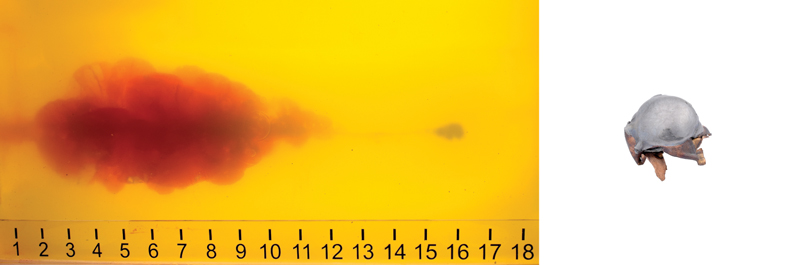
Hornady 147gr ELDM out of a 6.5 Creedmoor.
You can disagree all you want, but that doesn't change the fact that one of the major differences between humans and game/animals is our ability to comprehend and understand things. Thing like the severity of an injury.NRH ag 10 said:
@agsalaska: agreed about 1 MOA as the benchmark used. Vital sized targets make much more sense. What's stupid about using match bullets given there are many options that destroy more tissue than commonly used hunting bullets?
@schmellba99: I disagree with your premise. The most reliable way to make anything die is to destroy vitals. There are plenty of examples of people that give up upon being shot in a survivable manner, or people that fight on despite mortal wounds. Animals can do the same. There's a reason that many military units that have a choice do not use FMJ rounds. As said above, there are quite a few "match" bullets that destroy much more tissue per given diameter/weight/velocity than "hunting" rounds, and there are hundreds of documented examples, some of which Meggy09 linked in this thread.
Most deer that don't hit the ground when shot will run, but after a usually short distance they stop. Because they simply don't know what happened. They don't know that an arrow or bullet just punched through their lungs or heart - all they know is something happened. Then they generally bleed out and that's the end of it.
A human, outside of an infant or toddler, knows exactly what happened and the psychological component of things kick in. Shock kicks in, the fight or flight instinct kicks in. Adrenaline does a lot of very unique things, which is why some people can stay in the fight after a mortal wound longer than you would think, and why some people freeze up in shock with a minor wound. All of it comes back to the simple point that we, as humans, have the cognitive ability to assess and comprehend a situation and it is that assessment and comprehension that separates us from a white tail deer in terms of knowing what has happened versus just knowing something happened.
What militaries use non FMJ projectiles as their standard? I've also never made the argument that match do more or less damage than hunting rounds, so that goalpost needs to stay way over there where you found it.
I was preempting the common refrain that manufacturers state "match" bullets aren't recommended for hunting by mentioning that the same manufacturer seems to think they're totally ok for shooting criminals.
2-3 what? Inches? MOA? Mils?agsalaska said:schmellba99 said:So, what would your requirement be in terms of acceptible margin of error at 500 yards?agsalaska said:In other words, hydrostatic shock is only a metric if vitals are hit, and even if vitals are hit hydrostatic shock does not always have an effect on deer. Sometimes but not always.schmellba99 said:
Hydrostatic shock is also an overrated metric.
I've seen deer get knocked on their ass at 115 yards with a .30-06 that got up and ran off to not be recovered. Because even though that projo had a crap ton of energy and hit the buck with a lot of hydostatic shock, the round unfortunately didn't hit vitals. The shock wore off pretty quick and boom - running deer.
Bottom line, no matter what you are shooting - bow, atlatl, .223, .416 Rigby - doesn't matter if you don't hit vitals. Lungs, heart ,brachial nerve, brain - those put deer down. All of the other stuff is pomp and fluff and things that everybody wants to talk about to sound knowledgeable and technical.
Every round has limitations, and usually those limitations far exceed the shooter. And because you have certain limitations doesn't mean that everybody has the same ones. There are a few posters here that I am quite certain could probably drop a white tail with a friggin .22 LR at some obscene range because they have the capabilities.
Just last year I saw three deer get shot with the same .243 bullet from 60-190 yards. All three shots destroyed vitals. One deer ran 30 yards and fell, one about 20 and fell, and one was DRT. The year before, with the same type bullet, both deer fell DRT No rhyme or reason to why those two last year lived five more seconds than the other four. It just happens.
So, to pull this back to the OP, at 500 yards its about hitting vitals, not hydrostatic shock. And requiring 1moa a 500 to justify the shot at 500 yards is just stupid.
Maybe 2-3. I mean we(collectively) shoot deer all the time with open sight rifles, revolvers, buck shot, etc that are nowhere near 1moa at 100 yards.
I'd say at 500 if you can keep two three shot groups in the vitals go for it.
Bullet selection is much more important
The argument or useag of 1 MOA at 500 for a cold bore shot is actually pretty solid for a generic tolerance, especially for what the guy in the OP's video was trying to convey that is evidently way over the heads of a lot of people.
Why? Well, because 1 MOA at 500 is a smidge over 5". The vitals on a normal run of the mill white tail are approximately 10"-11" in diameter (the old paper plate comparison).
That means that if you center your crosshairs and send the round and can keep that round within 1 MOA accuracy, no matter which direction your bullet drifts from the center of vitals, you still hit vitals at maximum error.
The point of the video wasn't to show how good XYZ round is or how good the shooter can shoot - it was to challenge people into taking a long hard look at what their limitations really are. Because if you can't punch a cold bore shot at 500 into a 1MOA tolerance on the first shot, neither you nor your equipment probably should be taking 500 yard shots no matter what your cartridge is or what type of projectile you are shooting. Yet a whole lot of people do because they think if they go out and buy a 6.5 Creedmor or whatever the cartridge du jour is and a fancy stock and scope, they suddenly have this super shooting skill, when 99.999% of the time they do not possess such natural talent.
1 out of 5 hit the target. 20%. One dude missed the deer completely. One might argue that 3 of the misses most likely would have resulted in a dead deer, but all of those misses were at or very close to the extreme edge of that 1 MOA tolerance. With a static target, ideal shooting position, known distance and shooting angle, limited windage, no rush and little to no adrenaline in the system of the shooter.
He's also showing that it often isn't as easy as one wants to believe under very good conditions. Throw in real world complications that have already been brought up and it becomes significantly more challenging. Which goes back to the point - if you are going to take that 500+ yard shot, make sure you are capable of doing so - and not after putting 20 spotting rounds downrange to get your windage and elevation dialed in and your barrel warmed up like you get to do from the bench at the gun range.
TarponChaser said:Deats99 said:
Sorry but that is a just a plain PETA set up. I guess I am lazy(didn't look him up) but is this guy some sort of anti hunting idiot?
I have no idea what idea you're trying to convey with this comment.
That this guy might be smart but his scenario is ****ing pointless. When done with a proper round 90% of those put meat in the freezer.
A good plan violently executed now is better than a perfect plan executed next week.
-George S Patton
-George S Patton
Yea for some reason I was completely brainfarting on 1moa at 500 being 5.5 inches. Not sure why. That is not exactly hard math. But yea, like I said, if you can keep two three shot groups in the vitals go for it. The rest, we get that. 500 is hard and there are lots of variables. . I would never take that shot on a deer.
I think his delivery and tone just threw me off because I had the exact same thought that you did. I have watched a LOT of gun tube videos and never seen that guy.Deats99 said:TarponChaser said:Deats99 said:
Sorry but that is a just a plain PETA set up. I guess I am lazy(didn't look him up) but is this guy some sort of anti hunting idiot?
I have no idea what idea you're trying to convey with this comment.
That this guy might be smart but his scenario is ****ing pointless. When done with a proper round 90% of those put meat in the freezer.
Featured Stories
See All
Ten season-defining moments along Texas A&M's championship run
by Richard Zane
5:44
2d ago
3.5k
The Film Room: Miami 10, Texas A&M 3
by Stephen McGee
6:00
2d ago
4.7k
Defense in Review feat. Sean Porter: Miami 10, Texas A&M 3
by Billy Liucci
5:21
2d ago
1.6k
LB Blitz: Miami 10, Texas A&M 3
by Sean Porter
Three Things: Top Christmas movies, portal reminders & more
by Jason Howell
The Asset 07
Last 5 star (composite) to play like a 5 star at A&M?
in Billy Liucci's TexAgs Premium
196
Windy City Ag
Last 5 star (composite) to play like a 5 star at A&M?
in Billy Liucci's TexAgs Premium
67
AgPrognosticator
I asked ChatGPT to turn Concepcion into a Rockwell
in Billy Liucci's TexAgs Premium
54