
It's hard to believe that it was more than three years ago that I was sitting in guide Rob Woodruff's old white Tundra headed towards the Lower Mountain Fork River. Earlier that summer I had my first fly fishing experience, on the rivers of Washington State. But I had come to learn that I was in sore need to expertise. On that day in Oklahoma, Mr. Woodruff showed me something he was very excited about. A tenkara rod, based on traditional Japanese fly fishing. No reel, no fly line. He told me that he would be guiding tenkara trips on the river. When I got home, I did go online and investigate it a bit. But I was new to regular fly fishing and didn't want to dabble in something else. Not yet anyway.
Now three years later I am ready to take a second look at Tenkara. I enrolled in Mr. Woodruff's "Introduction to Tenkara" hands-on course at the LMFR which consisted of a hands-on demonstration as well as the opportunity to put the tenkara rods to effect on the river. And then finally a class on tying traditional tenkara flies.
The class started early at 7am. Nippy at 41 degrees. The class consisted of five students in the morning, and then four in the afternoon. Mr. Woodruff had several different versions of Tenkara USA rods on hand, provided by Daniel Galhardo. In Western fly fishing we use a reel with backing, fly line, a leader, and tippet. In contrast with tenkara, a short line (either a furled leader, or a "level line" is attached directly to the end of the rod. With about 4 feet of 4x or 5x tippet on the end of that. That whole process of getting your line through the guides? Doesn't exist. Getting your rod pieces exactly aligned? Not neccessary. Just extend the rod. We were shown the various traditional knots, as well as the Western versions that are useful. They went over my head. What I didn't confess is that I only do one knot. The nail knot with my tie fast tool. And a clinch knot, if I for some reason didn't have my tool. If I need to put two lines together? Double nail knot. Anyway, it was just for the purpose of introducing us to the knots, not for us to learn them on the spot. A casting demonstration followed. You would think that a rod that is 13 feet long would be unmanageable in tight spots with lots of brush around. Not at all. The backcast brings the line up, rather than back.
Before I talk about our time on the water, perhaps I should mention why anyone would be interested in tenkara at all. One reason is the attraction to the very, simple, pure essential elements of fly fishing and nothing else. It requires minimal equipment and expense. It's light-weight. You are very connected to the water and the fish as a result. Another reason is that it's really very effective. The trick to getting a fish to take the fly is to be able to drift a fly at the exact same speed as the river current, with no drag. The problem with Western fly fishing is that the fly line is like a huge anchor on the water, creating significant drag. We can mitigate that by keeping the fly line off the water by raising our rods (high sticking), or by using other techniques, like mending the line, that is moving the fly line on the water by flipping it upstream or downstream as required. Well, tenkara is essentially high sticking without the requirement that you raise your rod. And because the rods can be an extra 5 feet longer than traditional rods, it's much more effective and gives you more reach on these small rivers. So you get a dead drift much more easily. Which can mean more strikes and more fish.
I selected a rod at random and ended up with the Yamame rod, which is a 12 foot rod with more backbone than the others, designed to land bigger fish. As such I found the casting to be kind of stiff, maybe like a 6 weight. And I was finding that my casting of the level line looked like garbage. That improved significantly over time. All 5 of us students were lined up on the river and Mr. Woodruff attended to each of us. He came over to me and demonstrated a couple of casts. And then observed me. I always perform best under pressure and sure enough I soon brought a Rainbow to hand. It was small, but it was river-born, so that makes it a good fish by definition. Caught another small one that got off before it came to hand. Mr. Woodruff then moved us upriver and put me on a couple of holes. On the first hole S-shaped hole (a bend in the river, as it were, for you literary folks) I was having no luck. I saw one fish rise halfway in the water column though I couldn't tell if it had anything to do with my fly passing by. A little late on the trigger as it were. One thing I found difficult was determining where my level line ended and where my tippet started. If I had been nymphing Western style, I would be able to clearly distinguish the end of my fly line from the leader (monofilament), and of course I would be looking at my strike indicator. With tenkara once my orange level line was in the water, I had a hard time knowing whether it was 3 inches into the water (more ideal), or 3 feet into the water (not ideal). One solution is practice. Another is to use a different color of level line on the end. And yet another is to add a small something to the end of the line, like a taped on strike indicator.
 [Orvis-endorsed guide Rob Woodruff calling me out for cutting up during instruction time
  ]
]
Having played out the first hole, I moved up a few feet to the second hole which was just below a small falls, with lots of bubbles and water movement next to a slower column of water. The action was very nice there. One to net and photoed. Another two that came off close to hand. And a couple more strikes as well. This was in relatively short amount of time. Because of how "uninvasive" tenkara is, Mr. Woodruff says that clients tend to get more fish from each hole than using Western methods.
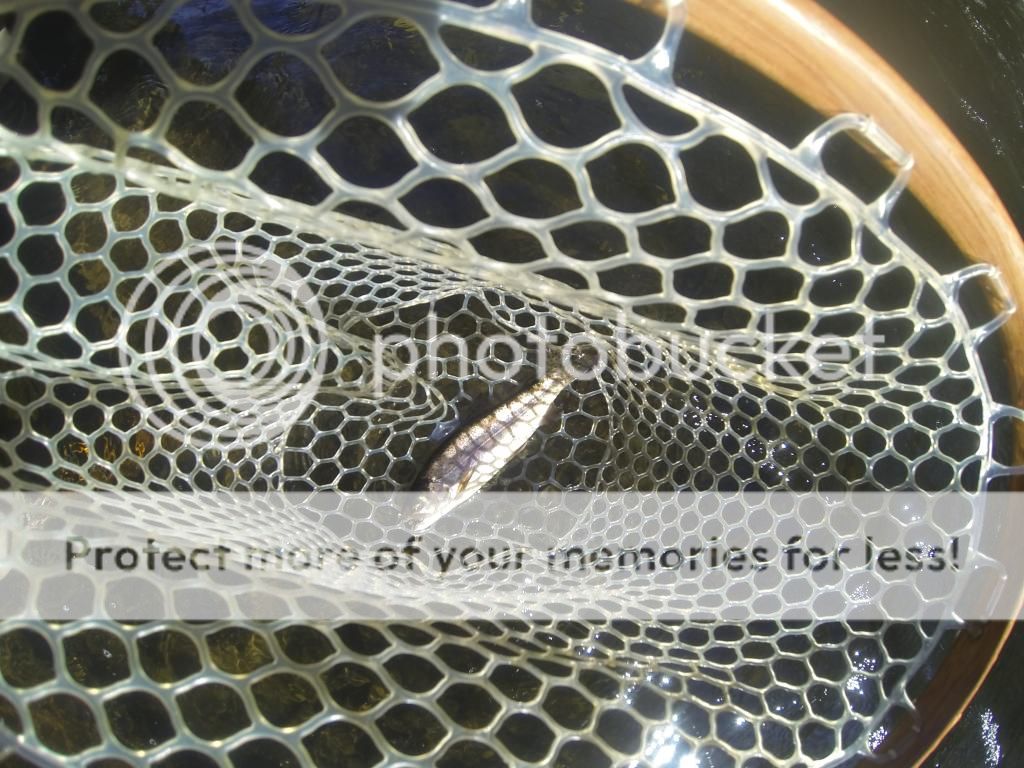 [It was pretty small, but the deep net and fisheye lens makes it appear minnow-esque]
And perhaps a comment on nymphing vs. tenkara. When I nymph, I am generally using a double nymph setup. From the bottom up it is nymph, nymph, weight, strike indicator. Three knots plus placement of the weight and the strike indicator. It makes it hard to change setups quickly. Last time I was at the river, I brought two rods. One set up for dries and the other for nymphs. So I wouldn't have to hassle with changing over. Contrast that with Tenkara. One knot to one nymph. With Western fly fishing with nymphs, I am doing my best to achieve a dead drift, manipulating the line, and closely watching the strike indicator for signs of a fish taking the nymph. It's very visual. Some people don't use a strike indicator while nymphing, but that's very much the exception. In contrast, tenkara combines the visual with physical feel. You hold the rod with your forefinger extended, to pick up vibrations. You watch the level line or furled leader for it to lose slack. I was having just as much success with the tenkara rod, if not more success, and I wasn't using a strike indicator. That's like an answered prayer! Nymphing is great...but NO ONE prefers nymphing to fishing dry flies. You only fish nymphs when you can't fish dry flies. And tenkara makes nymphing more like fishing a dry fly. Tippet and a fly. That's all.
Moving down the river can be a pain with Western-style rods. You have to get reeled up and get your fly squared away, and try not to break your rod on all the brush around you. With tenkara you just telescope down your rod, wrap your line around a round plastic line holder, and place the holder over your rod, which is now two feet long. Now instead of carrying an eight foot rod through the brush, you are carrying a flash light. Much easier.
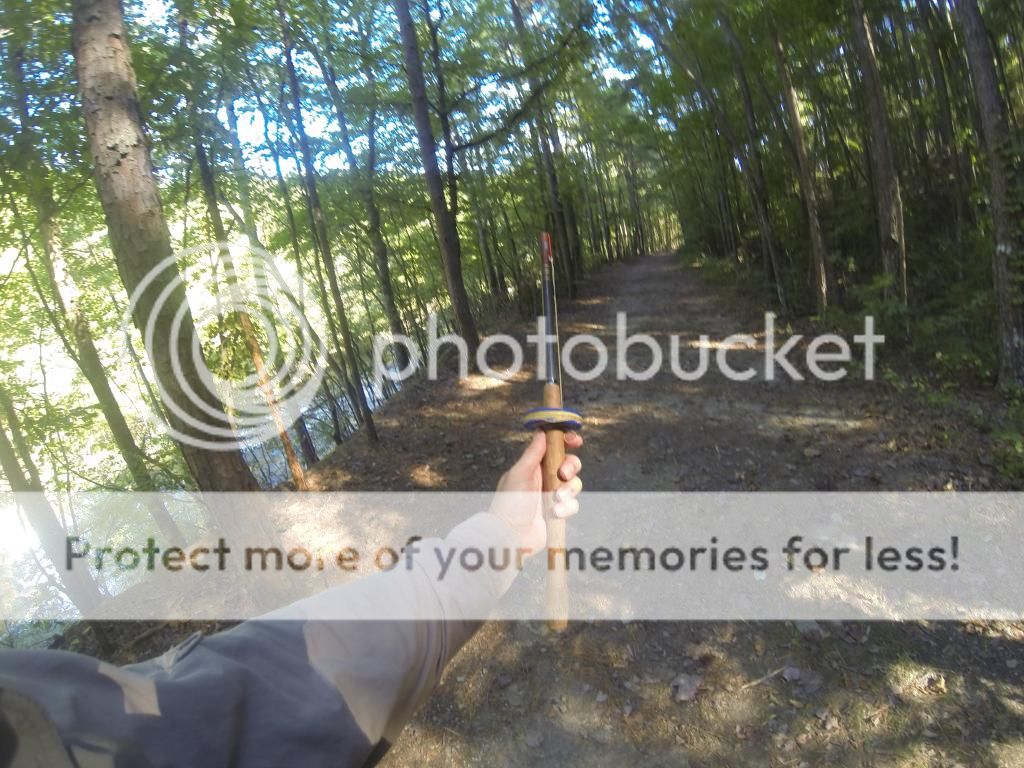 [Note how small the Iwana rod is when telescoped down. The line is wrapped on the plastic line holder, which itself is placed over the rod.]
After lunch we learned about the traditional Japanese tenkara flies as well as new Western adaptations. The traditional tenkara fly that we normally think of has reverse hackle, which distinguishes it from Western flies where the hackle goes down towards the end of the hook (one wonder if in Japan they call Western flies "reverse hackle"). In Western fly fishing we try to "match the hatch." We may carry dozens of varieties of flies. Nymphs, drys, terrestrials, clousers, attractors, stimulators, etc. The masters of tenkara in Japan fish with just one fly. That's right, when they open up their fly box, all they see is one fly all on the same size hook. And not with a billion little plastic doodads. Just a reverse hackle skirt and some thread. That's it. Couldn't be simpler to tie. One rod, one line, and one fly? Are you kidding me? And it works just as well or better than our Western methods in small rivers? Yes. Tenkara is about technique. Not about equipment. It includes rod manipulation that brings the fly up and down in the water column, the reverse hackle making the fly appear very life-like. Also tenkara masters may bring the fly back upstream at the end of a drift. In a series of slow motions. One of my more sheepish moments on the river was when I was moving from one hole to another and just dragging my line in the river as I walked. Yes, I got a fish on with the stationary fly. Doing some research afterward, I discovered that pausing and dragging your fly on the water is actually one of the prescribed tenkara techniques. They just generally recommend you not be facing the opposite way from your fly.
 [Learning to tie Japanese tenkara-style flies]
In the afternoon Mr. Woodruff was gracious enough to allow me use the Iwana rod with a furled leader, since that was more representative of what I would probably want to own. The Iwana had more flex and was easier to cast. The furled leader was also easier to manipulate, except when the wind picked up. And then I felt like the wind was actually creating drag by pulling on the leader. I drove my car towards evening hole and saw a lot of fly fishers on the water from the bridge. In fact, it was the most I had ever seen. Regardless I decided to try this rod just upstream from where Evening hole makes its big turn to the right. I tried a downstream presentation with no success. But with so many people there, I'm sure the fish had been spooked for hours. Further upstream from there yielded no success either. I decided to return to Spillway Creek.
I crossed the Creek and passed a couple of older female fly fishers walking the opposite direction. Not long after, I passed a group of four attractive women fly fishers on the river. I had never seen so many women fly fishers in one spot. Turns out that was Mr. Woodruff's wife guiding a group of women. It was cool to see. Gives me (faint) hope that my wife might one day try fly fishing.
After walking upstream past most people, I settled on the river and fished with the Iwana. I had good success. One to hand, a couple more that were on, but came off. I had many that came off, probably something to do with bad technique in keeping the line taut. I had wanted to catch one big trout before leaving, but after hooking the last one and it coming off and the fly going into a tree (and breaking off), I decided to call it quits. I would save the big fish for my OWN tenkara rod on my next trip.
As I walked downstream back to my car, I observed the various fly fishers on the water. Casting, mending their lines, stripping line. It looked so tedious. Gauche. I realized in the course of one day, I had started to feel sorry for these Western fly fishers, trudging around with their equipment, flailing on the water. And then it struck me, I was looking at these fly fishers like they were bait fishermen. Kind of like, "Good for them, they are outdoors and fishing, but not how I would do it." Wow, is that how a tenkara snob is born?
Tenkara definitely has a place in my future. I will be buying a rod and some line, for a quarter of the price of a single nice Orvis rod. Tenkara felt good. It felt simple, it felt right. It's going to be hard to go back to the weighted double nymph bobber setup after this. I'm certainly not giving up on Western fly fishing. It's superior in some (many) situations. But on little (mostly) nymphing river like the LMFR, man, it's hard to beat the tenkara experience. Which is exactly why Mr. Woodruff is spreading the word. I highly recommend his class and thank him for the opportunity to be his student.
Now three years later I am ready to take a second look at Tenkara. I enrolled in Mr. Woodruff's "Introduction to Tenkara" hands-on course at the LMFR which consisted of a hands-on demonstration as well as the opportunity to put the tenkara rods to effect on the river. And then finally a class on tying traditional tenkara flies.
The class started early at 7am. Nippy at 41 degrees. The class consisted of five students in the morning, and then four in the afternoon. Mr. Woodruff had several different versions of Tenkara USA rods on hand, provided by Daniel Galhardo. In Western fly fishing we use a reel with backing, fly line, a leader, and tippet. In contrast with tenkara, a short line (either a furled leader, or a "level line" is attached directly to the end of the rod. With about 4 feet of 4x or 5x tippet on the end of that. That whole process of getting your line through the guides? Doesn't exist. Getting your rod pieces exactly aligned? Not neccessary. Just extend the rod. We were shown the various traditional knots, as well as the Western versions that are useful. They went over my head. What I didn't confess is that I only do one knot. The nail knot with my tie fast tool. And a clinch knot, if I for some reason didn't have my tool. If I need to put two lines together? Double nail knot. Anyway, it was just for the purpose of introducing us to the knots, not for us to learn them on the spot. A casting demonstration followed. You would think that a rod that is 13 feet long would be unmanageable in tight spots with lots of brush around. Not at all. The backcast brings the line up, rather than back.
Before I talk about our time on the water, perhaps I should mention why anyone would be interested in tenkara at all. One reason is the attraction to the very, simple, pure essential elements of fly fishing and nothing else. It requires minimal equipment and expense. It's light-weight. You are very connected to the water and the fish as a result. Another reason is that it's really very effective. The trick to getting a fish to take the fly is to be able to drift a fly at the exact same speed as the river current, with no drag. The problem with Western fly fishing is that the fly line is like a huge anchor on the water, creating significant drag. We can mitigate that by keeping the fly line off the water by raising our rods (high sticking), or by using other techniques, like mending the line, that is moving the fly line on the water by flipping it upstream or downstream as required. Well, tenkara is essentially high sticking without the requirement that you raise your rod. And because the rods can be an extra 5 feet longer than traditional rods, it's much more effective and gives you more reach on these small rivers. So you get a dead drift much more easily. Which can mean more strikes and more fish.
I selected a rod at random and ended up with the Yamame rod, which is a 12 foot rod with more backbone than the others, designed to land bigger fish. As such I found the casting to be kind of stiff, maybe like a 6 weight. And I was finding that my casting of the level line looked like garbage. That improved significantly over time. All 5 of us students were lined up on the river and Mr. Woodruff attended to each of us. He came over to me and demonstrated a couple of casts. And then observed me. I always perform best under pressure and sure enough I soon brought a Rainbow to hand. It was small, but it was river-born, so that makes it a good fish by definition. Caught another small one that got off before it came to hand. Mr. Woodruff then moved us upriver and put me on a couple of holes. On the first hole S-shaped hole (a bend in the river, as it were, for you literary folks) I was having no luck. I saw one fish rise halfway in the water column though I couldn't tell if it had anything to do with my fly passing by. A little late on the trigger as it were. One thing I found difficult was determining where my level line ended and where my tippet started. If I had been nymphing Western style, I would be able to clearly distinguish the end of my fly line from the leader (monofilament), and of course I would be looking at my strike indicator. With tenkara once my orange level line was in the water, I had a hard time knowing whether it was 3 inches into the water (more ideal), or 3 feet into the water (not ideal). One solution is practice. Another is to use a different color of level line on the end. And yet another is to add a small something to the end of the line, like a taped on strike indicator.
[Orvis-endorsed guide Rob Woodruff calling me out for cutting up during instruction time ]
Having played out the first hole, I moved up a few feet to the second hole which was just below a small falls, with lots of bubbles and water movement next to a slower column of water. The action was very nice there. One to net and photoed. Another two that came off close to hand. And a couple more strikes as well. This was in relatively short amount of time. Because of how "uninvasive" tenkara is, Mr. Woodruff says that clients tend to get more fish from each hole than using Western methods.
[It was pretty small, but the deep net and fisheye lens makes it appear minnow-esque]
And perhaps a comment on nymphing vs. tenkara. When I nymph, I am generally using a double nymph setup. From the bottom up it is nymph, nymph, weight, strike indicator. Three knots plus placement of the weight and the strike indicator. It makes it hard to change setups quickly. Last time I was at the river, I brought two rods. One set up for dries and the other for nymphs. So I wouldn't have to hassle with changing over. Contrast that with Tenkara. One knot to one nymph. With Western fly fishing with nymphs, I am doing my best to achieve a dead drift, manipulating the line, and closely watching the strike indicator for signs of a fish taking the nymph. It's very visual. Some people don't use a strike indicator while nymphing, but that's very much the exception. In contrast, tenkara combines the visual with physical feel. You hold the rod with your forefinger extended, to pick up vibrations. You watch the level line or furled leader for it to lose slack. I was having just as much success with the tenkara rod, if not more success, and I wasn't using a strike indicator. That's like an answered prayer! Nymphing is great...but NO ONE prefers nymphing to fishing dry flies. You only fish nymphs when you can't fish dry flies. And tenkara makes nymphing more like fishing a dry fly. Tippet and a fly. That's all.
Moving down the river can be a pain with Western-style rods. You have to get reeled up and get your fly squared away, and try not to break your rod on all the brush around you. With tenkara you just telescope down your rod, wrap your line around a round plastic line holder, and place the holder over your rod, which is now two feet long. Now instead of carrying an eight foot rod through the brush, you are carrying a flash light. Much easier.
[Note how small the Iwana rod is when telescoped down. The line is wrapped on the plastic line holder, which itself is placed over the rod.]
After lunch we learned about the traditional Japanese tenkara flies as well as new Western adaptations. The traditional tenkara fly that we normally think of has reverse hackle, which distinguishes it from Western flies where the hackle goes down towards the end of the hook (one wonder if in Japan they call Western flies "reverse hackle"). In Western fly fishing we try to "match the hatch." We may carry dozens of varieties of flies. Nymphs, drys, terrestrials, clousers, attractors, stimulators, etc. The masters of tenkara in Japan fish with just one fly. That's right, when they open up their fly box, all they see is one fly all on the same size hook. And not with a billion little plastic doodads. Just a reverse hackle skirt and some thread. That's it. Couldn't be simpler to tie. One rod, one line, and one fly? Are you kidding me? And it works just as well or better than our Western methods in small rivers? Yes. Tenkara is about technique. Not about equipment. It includes rod manipulation that brings the fly up and down in the water column, the reverse hackle making the fly appear very life-like. Also tenkara masters may bring the fly back upstream at the end of a drift. In a series of slow motions. One of my more sheepish moments on the river was when I was moving from one hole to another and just dragging my line in the river as I walked. Yes, I got a fish on with the stationary fly. Doing some research afterward, I discovered that pausing and dragging your fly on the water is actually one of the prescribed tenkara techniques. They just generally recommend you not be facing the opposite way from your fly.
[Learning to tie Japanese tenkara-style flies]
In the afternoon Mr. Woodruff was gracious enough to allow me use the Iwana rod with a furled leader, since that was more representative of what I would probably want to own. The Iwana had more flex and was easier to cast. The furled leader was also easier to manipulate, except when the wind picked up. And then I felt like the wind was actually creating drag by pulling on the leader. I drove my car towards evening hole and saw a lot of fly fishers on the water from the bridge. In fact, it was the most I had ever seen. Regardless I decided to try this rod just upstream from where Evening hole makes its big turn to the right. I tried a downstream presentation with no success. But with so many people there, I'm sure the fish had been spooked for hours. Further upstream from there yielded no success either. I decided to return to Spillway Creek.
I crossed the Creek and passed a couple of older female fly fishers walking the opposite direction. Not long after, I passed a group of four attractive women fly fishers on the river. I had never seen so many women fly fishers in one spot. Turns out that was Mr. Woodruff's wife guiding a group of women. It was cool to see. Gives me (faint) hope that my wife might one day try fly fishing.
After walking upstream past most people, I settled on the river and fished with the Iwana. I had good success. One to hand, a couple more that were on, but came off. I had many that came off, probably something to do with bad technique in keeping the line taut. I had wanted to catch one big trout before leaving, but after hooking the last one and it coming off and the fly going into a tree (and breaking off), I decided to call it quits. I would save the big fish for my OWN tenkara rod on my next trip.
As I walked downstream back to my car, I observed the various fly fishers on the water. Casting, mending their lines, stripping line. It looked so tedious. Gauche. I realized in the course of one day, I had started to feel sorry for these Western fly fishers, trudging around with their equipment, flailing on the water. And then it struck me, I was looking at these fly fishers like they were bait fishermen. Kind of like, "Good for them, they are outdoors and fishing, but not how I would do it." Wow, is that how a tenkara snob is born?
Tenkara definitely has a place in my future. I will be buying a rod and some line, for a quarter of the price of a single nice Orvis rod. Tenkara felt good. It felt simple, it felt right. It's going to be hard to go back to the weighted double nymph bobber setup after this. I'm certainly not giving up on Western fly fishing. It's superior in some (many) situations. But on little (mostly) nymphing river like the LMFR, man, it's hard to beat the tenkara experience. Which is exactly why Mr. Woodruff is spreading the word. I highly recommend his class and thank him for the opportunity to be his student.