

Umm, etymologists study words, etiologists study causation, and entomologists study bugs. You mean herpetologist I believe.
Texas Horned Lizard
44,177 Views |
196 Replies |
Last: 3 yr ago by philevans
If it is difficult for herpetologists, it is really difficult for etymologists.
Actually, it was a simple error on my part.
Actually, it was a simple error on my part.
When they got a successful breeding at the FW Zoo, it was almost purely by accident. It was about 5 years ago now, so I can't remember the exact details.---Basically completely out of the controlled methology in zoo breeding.
Little tiny bottles of beer?
quote:
When they got a successful breeding at the FW Zoo, it was almost purely by accident. It was about 5 years ago now, so I can't remember the exact details.---Basically completely out of the controlled methology in zoo breeding.

Saw another one today, same general area as my previous pics.

IMG_2904 by CHS Girls Soccer, on Flickr
IMG_2904 by CHS Girls Soccer, on Flickr
Now that is a nice pic!
haven't seen one in many, many years, but I use to catch them all the time when I was a kid...both in texas and NM.
Thanks robk, actually had my camera with me this time instead of just the cell phone.
Got quite a few other shots on my thread on Panhandle-South Plains Board
Got quite a few other shots on my thread on Panhandle-South Plains Board
We saw 8 at our ranch in Runnels county this past weekend.
I see plenty of them every time I mow my yard. Saw at least 6 last weekend. My 4 year old thinks they are the coolest thing ever.
Spent most of the day looking for horned lizard scat out near Weatherford. Didn't find any, but it really wasn't a shock.
Found this little guy on a well location in Atascosa County two years ago.
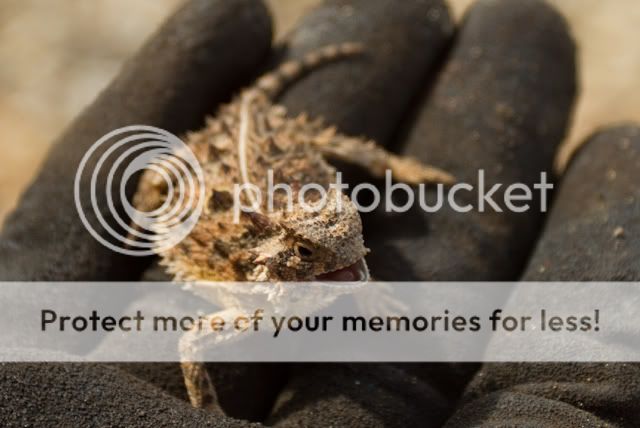
Wasn't looking for scat at the time.
Wasn't looking for scat at the time.
quote:
We saw 8 at our ranch in Runnels county this past weekend.
The only one I've seen in person was on the Winters Golf Course on the fourth (I'm pretty sure, maybe third) green.
Very cool animals.
quote:
When they got a successful breeding at the FW Zoo, it was almost purely by accident. It was about 5 years ago now, so I can't remember the exact details.---Basically completely out of the controlled methology in zoo breeding.
Funny, you'd think Horny Toads would be, well, hornier.
found this guy while at a ranch outside of eagle pass. had to give him a helping finger.

they were everywhere when I was growing up..used to tie a thread on them like a leash and walk them like a dog. good memories
I almost crapped on this little guy early one morning a couple weeks ago in Dickens County:

Few new picks from today. Found in the field of a fellow Aggie.
See anything?

IMG_3117 by CHS Girls Soccer, on Flickr
How about now?

IMG_3118 by CHS Girls Soccer, on Flickr
Kind of small for a dinosaur

IMG_3122 by CHS Girls Soccer, on Flickr
See anything?
IMG_3117 by CHS Girls Soccer, on Flickr
How about now?
IMG_3118 by CHS Girls Soccer, on Flickr
Kind of small for a dinosaur
IMG_3122 by CHS Girls Soccer, on Flickr
Taken the first weekend of August 2012 in Dickens County:

Very cool. I hope to stumble upon one someday.
cool little critters
At a meeting with the folks that run this Horned Lizard Watch program.
http://www.tpwd.state.tx.us/huntwild/wild/wildlife_diversity/texas_nature_trackers/horned_lizard/
http://www.tpwd.state.tx.us/huntwild/wild/wildlife_diversity/texas_nature_trackers/horned_lizard/
The first deer lease I was on in Childress had a bunch of them. We found two different groups of babies out there. First time I had ever seen the baby ones.
Used to see them all the time when I was a kid in Henderson Co. Loved picking them up and putting them in my sister's face to see her freak out!
perhaps we need some "red ant farms" created to keep a steady food source flowing for the horned toad, hell, they might even make a comeback.
This is one I saw last weekend near Freer. Took with my cell phone and he was pretty small.
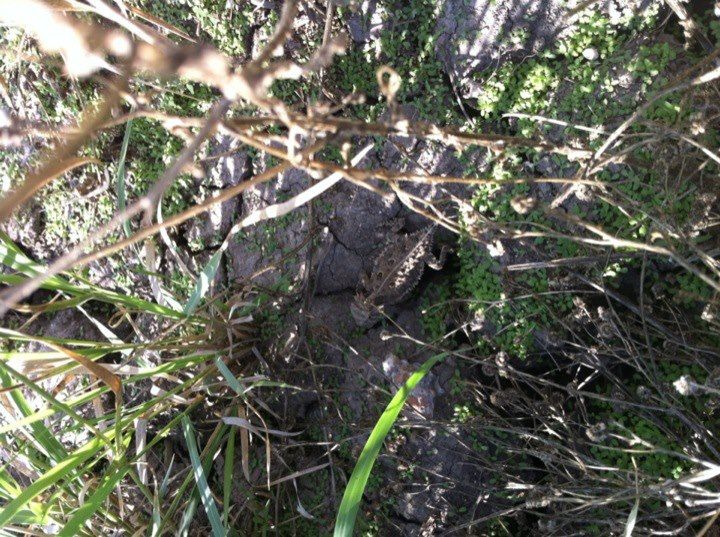
I took a dozen or so "dime size" ones to trade with at the Boy Scout National Jamboree in Colorado Springs, 1960. Gone in one day - mostly to yankees.
I used to see and catch them at my Grandma's farm in Holman. The comment about taking them to the National Jamboree reminds me of a story my cousin told me about going to one in the 50's where someone took cockleburs and sold them as porcupine eggs to the unsuspecting scouts not familiar with them.
Followed Canyon's link to this thread. Man did this bring back some fond memories from childhood. We lived on a dirt road in Lubbock & my brother and I started many a Summer day with tracking & catching horny toads in the fine sand on either side. He would take one side and I the other. We used to catch 15-30 a day.
When it rained a nearby road would flood and we would catch toads, tadpoles, & tadpole shrimp by the bucket full.
Good times...
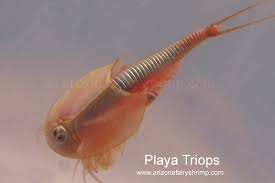
Here is what a tadpole shrimp looks like if you're curious:
When it rained a nearby road would flood and we would catch toads, tadpoles, & tadpole shrimp by the bucket full.
Good times...
Here is what a tadpole shrimp looks like if you're curious:
Wanted to do a ttt with an updated census. Was planting sorghum this week in a field that was no-tilled after wheat. Wheat was not harvested, should have been cut in 2012. Lost it to drought, haven't planted since due to drought.
Regardless, based on the number of lizards I spotted from the tractor seat, there is at least one lizard on every 10 acres. Seems like good numbers to me, most I've seen in a long time.
Hope they continue to thrive.
And those Triops/Tadpole Shrimp are beyond cool. I remember the first time I found one as a kid, I thought I had found a dinosaur. I've found a couple in the last few years. One in a ditch, the other in simply a rut.
I can't imagine how they survive years of drought and come back when a little rain falls. Don't know if they come from eggs or adults that hibernate.
EDIT: Wiki to the rescue:
Regardless, based on the number of lizards I spotted from the tractor seat, there is at least one lizard on every 10 acres. Seems like good numbers to me, most I've seen in a long time.
Hope they continue to thrive.
And those Triops/Tadpole Shrimp are beyond cool. I remember the first time I found one as a kid, I thought I had found a dinosaur. I've found a couple in the last few years. One in a ditch, the other in simply a rut.
I can't imagine how they survive years of drought and come back when a little rain falls. Don't know if they come from eggs or adults that hibernate.
EDIT: Wiki to the rescue:
quote:
the longtail tadpole shrimp is considered a living fossil because its basic prehistoric morphology has changed little in the last 70 million years, exactly matching their ancient fossils. Triops longicaudatus is one of the oldest animal species still in existence
The eggs are released in batches, have a thick shell, and can stand freezing temperatures as well as drought, enabling the population to survive from one season to the next. The eggs have to dry out completely before being submerged in water again in order to hatch successfully; they may remain in a state of diapause for up to 20 years. These eggs may have helped Triops longicaudatus, as well as other notostracans, to survive the various natural disasters and mass extinctions to date.
To complete their lives, tadpole shrimps depend on the changing nature of the temporary waters they inhabit. During the dry season (summer and fall), their offspring stay inside the eggs. As the pool fills with rainwater during the winter and spring, they hatch and feed on fairy shrimps and other invertebrates. The first larval stage (the metanauplius) is orange in color. It has a single eye, six legs, and develops through instars (growth stages). Each instar ends with shedding the exoskeleton. The number of segments and appendages increases as Triops grow, and they slowly change to greyish-brown. In approximately eight days, they reach maturity and lay eggs. Adult Triops die as the pools dry up. Triops generally live for about 20–90 days if the pool does not dry up."
[This message has been edited by CanyonAg77 (edited 6/19/2014 8:55p).]
Still lots of horny toads in west central NM. It's certainly dry enough for them here.
Horny toads were very common 40 or 50 years ago in Texas. Unfortunately, even though you do not see as many as you once did, they are making somewhat of a comeback.
http://www.tpwd.state.tx.us/publications/pwdpubs/media/pwd_bk_w7000_0038.pdf
http://www.tpwd.state.tx.us/publications/pwdpubs/media/pwd_bk_w7000_0038.pdf
Keep in mind there are several species of horned lizards (3 specifically in Texas). In the Trans Pecos and Panhandle, they've held on pretty well. But, Texas horned lizard has mostly disappeared from the eastern 2/3 of what they occupied.
The lizards in central NM are a completely different species.
The lizards in central NM are a completely different species.
I see one
Featured Stories
See All
10:14
1d ago
7.9k
Zach Clemence leads Texas A&M's 3-point barrage vs. South Carolina
by Olin Buchanan
5 Thoughts: Texas A&M 92, South Carolina 69
by Luke Evangelist
5:03
1d ago
2.1k
Game Highlights: Texas A&M 92, South Carolina 69
by Reece Nygren
Skid reaches four as Texas A&M falls at Mizzou, 81-70
by Justin Paez
wtr1975
Difference between eccentric and just "off". Anyone heard a recent Buzz interview?
in Texas A&M Men's Basketball
3