
Outdoors
Sponsored by

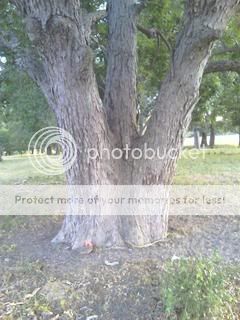
MASSIVE pecan tree

19,885 Views | 37 Replies | Last: 16 yr ago by Tree Hugger
Mr. Guy
How long do you want to ignore this user?
My buddy's neighbor has the largest pecan tree i have ever seen.

I have seen some very large and old ones growing near the river back home, and this one really dwarfs them. Without exaggerating too much, I think I can safely estimate it has about a 6 foot diameter trunk. I'm about to go over there so I'll take another look.

but this thing has got to be old as dirt. can you age a tree without cutting it down?
Aggiefan54
How long do you want to ignore this user?
From US Forest Service web site:
http://www.na.fs.fed.us/spfo/pubs/uf/lab_exercises/how_old_this_tree.htm

There are two ways to find out how old a tree is. The first is to wait until the tree is cut down and count the rings. The second is to use an increment borer and count the rings on a trunk cross section. The study of tree rings to calculate a trees' age is called dendrochronology.

In each method the tree sustains damage. To obtain a trunk cross section sometimes called 'beaver cookies', 'tree cookies', or 'hockey pucks', the tree must be killed. To get an accurate age of the tree, the rings must be near the base (ground) of the tree. The borer takes a small (0.200 inch diameter) straw-like sample from the bark to the pith of the tree. Though this hole is small, it can still introduce decay in the trunk.

SWCBonfire
How long do you want to ignore this user?
You're probably being conservative... pecan trees can get massive. A 9' diameter trunk is not unusual if the tree is in a protected area and has conditions conducive to good health, like plenty of water, airflow and sunlight.

Many times you will see the largest trees in a river bottom on the bluff out of the normal floodplain - still low enough to collect water from the alluvial gravel/water formation, but high enough to escape flood damage and separated from competitive trees for sunlight, airflow and nutrients. The soil there is still sedimentary and well drained, so there are plenty of nutrients.
ursusguy
How long do you want to ignore this user?
The Texas "Champion" pecan, in Parker County, is 21.5' in circumference (someone else can guess the diameter).

Some neat tree stats to look over
http://txforestservice.tamu.edu/main/article.aspx?id=1336
Courtesy Flush
How long do you want to ignore this user?
Why exactly is it that pecan trees are native to river bottoms. It is interesting to me. When I am driving, I constantly look at the trees and I can always tell when I am getting close to a river because pecan trees just all of a sudden show up
rock08
How long do you want to ignore this user?
The Texas "Champion" pecan, in Parker County, is 21.5' in circumference (someone else can guess the diameter).

d=C/Pi

d=21.5/Pi

d=6.84366255 ft
ursusguy
How long do you want to ignore this user?
I know the formula, just didn't feel like doing it. But now we know
Duck Blind
How long do you want to ignore this user?
Damn that baby could smoke A LOT of ribs!
SWCBonfire
How long do you want to ignore this user?
Is that all? I think I'm going down to the riverbottom with a tape measure!

To be fair, most pecan trees are oval shaped... but that seems ridiculously low for a "grand champion" considering all the large trees in Texas.
Mr. Guy
How long do you want to ignore this user?
i'm gonna go over there and see if his neighbor will let me measure that thing...we may have a grand champion on our hands here boys
ursusguy
How long do you want to ignore this user?
Keep in mind the height of the tree and crown spread are also part of the calculation for the "champion" trees.
Doc Hayworth
How long do you want to ignore this user?
SWCBonfire,

it's true that pecans can get very large, but I would have to disagree that a 9' diameter pecan is not unusual. IMO, that size is Very unusual.

We have several along our creek that are probably around 200-300 years old, but are only 5-6 foot in diameter.
Tree Hugger
How long do you want to ignore this user?
I spend a lot of time in floodplains doing work and pretty much anything over a 50" diameter tree is usually a site to behold. I don't think I've ever seen anything anywhere remotely close to a 9' diameter tree.
SWCBonfire
How long do you want to ignore this user?
Yeah, 9' was an exaggeration but 6'+ is actually pretty common around here on the Guadalupe. I will measure the ones I know of down in several bottoms... maybe my mental diameter caliper is way off. I know for a fact that a 42" trunk shaker will not even grab a side root on these trees, you have to grab a limb with a boom shaker. That champion tree must have a gigantic canopy that is also figured in; most old trees are just stumps that limbs have fallen out of.

Where are these things measured, at the ground level or a certain elevation above ground? Because many large trees with a wide canopy flare out significantly at the base.
Mr. Guy
How long do you want to ignore this user?
i think the crown spread requirement is gonna hurt this tree...Ike took out a gigantuan limb, it fell across my buddy's entire lot, luckily his house wasn't built yet...it does not have the most impressive canopy..

but it's pretty damn tall, i'll see what i can get accomplished this evening on measuring it.
wapa
How long do you want to ignore this user?
quote:
Why exactly is it that pecan trees are native to river bottoms. It is interesting to me. When I am driving, I constantly look at the trees and I can always tell when I am getting close to a river because pecan trees just all of a sudden show up


Pecan trees are obviously native to parts of Texas and they like the well drained soils with good amount of water access. Therefore, nature chose the best places for pecan trees to grow. If you also notice, a lot of the pecan varieties out of Texas have Indian names because that is how they survived through winter, my collecting the pecans out of the river bottoms.

Native pecan trees are pretty slow growing in the scheme of things so some of the very old trees aren't not going to be as big as you think. I have been in some of the huge native bottoms and the trees are amazing. As SWC said, you can't get any modern machinery around the trunks so you have to wait for a lot of the pecans to drop.
Tree Hugger
How long do you want to ignore this user?
quote:
Where are these things measured, at the ground level or a certain elevation above ground?


Depends upon the measuring authority, but many would typically say diameter at breast height (dbh) or roughly 4.5 feet above ground level.
SWCBonfire
How long do you want to ignore this user?
I'll try to track down my 50' tape and take some pictures. I have several candidates in mind, all are within several miles of my house, some will be mine. Most of them are abnormally shaped, so I will take a circumference and a rough caliper measurement.

I've always heard that those big trees are only 150-250 years old - pecans are very brittle and fall to pieces once they get big, so their life is limited. Live oak and cypress trees are more flexible and can survive intact a lot longer. I do know some 70+ year old improved variety trees that are pushing the 42" trunk shaker capacity (Desirables). Pecans actually grow pretty fast if they have good growing conditions... a sub-1" caliper bare root tree can easily be large enough for production after 7 years, some varieties like Cheyenne will be even less than that.

SR90
How long do you want to ignore this user?
So how do pecan orchards harvest the nuts? Do they wait until they fall? Shake the tree? If so, with what?

I've always wondered about that.
wapa
How long do you want to ignore this user?
quote:
Pecans actually grow pretty fast if they have good growing conditions... a sub-1" caliper bare root tree can easily be large enough for production after 7 years, some varieties like Cheyenne will be even less than that.


Compared to other fruit or nut bearing trees they are relatively slow. And you are right, it depends on the variety and management techniques but Natives which are not normally cared for take longer to produce a crop and grow to those sizes. You have Desirable in that part of Texas? Have any scab problems with them? Also, Desirable are known for their limb breaking and being brittle. Cheyenne should be a little better off.

Large scale pecan orchards shake their trees with tree shakers, most of which are made out in California. They then take a harvester through that picks up the crop. Growers that have huge Native or Improved trees where the shaker pads can't get around the tree will either shake the limbs or wait until the nuts drop. I am trying to find a picture for you but you can google it as well.


[This message has been edited by wapa (edited 8/13/2009 10:57a).]
SWCBonfire
How long do you want to ignore this user?
You shake them with tree shakers. There are trunk shakers that mount on the back of a tractor... the biggest one I know of personally will shake a 54" diameter tree but it has a nasty habit of falling apart. There are also boom mounted shakers than allow you to grab individual limbs and shake them - something you have to do with large native trees if you want to gather them. They both operate with counterweights on a rotating shaft, the tractor mounted one is PTO driven while a boom shaker is hydraulic motor driven.

Shaking out pecans is very weather dependent. Ideally, you would have some cold, wet weather to cause the tree to lose leaves, crack the shuck open and loosen the pecan inside. The past few years we haven't had a lot of that, so you either gather what comes out and come back later, or wait and hope that every critter in Texas doesn't wipe them clean.

If you don't get enough moisture, or you have a lot of stress, you can get "bollies" - good pecans inside, but the shucks won't open and they won't come off the trees no matter how hard you shake.
MouthBQ98
How long do you want to ignore this user?
quote:
wait until the nuts drop


heh...
SWCBonfire
How long do you want to ignore this user?
wapa, the scab problem with Desirables is a recent phenomenon - probably early 90's when a fungicide-resistant scab came on the scene. Prior to that, desirables were considered one of the most scab-resistant varieties around.

But yes, we do have problems with scab. Not so much in that orchard because of the spacing and alignment of the trees allows for good sunlight penetration to reduce moisture, but in other areas where desirables are planted close together and/or in lower riverbottoms with less air movement it is a real problem when it actually rains.

We actually have a handful of Wichitas and Eastern Schleys that we can somewhat control the scab on in normal years, so we are on the cusp of that growing area. I wouldn't plant any more of them, though. We are going to see what Noconos look like over the long term, and continue to stick with Cheyennes since they produce the most useful nut for us on a consistent basis (we have a small shelling operation).
SWCBonfire
How long do you want to ignore this user?
Here you go:

http://aggie-horticulture.tamu.edu/syllabi/319/1pecan.html

A lot of boom shakers are almond shakers from california that are modified with larger booms.

Savage and SNT are manufacturers of trunk shakers... that is a savage harvester in that pic.

The harvesting is different for managed orchards out west than it is here, but that is how pecans are gathered in most of Texas. When you get out west or in Georgia you have windrowers/sweepers and vacuum harvesters.
wapa
How long do you want to ignore this user?
Yeah, I had wondered about that with Desirable. Growers in the Southeast have the same problem but they do make a beautiful crop as Georgia has seen in the last two years. Cheyenne is a good bet in your area and as you said, you have had success with it. Nacono have some of the same timing as Desirable but is a good tree like the Cheyenne so hopefully it does well for you. On a side note, I am sure we have probably met if you have ever attended any pecan activities in the last couple of years.
SWCBonfire
How long do you want to ignore this user?
Possibly... I haven't made it to many field days in the past few years. Does Bill Ree still work for the entomology service?
wapa
How long do you want to ignore this user?
Yep, still does extension out of College Station. The TPGA Conference is headed to your neck of the woods this coming year. Will be in San Marcos in 2010.
SR90
How long do you want to ignore this user?
Cool. Thanks for the education!
ursusguy
How long do you want to ignore this user?
If you go to the link I posted, you will find another link to the measuring standards and how to carry out the measurements.
SWCBonfire
How long do you want to ignore this user?
Checked it out... that list is immediately questionable because the big tree in Aransas is 35' in diameter and not on there... there evidently is some sort of composite score going on.

I'm pretty sure that champion Rio Grande cottonwood is out in front of Fort Davis... that is a massive giant of a tree.
ursusguy
How long do you want to ignore this user?
Bonfire, if you looked at it closely, you will notice the final score is a formulat of the circumference, height and canopy cover. Also keep in mind, the trees have to be reported to make the list, there are certainly larger trees out there.
sunchaser
How long do you want to ignore this user?
http://www.americanforests.org/resources/bigtrees/measure.php
Allen76
How long do you want to ignore this user?
I measured what I think is the biggest tree below my house. It is a bald cypress. 19.5 ft circumference. It is egg shaped, measuring 7.5 ft diameter one way, and just over 4 ft the other way. There are several studs, nailed steps, etc in this tree which had to have been put in there over 60 years ago. Since they have not been covered up yet, I assume these huge trees grow very slowly as opposed to a fast growing young cypress tree.

I don't think we have any pecan trees over 4 ft in diameter.
SWCBonfire
How long do you want to ignore this user?
OK, I haven't had a lot of time lately so it took all weekend, and I only went down into my river bottom. I did overestimate the size of the trees, but not by much.

The first one that sprang to mind is this multi-trunk b*stard that is a monster:


How many black cows fit under a tree in August? All of them. They were looking for a handout since it hasn't rained here to speak of in 2.5 years.

This tree measured 18'-3" in circumference, and that was right near the ground. It was much wider at 42". At that height, it was approximately 7' wide, but closer to 6' at the bottom.

Next:


This thing is a monster as well. Sheer mass it is bigger than the other tree. We had a hand that called it El Macho Grande.

It only measured 17'-3", but it also had a caliper dimension that exceeded 6' in one direction. It flared out significantly at the ground, as shown.

These are big, but I think if I look around I can find some bigger ones, especially in the neighbor's place and my dad's.

[This message has been edited by SWCBonfire (edited 8/18/2009 10:28a).]

[This message has been edited by SWCBonfire (edited 8/18/2009 11:19a).]
Bird Poo
How long do you want to ignore this user?
Dorm Log.
Page 1 of 2
 
×
subscribe Verify your student status
See Subscription Benefits
Trial only available to users who have never subscribed or participated in a previous trial.