
https://www.city-journal.org/article/scientific-american-dismisses-scientific-rigorQuote:
Scientific American, which dates to 1845 and touts itself as "the oldest continuously published magazine in the United States," recently ran an article arguing that scientists should prioritize "reality" over scientific "rigor." What would make a publication with a name like this one set empirical evidence at odds with reality? Masks, of course.
Naomi Oreskes, a Harvard professor of the history of science, argued that by "prioritizing scientific rigor" in its mask studies, the Cochrane Library may have "misled the public," such that "the average person could be confused" about the efficacy of masks. Oreskes criticized Cochrane for its "standard . . . methodological procedures," as Cochrane bases its "findings on randomized controlled trials, often called the 'gold standard' of scientific evidence." Since RCTs haven't shown that masks work, she writes, "t's time those standard procedures were changed."
City Journal contributing editor John Tierney called Cochrane "the world's largest and most respected organization for evaluating health interventions." A recent Cochrane review found that "[w]earing masks in the community probably makes little or no difference to the outcome of influenza-like illness (ILI)/COVID-19 like illness"or "to the outcome of laboratory-confirmed influenza/SARS-CoV-2""compared to not wearing masks." The review also found that "use of a N95/P2 respirators compared to medical/surgical masks probably makes little or no difference" for the "outcome of laboratoryconfirmed influenza infection."
While Oreskes asserts that Cochrane's findings were made with "low to moderate" certainty, each of the findings quoted above was made with "moderate certainty," the second-highest of four certainty classifications. "Moderate certainty," Cochrane notes, means that "the true effect is likely to be close to the estimate of the effect." The Cochrane review's lead author, Oxford's Tom Jefferson, said of masks in a subsequent interview with Australian investigative journalist Maryanne Demasi, "There is just no evidence that they make any difference. Full stop."
In response, Oreskes claimed that "[t]he Cochrane finding was not that masking didn't work but that scientists lacked sufficient evidence of sufficient quality to conclude that they worked." She continues, "Jefferson erased that distinction, in effect arguing that because the authors couldn't prove that masks did work, one could say that they didn't work. That's just wrong." But Jefferson didn't simply say that masks don't work; he said there's "no evidence" they work. The burden of proof should be on the side of those advocating a medical intervention. Without remotely having met that burden, Oreskes asserts that masks do work. Cochrane, she writes, "gave the false impression that masking didn't help."...
In a way, Oreskes has provided a public service with her article, as has Scientific American in running it. The article makes clear how willing mask advocates are to sacrifice scientific objectivity on the altar of their newfound religion.
Post Reply
1 of 1
Scientific American: Reject scientific rigor in favor of Liberal Knowing
2,831 Views |
29 Replies |
Last: 2 yr ago by American Hardwood
We all know liberal knowing isn't reality. It's feeling.
I'm a boy, but I feel like a girl. That's my truth. That is knowing.
Here's Thomas Sowell

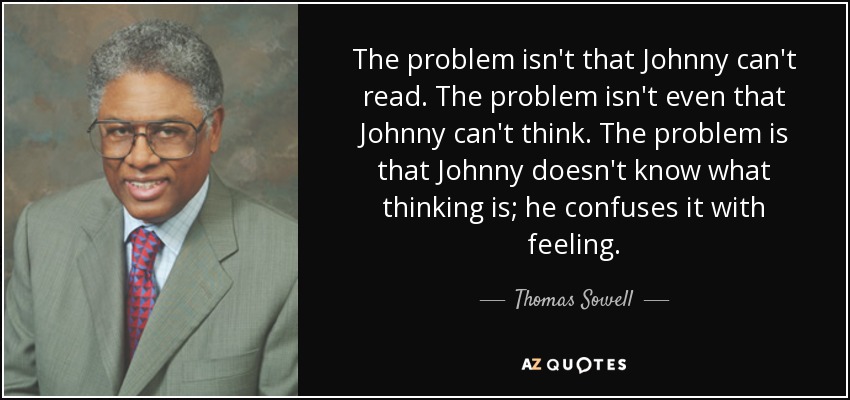
I'm a boy, but I feel like a girl. That's my truth. That is knowing.
Here's Thomas Sowell
A prime example of the sharpshooter fallacy where a gunman shoots the wall, draws a circle around the hole and declares himself a perfect shot.captkirk said:https://www.city-journal.org/article/scientific-american-dismisses-scientific-rigorQuote:
Scientific American, which dates to 1845 and touts itself as "the oldest continuously published magazine in the United States," recently ran an article arguing that scientists should prioritize "reality" over scientific "rigor." What would make a publication with a name like this one set empirical evidence at odds with reality? Masks, of course.
Naomi Oreskes, a Harvard professor of the history of science, argued that by "prioritizing scientific rigor" in its mask studies, the Cochrane Library may have "misled the public," such that "the average person could be confused" about the efficacy of masks. Oreskes criticized Cochrane for its "standard . . . methodological procedures," as Cochrane bases its "findings on randomized controlled trials, often called the 'gold standard' of scientific evidence." Since RCTs haven't shown that masks work, she writes, "t's time those standard procedures were changed."
City Journal contributing editor John Tierney called Cochrane "the world's largest and most respected organization for evaluating health interventions." A recent Cochrane review found that "[w]earing masks in the community probably makes little or no difference to the outcome of influenza-like illness (ILI)/COVID-19 like illness"or "to the outcome of laboratory-confirmed influenza/SARS-CoV-2""compared to not wearing masks." The review also found that "use of a N95/P2 respirators compared to medical/surgical masks probably makes little or no difference" for the "outcome of laboratoryconfirmed influenza infection."
While Oreskes asserts that Cochrane's findings were made with "low to moderate" certainty, each of the findings quoted above was made with "moderate certainty," the second-highest of four certainty classifications. "Moderate certainty," Cochrane notes, means that "the true effect is likely to be close to the estimate of the effect." The Cochrane review's lead author, Oxford's Tom Jefferson, said of masks in a subsequent interview with Australian investigative journalist Maryanne Demasi, "There is just no evidence that they make any difference. Full stop."
In response, Oreskes claimed that "[t]he Cochrane finding was not that masking didn't work but that scientists lacked sufficient evidence of sufficient quality to conclude that they worked." She continues, "Jefferson erased that distinction, in effect arguing that because the authors couldn't prove that masks did work, one could say that they didn't work. That's just wrong." But Jefferson didn't simply say that masks don't work; he said there's "no evidence" they work. The burden of proof should be on the side of those advocating a medical intervention. Without remotely having met that burden, Oreskes asserts that masks do work. Cochrane, she writes, "gave the false impression that masking didn't help."...
In a way, Oreskes has provided a public service with her article, as has Scientific American in running it. The article makes clear how willing mask advocates are to sacrifice scientific objectivity on the altar of their newfound religion.
Sad to see it in any science. Unfortunately, Dems have run rampant with this fallacy and others.
Trump will fix it.
Quote:
So inveterate is their appetite for Heaven that our best method, at this stage, of attaching them to earth is to make them believe that earth can be turned into Heaven at some future date by politics or eugenics or 'science' or psychology, or what not.
C.S. Lewis published that in 1941 and it still nails leftists to a 'T' to this very day.
Leave me out of this, please.techno-ag said:
A prime example of the sharpshooter fallacy where a gunman shoots the wall, draws a circle around the hole and declares himself a perfect shot.
Sad to see it in any science. Unfortunately, Dems have run rampant with this fallacy and others.
We saw it all throughout the pandemic that draconian masker states and cities didn't have any better outcomes than those who didn't
Scientific rigor IS reality.
Dumbasses...
Dumbasses...

Elections are when people find out what politicians stand for, and politicians find out what people will fall for.
The null hypothesis is that masks do not work. That has to be the null because you are talking about life and death potentially.
The goal of the study was to reject that hypothesis. It failed. Thus the null stands.
The goal of the study was to reject that hypothesis. It failed. Thus the null stands.
Scientists finally making BANK to say anything for a buck and some fame.
Scientific rigor is already being rejected by both sides because the data doesn't support their political goals. The climate IS changing, but how much people have affected it is still not proven. Yet some just flat out ignore the science....or worse...find some sketchy research to support their own conclusion because 'they really know whats happening'.captkirk said:https://www.city-journal.org/article/scientific-american-dismisses-scientific-rigorQuote:
Scientific American, which dates to 1845 and touts itself as "the oldest continuously published magazine in the United States," recently ran an article arguing that scientists should prioritize "reality" over scientific "rigor." What would make a publication with a name like this one set empirical evidence at odds with reality? Masks, of course.
Naomi Oreskes, a Harvard professor of the history of science, argued that by "prioritizing scientific rigor" in its mask studies, the Cochrane Library may have "misled the public," such that "the average person could be confused" about the efficacy of masks. Oreskes criticized Cochrane for its "standard . . . methodological procedures," as Cochrane bases its "findings on randomized controlled trials, often called the 'gold standard' of scientific evidence." Since RCTs haven't shown that masks work, she writes, "t's time those standard procedures were changed."
City Journal contributing editor John Tierney called Cochrane "the world's largest and most respected organization for evaluating health interventions." A recent Cochrane review found that "[w]earing masks in the community probably makes little or no difference to the outcome of influenza-like illness (ILI)/COVID-19 like illness"or "to the outcome of laboratory-confirmed influenza/SARS-CoV-2""compared to not wearing masks." The review also found that "use of a N95/P2 respirators compared to medical/surgical masks probably makes little or no difference" for the "outcome of laboratoryconfirmed influenza infection."
While Oreskes asserts that Cochrane's findings were made with "low to moderate" certainty, each of the findings quoted above was made with "moderate certainty," the second-highest of four certainty classifications. "Moderate certainty," Cochrane notes, means that "the true effect is likely to be close to the estimate of the effect." The Cochrane review's lead author, Oxford's Tom Jefferson, said of masks in a subsequent interview with Australian investigative journalist Maryanne Demasi, "There is just no evidence that they make any difference. Full stop."
In response, Oreskes claimed that "[t]he Cochrane finding was not that masking didn't work but that scientists lacked sufficient evidence of sufficient quality to conclude that they worked." She continues, "Jefferson erased that distinction, in effect arguing that because the authors couldn't prove that masks did work, one could say that they didn't work. That's just wrong." But Jefferson didn't simply say that masks don't work; he said there's "no evidence" they work. The burden of proof should be on the side of those advocating a medical intervention. Without remotely having met that burden, Oreskes asserts that masks do work. Cochrane, she writes, "gave the false impression that masking didn't help."...
In a way, Oreskes has provided a public service with her article, as has Scientific American in running it. The article makes clear how willing mask advocates are to sacrifice scientific objectivity on the altar of their newfound religion.
Scientific American used to be a great magazine, but they got so left-wing that I finally gave up on them and didn't renew my subscription.
Quote:
scientists should prioritize "reality" over scientific "rigor."
Wrong,
Science is the culture of doubt whereas Religion is the culture of faith (R. Feyman). When science is based on "faith" it becomes a religion.
A scientist does not believe the science (doubts), rather a scientist trusts the scientific method (the rigor).
Reality is often in the eye of the beholder, however the rigor (scientific method), when allowed to be correctly applied, will weed out the fact from the fiction.
Quote:
Naomi Oreskes, a Harvard professor of the history of science
FYI : Oreskes is a historian, not a scientist.
"It isn't so much that liberals are ignorant. It's just that they know so many things that aren't so." - Ronald Reagan
They have been doing mask studies for decades and a bunch of them in the last couple of years. None of those studies have shown that masks are effective and may even do some harm. Yet, people will argue with you that masks absolutely work.
Saw a couple of people wearing masks today. At this point I just assume that mask wearers are stupid and useless people and if they were to ask me I would tell them that.
Saw a couple of people wearing masks today. At this point I just assume that mask wearers are stupid and useless people and if they were to ask me I would tell them that.
Well doneSharpshooter said:Leave me out of this, please.techno-ag said:
A prime example of the sharpshooter fallacy where a gunman shoots the wall, draws a circle around the hole and declares himself a perfect shot.
Sad to see it in any science. Unfortunately, Dems have run rampant with this fallacy and others.
BluHorseShu said:Scientific rigor is already being rejected by both sides because the data doesn't support their political goals. The climate IS changing, but how much people have affected it is still not proven. Yet some just flat out ignore the science....or worse...find some sketchy research to support their own conclusion because 'they really know whats happening'.captkirk said:https://www.city-journal.org/article/scientific-american-dismisses-scientific-rigorQuote:
Scientific American, which dates to 1845 and touts itself as "the oldest continuously published magazine in the United States," recently ran an article arguing that scientists should prioritize "reality" over scientific "rigor." What would make a publication with a name like this one set empirical evidence at odds with reality? Masks, of course.
Naomi Oreskes, a Harvard professor of the history of science, argued that by "prioritizing scientific rigor" in its mask studies, the Cochrane Library may have "misled the public," such that "the average person could be confused" about the efficacy of masks. Oreskes criticized Cochrane for its "standard . . . methodological procedures," as Cochrane bases its "findings on randomized controlled trials, often called the 'gold standard' of scientific evidence." Since RCTs haven't shown that masks work, she writes, "t's time those standard procedures were changed."
City Journal contributing editor John Tierney called Cochrane "the world's largest and most respected organization for evaluating health interventions." A recent Cochrane review found that "[w]earing masks in the community probably makes little or no difference to the outcome of influenza-like illness (ILI)/COVID-19 like illness"or "to the outcome of laboratory-confirmed influenza/SARS-CoV-2""compared to not wearing masks." The review also found that "use of a N95/P2 respirators compared to medical/surgical masks probably makes little or no difference" for the "outcome of laboratoryconfirmed influenza infection."
While Oreskes asserts that Cochrane's findings were made with "low to moderate" certainty, each of the findings quoted above was made with "moderate certainty," the second-highest of four certainty classifications. "Moderate certainty," Cochrane notes, means that "the true effect is likely to be close to the estimate of the effect." The Cochrane review's lead author, Oxford's Tom Jefferson, said of masks in a subsequent interview with Australian investigative journalist Maryanne Demasi, "There is just no evidence that they make any difference. Full stop."
In response, Oreskes claimed that "[t]he Cochrane finding was not that masking didn't work but that scientists lacked sufficient evidence of sufficient quality to conclude that they worked." She continues, "Jefferson erased that distinction, in effect arguing that because the authors couldn't prove that masks did work, one could say that they didn't work. That's just wrong." But Jefferson didn't simply say that masks don't work; he said there's "no evidence" they work. The burden of proof should be on the side of those advocating a medical intervention. Without remotely having met that burden, Oreskes asserts that masks do work. Cochrane, she writes, "gave the false impression that masking didn't help."...
In a way, Oreskes has provided a public service with her article, as has Scientific American in running it. The article makes clear how willing mask advocates are to sacrifice scientific objectivity on the altar of their newfound religion.
Climate science uses the same level of scientific "rigor" that Scientific American recommends above. You just fell for it, proving the point in this thread.
BluHorseShu said:Scientific rigor is already being rejected by both sides because the data doesn't support their political goals. The climate IS changing, but how much people have affected it is still not proven. Yet some just flat out ignore the science....or worse...find some sketchy research to support their own conclusion because 'they really know whats happening'.captkirk said:https://www.city-journal.org/article/scientific-american-dismisses-scientific-rigorQuote:
Scientific American, which dates to 1845 and touts itself as "the oldest continuously published magazine in the United States," recently ran an article arguing that scientists should prioritize "reality" over scientific "rigor." What would make a publication with a name like this one set empirical evidence at odds with reality? Masks, of course.
Naomi Oreskes, a Harvard professor of the history of science, argued that by "prioritizing scientific rigor" in its mask studies, the Cochrane Library may have "misled the public," such that "the average person could be confused" about the efficacy of masks. Oreskes criticized Cochrane for its "standard . . . methodological procedures," as Cochrane bases its "findings on randomized controlled trials, often called the 'gold standard' of scientific evidence." Since RCTs haven't shown that masks work, she writes, "t's time those standard procedures were changed."
City Journal contributing editor John Tierney called Cochrane "the world's largest and most respected organization for evaluating health interventions." A recent Cochrane review found that "[w]earing masks in the community probably makes little or no difference to the outcome of influenza-like illness (ILI)/COVID-19 like illness"or "to the outcome of laboratory-confirmed influenza/SARS-CoV-2""compared to not wearing masks." The review also found that "use of a N95/P2 respirators compared to medical/surgical masks probably makes little or no difference" for the "outcome of laboratoryconfirmed influenza infection."
While Oreskes asserts that Cochrane's findings were made with "low to moderate" certainty, each of the findings quoted above was made with "moderate certainty," the second-highest of four certainty classifications. "Moderate certainty," Cochrane notes, means that "the true effect is likely to be close to the estimate of the effect." The Cochrane review's lead author, Oxford's Tom Jefferson, said of masks in a subsequent interview with Australian investigative journalist Maryanne Demasi, "There is just no evidence that they make any difference. Full stop."
In response, Oreskes claimed that "[t]he Cochrane finding was not that masking didn't work but that scientists lacked sufficient evidence of sufficient quality to conclude that they worked." She continues, "Jefferson erased that distinction, in effect arguing that because the authors couldn't prove that masks did work, one could say that they didn't work. That's just wrong." But Jefferson didn't simply say that masks don't work; he said there's "no evidence" they work. The burden of proof should be on the side of those advocating a medical intervention. Without remotely having met that burden, Oreskes asserts that masks do work. Cochrane, she writes, "gave the false impression that masking didn't help."...
In a way, Oreskes has provided a public service with her article, as has Scientific American in running it. The article makes clear how willing mask advocates are to sacrifice scientific objectivity on the altar of their newfound religion.

The climate ALWAYS changes. It was waaaaaaaaaaay warmer during Roman times than it is now. They had no fossil fuels.
Thus, the issue is whether man is the primary cause and if anything can be done to mitigate it if so.
Your constant schtick of equivalence between the left and right is wearing thin.
Thus, the issue is whether man is the primary cause and if anything can be done to mitigate it if so.
Your constant schtick of equivalence between the left and right is wearing thin.
Sharpshooter said:Leave me out of this, please.techno-ag said:
A prime example of the sharpshooter fallacy where a gunman shoots the wall, draws a circle around the hole and declares himself a perfect shot.
Sad to see it in any science. Unfortunately, Dems have run rampant with this fallacy and others.
I've always considered you as Sharpshooter Phallacy.
Harvard? I found the problem.
Well, you can't miss it.Win At Life said:Sharpshooter said:Leave me out of this, please.techno-ag said:
A prime example of the sharpshooter fallacy where a gunman shoots the wall, draws a circle around the hole and declares himself a perfect shot.
Sad to see it in any science. Unfortunately, Dems have run rampant with this fallacy and others.
I've always considered you as Sharpshooter Phallacy.
https://brownstone.org/articles/studies-and-articles-on-mask-ineffectiveness-and-harms/
More than 170 Comparative Studies and Articles on Mask Ineffectiveness and Harms
More than 170 Comparative Studies and Articles on Mask Ineffectiveness and Harms
We have known masks don't work for the flu or the cold for 30 years, not sure why smooth brains thought they would just start working for SARS2, when they also didn't work for SARS1 from 2003.
Scientific American has lost its way.captkirk said:Quote:
Scientific American, which dates to 1845 and touts itself as "the oldest continuously published magazine in the United States," recently ran an article arguing that scientists should prioritize "reality" over scientific "rigor."
ScIeNcE!! is based on feels
Science is based on reality
No, I don't care what CNN or MSNBC said this time
Ad Lunam
Ad Lunam
Scientists should prioritize "reality" over scientific "rigor.".
And why not for the "climate change" alarmist have been using this for decades.
And why not for the "climate change" alarmist have been using this for decades.
Well I'm sure it does wear thin for those who don't want to consider anything other than one side. And you just repeated what I said....The climate is changing. I never said it never has. Glad you agree.Logos Stick said:
The climate ALWAYS changes. It was waaaaaaaaaaay warmer during Roman times than it is now. They had no fossil fuels.
Thus, the issue is whether man is the primary cause and if anything can be done to mitigate it if so.
Your constant schtick of equivalence between the left and right is wearing thin.
Wow, I apologize. I knew we had one or two people on here that really understand scientific rigor, but you are obviously very well read.deddog said:BluHorseShu said:Scientific rigor is already being rejected by both sides because the data doesn't support their political goals. The climate IS changing, but how much people have affected it is still not proven. Yet some just flat out ignore the science....or worse...find some sketchy research to support their own conclusion because 'they really know whats happening'.captkirk said:https://www.city-journal.org/article/scientific-american-dismisses-scientific-rigorQuote:
Scientific American, which dates to 1845 and touts itself as "the oldest continuously published magazine in the United States," recently ran an article arguing that scientists should prioritize "reality" over scientific "rigor." What would make a publication with a name like this one set empirical evidence at odds with reality? Masks, of course.
Naomi Oreskes, a Harvard professor of the history of science, argued that by "prioritizing scientific rigor" in its mask studies, the Cochrane Library may have "misled the public," such that "the average person could be confused" about the efficacy of masks. Oreskes criticized Cochrane for its "standard . . . methodological procedures," as Cochrane bases its "findings on randomized controlled trials, often called the 'gold standard' of scientific evidence." Since RCTs haven't shown that masks work, she writes, "t's time those standard procedures were changed."
City Journal contributing editor John Tierney called Cochrane "the world's largest and most respected organization for evaluating health interventions." A recent Cochrane review found that "[w]earing masks in the community probably makes little or no difference to the outcome of influenza-like illness (ILI)/COVID-19 like illness"or "to the outcome of laboratory-confirmed influenza/SARS-CoV-2""compared to not wearing masks." The review also found that "use of a N95/P2 respirators compared to medical/surgical masks probably makes little or no difference" for the "outcome of laboratoryconfirmed influenza infection."
While Oreskes asserts that Cochrane's findings were made with "low to moderate" certainty, each of the findings quoted above was made with "moderate certainty," the second-highest of four certainty classifications. "Moderate certainty," Cochrane notes, means that "the true effect is likely to be close to the estimate of the effect." The Cochrane review's lead author, Oxford's Tom Jefferson, said of masks in a subsequent interview with Australian investigative journalist Maryanne Demasi, "There is just no evidence that they make any difference. Full stop."
In response, Oreskes claimed that "[t]he Cochrane finding was not that masking didn't work but that scientists lacked sufficient evidence of sufficient quality to conclude that they worked." She continues, "Jefferson erased that distinction, in effect arguing that because the authors couldn't prove that masks did work, one could say that they didn't work. That's just wrong." But Jefferson didn't simply say that masks don't work; he said there's "no evidence" they work. The burden of proof should be on the side of those advocating a medical intervention. Without remotely having met that burden, Oreskes asserts that masks do work. Cochrane, she writes, "gave the false impression that masking didn't help."...
In a way, Oreskes has provided a public service with her article, as has Scientific American in running it. The article makes clear how willing mask advocates are to sacrifice scientific objectivity on the altar of their newfound religion.
Climate science uses the same level of scientific "rigor" that Scientific American recommends above. You just fell for it, proving the point in this thread.
And to your point and mine, if we don't like the science we can just attack the rigor behind it.
I would strongly advise actually reading the Scientific American article before reading the City Journal article criticizing it. I don't think the City Journal author accurately conveys the point that the original article is trying to make and decides to leave out certain information that completely confuses the issue.
For example, the City Journal article contains lines like "Oreskes asserts that Cochrane's findings were made with "low to moderate" certainty". From that reading, you'd probably assume that the statement was Oreskes opinions but when you read the original Scientific American article it is clear that it was the authors of the report themselves who described the certainty as "low to moderate".
The City Journal article also fails to mention that Cochrane themselves have come out stating that their article has been misinterpreted. Cochrane says it outright:
For example, the City Journal article contains lines like "Oreskes asserts that Cochrane's findings were made with "low to moderate" certainty". From that reading, you'd probably assume that the statement was Oreskes opinions but when you read the original Scientific American article it is clear that it was the authors of the report themselves who described the certainty as "low to moderate".
The City Journal article also fails to mention that Cochrane themselves have come out stating that their article has been misinterpreted. Cochrane says it outright:
And while you're at it, consider reading the original article itself. Here's their conclusion:Quote:
Many commentators have claimed that a recently-updated Cochrane Review shows that 'masks don't work', which is an inaccurate and misleading interpretation.
Quote:
Author's conclusions
The high risk of bias in the trials, variation in outcome measurement, and relatively low compliance with the interventions during the studies hamper drawing firm conclusions and generalising the findings to the current COVID19 pandemic.
There is uncertainty about the effects of face masks. The lowmoderate certainty of the evidence means our confidence in the effect estimate is limited, and that the true effect may be different from the observed estimate of the effect. The pooled results of randomised trials did not show a clear reduction in respiratory viral infection with the use of medical/surgical masks during seasonal influenza. There were no clear differences between the use of medical/surgical masks compared with N95/P2 respirators in healthcare workers when used in routine care to reduce respiratory viral infection. Hand hygiene is likely to modestly reduce the burden of respiratory illness. Harms associated with physical interventions were underinvestigated.
There is a need for large, welldesigned RCTs addressing the effectiveness of many of these interventions in multiple settings and populations, especially in those most at risk of ARIs.
Perceived reality versus absolute reality. That's how they get away with the argument, or at least would like to.agent-maroon said:
Scientific rigor IS reality.
Dumbasses...
Featured Stories
See All
Win on Saturday would enable A&M to silence ever-present detractors
by Olin Buchanan
A&M's game week focus has been on the requirements for success
by Olin Buchanan
8:14
6h ago
2.1k
Win a dream trip through the Texas Aggies United Playoff Challenge!
by Texas Aggies United
aggie93
Sure bet we break the attendance record on Saturday, right?
in Billy Liucci's TexAgs Premium
80