
I guess 'consensus' is an overstatement. But you might just have uncovered the roots of zoroastrianism. There is a lot of noted overlap in theology at a basic level.ramblin_ag02 said:And here I thought they were Persian Jews from the courts of that empire that were part of a yeshiva started by Daniel.one MEEN Ag said:I thought the consensus view was the Magi were zoroastrianists from ancient Iran.lb3 said:
I'm intrigued by the theory that the 3 wise men were Buddhist monks searching for their next Lama and that Jesus could have spent his childhood training in India.
I view Buddhism as more philosophy than religion if you ignore the reincarnation thing so I don't have any real heresy issues with this theory.
Why don't we know anything about Jesus' Childhood?
12,126 Views |
117 Replies |
Last: 4 yr ago by AG @ HEART
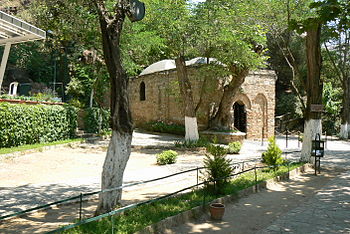
Finding remains of an ancient home in Ephesus on a hill and claiming it matcher her description thus...is pretty sketchy to even qualify as 'some.' The RCC knows how to run a pretty good tourist revenue generating business for shrines to dead saints but this sounds like...poppycock.Redstone said:
Believe in Bl. Emmerich or not, her visions have had SOME MEASURE of materialist / archeological validation - most famously near Ephesus.
Quite different than the many Gnostic-based traditions in written and oral form, including that one - which started after all the Gospels were composed.
Quote:
Ann Catherine Emmerich (8 September 1774 9 February 1824) was an Augustinian nun of the Roman Church. She supposedly saw visions which told about the Mother of God falling asleep in Ephesus and being buried also in Ephesus but it seems that her followers never found a tomb of the Mother of God in Ephesus but just her house. According to Ann, "The sepulcher prepared for her on the Mount of Olives was always held in honor, and later a church was built over it, and John Damascene (so I heard in the spirit, but who and what was he?)". Prelest in all its grandeur!
During her bedridden years, a number of well-known figures visited her. The poet Clemens Brentano interviewed her at length and wrote two books based on his notes of her visions and which described the location and appearance of a small isolated house near Ephesus, where she said Mary lived and died. Emmerich also said that Mary was buried near the house, although to date no grave has been found. The authenticity of Brentano's writings has been questioned and critics have characterized the books as "conscious elaborations by a poet" and a "well-intentioned fraud" by Brentano.
Neither Brentano nor Emmerich had ever been to Ephesus, and the city had not yet been excavated; but visions contained in The Life of The Blessed Virgin Mary were used during the discovery of the "House of the Virgin Mary", the Blessed Virgin's supposed home before her Assumption, located on a hill near Ephesus, as described in the book Mary's House.
The Holy See has taken no official position on the authenticity of the location yet, but in 1896 Pope Leo XIII visited it and in 1951 Pope Pius XII initially declared the house a Holy Place. Pope John XXIII later made the declaration permanent. Pope Paul VI in 1967, Pope John Paul II in 1979 and Pope Benedict XVI in 2006 visited the house and treated it as a shrine. In 1881, a French priest, the Abb Julien Gouyet used Emmerich's book to search for the house in Ephesus and found a house supposedly based on the descriptions. He was not taken seriously at first, but a nun named Marie de Mandat-Grancey persisted until two other priests followed the same path and confirmed the finding.
Today another group of Benedictines, Benedictine nuns, have made a monastery below this "shrine" in Ephesus and so we have Benedictines keeping two shrines in two faraway lands both claiming to be the site of the Falling Asleep of the Mother of God and Roman Catholics have one tomb of the Theotokos in Jerusalem and one tomb that Emmerich says the Mother of God was buried in somewhere in Turkey.
It might not be her abode - though I think it is - and that's not all. I hope people investigate if interested.
one MEEN Ag said:I thought the consensus view was the Magi were zoroastrianists from ancient Iran.lb3 said:
I'm intrigued by the theory that the 3 wise men were Buddhist monks searching for their next Lama and that Jesus could have spent his childhood training in India.
I view Buddhism as more philosophy than religion if you ignore the reincarnation thing so I don't have any real heresy issues with this theory.
I have read several speculations that the wise men were of Eastern origin, and their teachings influenced Christ. It is interesting to at least think about. The Kingdom of Heaven is very different than legalistic Judaism. In those speculations though, the magi left some people behind with Jesus and their family. Pure speculation, and quite silly imo.
But, there is this beatitude:
"Blessed are those who mourn, for they will be comforted."
This is anathema to Bhuddism. If anything, it is a direct refutation of the core of Bhuddism, where the point is not to be attached to anything so much that it causes you pain to lose it.
It takes a special kind of brainwashed useful idiot to politically defend government fraud, waste, and abuse.
Quote:
The Kingdom of Heaven is very different than legalistic Judaism
If we leave off the word legalistic, this train of thought seems very suspect. Christ is both Lawgiver and Judge. I find the idea that He would teach something different pretty difficult to imagine.
A lot of that is just much later speculation with embellishments (the '3 wise men'), but the ultimate purpose of the story is that the gifts are a metaphorical way to convey that Jesus was born a king (of sorts). IMHO, they were likely from Arabia, and came via horseback, not following 'the north star' etc.
Put into the context of the time of Christ.Zobel said:Quote:
The Kingdom of Heaven is very different than legalistic Judaism
If we leave off the word legalistic, this train of thought seems very suspect. Christ is both Lawgiver and Judge. I find the idea that He would teach something different pretty difficult to imagine.
People were trying to find God by ever more incremental exactness in following the law. That is just the wrong direction.
Jesus is the perfect judge. The laws / guides given by God to tell us how to live are excellent rules to follow, but they only point in the general direction of salvation, they are not salvation in and of itself. It's the relationship and heart that matters.
Whether or not the OT teaches these concepts is debatable. However, a huge amount of Jesus's teachings were focused on how Jewish legalism of the time was wrong headed.
Just to be clear here, I don't think for a second that Jesus's ministry was impacted by the teaching of some eastern philosophers. I'm just saying it is interesting that people could come to that conclusion, given the difference in tone between Leviticus and the Sermon on the Mount.
It takes a special kind of brainwashed useful idiot to politically defend government fraud, waste, and abuse.
I was mostly with you until the last paragraph.
If you see a disjunction between the Sermon on the Mount and Leviticus I think you're misreading one or the other.
If you see a disjunction between the Sermon on the Mount and Leviticus I think you're misreading one or the other.
Well, it is called the 'Antitheses' for a reason.
It's not so much a disjunction, imho, as an extension, however.Quote:
Examples of fence building attributed to Jesus appear most clearly in the so-called Antitheses of the Sermon on the Mount (Matt. 5:2147). To those who heard it said, "You shall not murder," Jesus says, "If you are angry with a brother or sister, you shall be liable to judgment." To those who heard it said, "You shall not commit adultery," Jesus says, "Everyone who looks at a woman with lust has already committed adultery with her in his heart." To those who heard it said, "You shall not swear falsely," Jesus says, "Do not swear at all" (a point ignored by those who insist on "swearing on a stack of Bibles" or being "sworn in" by placing one's hand on a Bible). In each case, Jesus is taking the Law, the Torah, so seriously that he extends prohibitions regarding action to prohibition regarding thought. The term "Antitheses" itself is an unfortunate label that gives the impression of separating Jesus from Jewish tradition, for it suggests that Jesus is antithetical to the Torah. Jesus does not "oppose" the Law; he extends it. Moreover, his attitude toward it is not liberal, but highly conservative.
The only actual "antithesis" of this section of the Sermon on the Mount is Matthew 5:4344: "You have heard that it was said, 'You shall love your neighbor and hate your enemy.' But I say to you, Love your enemies and pray for those who persecute you." No law commands hatred of enemies. On the contrary, Proverbs 25:21 advises, "If your enemies are hungry, give them bread to eat, and if they are thirsty, give them water to drink." Granted, there is a compensatory aspect to this bit of wisdom, for the proverb does indicate that those who do behave in such a benecent manner toward enemies "will heap coals of re on their heads, and the Lord will reward you" (25:22). Jesus therefore goes a step beyond the biblical tradition. Nevertheless, at least the enemy gets fed, and it might be a good reminder to those who hear his words in the Sermon on the Mount that "loving the enemy" also involves physical care, including "daily bread."
It seems like your quote agrees with me. Antithesis is a bad label. It's closer to synthesis than anything.
I don't think they would call bull**** for various reasons.Quote:
Question here though. If the interpretation is as you say, don't you think readers sixty years later would call bull***** If the writer is saying that tens or hundreds of thousands of people had to travel for the census, and this is incorrect, wouldn't a 90 ad reader know enough to call bs? I mean, the writer mentions the name of the census, so people that were alive for that census would have recognized it.
1. This narrative may not have originated in that area.
2. The religion may not have been relevant enough for people to care about refuting.
3. How much did 90AD or 60AD people know about a 0AD census. I know very little about any day to day things about my dad or my grandpa. Anything I think is inferred by the general information of the time. It's pretty terrible in the 1900s and I can't imagine how bad it was in the 0000's.
I feel like something got deleted because I responded this before.
I don't think the lie was easily refuted back then.Quote:
It seems silly to add in an obvious and easily refuted lie. It might not be easy to refute 2000 years later, but it would have been easy back then.
I don't think it was relevant for people to disprove the census. It was a minor religion at the time and that is why the only documentations if from people who were 100% bought in. The rest didn't care and had no way to know that a roman emperor would later adopt it and legitimize it.Quote:
Or, do you believe that this story was added much later, after everyone who remembered this census, or who's grandparents would have talked about the census, had already died? Different animal.
There is no reason at all to believe any of this is true. It literally requires belief that things were done in a completely inefficient and stupid manner. if this same situation was proposed to you as proof or validation of any other religion you would laugh it off as evidence the faith wasn't real. Mohammed flew to heaven on a flying horse. Obviously islam is true. Nobody would lie about that. It's clearly true and anybody who doubts that is just a meany atheist or pagan who doesn't understand that. Why don't you believe in the one true god, mohammed's god? You can easily see islam is utterly stupid but the exact same reasons that show islam is stupid show christianity is stupid too. The thing is people who are into christianity or islam completely disagree. They can both look at each others faiths and show how silly they are but they cannot look at their own faith and do the same.Quote:
We have three elements here:
1) a census was called
2) Joseph was "of bethleham" and went there for the census
3) Joseph was of the line of David
You cut out a big chunk of my post.
The verse does not clearly say that everyone went to their ancestral town for the census once you look at the Greek. It says that Joseph did. It says everyone went to their own town. That could easily mean everyone went home.
The way you interpreted it is a pretty straightforward interpretation, but not the only possible interpretation.
But, if you want to get into whether or not Christianity is "silly", that's a whole different topic. Like I said, I am comfortable with my faith even if the Bible has parts of it that are potentially not historically accurate. It's just a better way to live.
The verse does not clearly say that everyone went to their ancestral town for the census once you look at the Greek. It says that Joseph did. It says everyone went to their own town. That could easily mean everyone went home.
The way you interpreted it is a pretty straightforward interpretation, but not the only possible interpretation.
But, if you want to get into whether or not Christianity is "silly", that's a whole different topic. Like I said, I am comfortable with my faith even if the Bible has parts of it that are potentially not historically accurate. It's just a better way to live.
Featured Stories
See All
21:37
7h ago
2.9k
Swarming defense paves the way for A&M to advance
by Olin Buchanan
8:13
8h ago
2.3k
6:49
8h ago
1.6k
Agee's 22 vs. Saint Mary's sends A&M to third straight Round of 32
by Olin Buchanan
BetterNotBeChipKelly
Bucky already achieved everything Buzz did.
in Billy Liucci's TexAgs Premium
24