DIY Molding/Trim - Advice for beginner

8,237 Views | 37 Replies | Last: 7 yr ago by AgCWby90CS
DeBoss
How long do you want to ignore this user?
So I think I want to start learning how to do trim and molding so that I can slowly replace everything in my house without having to pay someone a ton of money. What are the basics I need and how can I learn how to do everything properly? Seems I really need a table saw with the ability to cut at angles and a way to paint each board easily.

Anything I'm missing or am I crazy for wanting to do this myself?
Flashdiaz
How long do you want to ignore this user?
i've never done it myself but I would think a miter saw would be better than a table saw for cutting molding especially at different angles.

and no you're not crazy for wanting to learn something new and to have an excuse to buy more tools
JDCAG (NOT Colin)
How long do you want to ignore this user?
Agree on miter saw vs table saw.

Table saws are great for ripping down plywood and you can do some crosscutting too.

With trim, I wouldn't expect you to be ripping much (not sure, never done it myself), but you will need to make precise angled cuts and that can be a pain in the ass on a table saw - especially if you have a long piece.

If nothing else, I'd start with the miter saw and then see if the TS is still a need.

You'll probably also want to invest in some good tools for taking accurate measurements of angles.
DeBoss
How long do you want to ignore this user?
Ok so I used the wrong saw name. Totally meant a miter saw because that is what a buddy brought over 1 time when he helped me. So definitely will need that.

The corner/angles are what I think might be the hardest part. The long straight spots seem to be the easiest. Just cut each board at an angle so they overlap and then you can't see the seem.

But the angles scare me since I will need a small piece in the middle the "bridge" the gap between two longer pieces.

Also I guess a battery operated nail gun will be necessary right?
Ikanizer
How long do you want to ignore this user?
18 gauge nail gun works great for small trim and molding. You can get one along with a small compressor at Harbor Freight and you won't be disappointed.
mneisch
How long do you want to ignore this user?
No need for anything in the middle to bridge the gap. If you are close enough on the angles, simple latex caulk will fill the gap (you'll be using it anyways). I've replaced nearly all the trim in my house, and the easiest method I have found is to:

1. Buy primed trim (MDF or finger jointed pine, doesn't matter. MDF is cheaper, but I don't like to use it anywhere the trim might get wet like bathroom baseboards)
2. Paint trim with your desired trim paint out in garage or wherever
3. Measure and hang trim with nail gun, preferably 18 gauge
4. Caulk all joints and over nail holes
5. Hit the trim with a second coat to cover caulk

A miter saw will have stops at all the common angles, so unless you have some intricate crown moulding and weird angles, it really isn't hard. Just make sure to follow the adage, measure twice, cut once.

I would recommend a dual bevel 10" or 12" saw. My $99 Hitachi has been more than adequate, though one day I plan to upgrade to a 12" sliding saw.
DeBoss
How long do you want to ignore this user?
So the Dewalt 12" dual bevel sliding is $350. Is that the normal price and I should wait for a sale or is that a good deal?
Bob_Ag
How long do you want to ignore this user?
Look around your house and see what kind of angles you have. Are you wanting to do or replace crown molding on the ceilings? Do have vaulted or raised portions or places where the angles are not 90?

On the floor trim, do you have rounded drywall corners? The reason I ask is that it will change the way you miter pieces together. If it's just simple 90 degree miter cuts, then it's pretty easy. When you have vaulted sections or rounded portions, it gets a little more involved, but still doable. Youtube will help.

Another thing to keep in mind is the size of the molding you will want to use which will then dictate the size of the miter saw. If you plan to do crown, you should just spring for a 12" sliding dual compound miter saw. Simple 2.5" floor trim can be done with a basic miter saw, but I would still opt for the 12" vs the 10" for the future.
mneisch
How long do you want to ignore this user?
It's overkill for you right now if you are only using it for trim work. I use my miter for tons of things but the 10" can't cut a 4x4. A 12" saw will, and then add the sliding and you can cross cut a 12" board, if not even wider. They are big and bulky though compared to a 10" non-sliding saw.

I would recommend the 10" Hitachi, which will accomplish everything you described and only run you $99, or even $79 if you find it on sale like I did. Once you get more accomplished you can then add the 12" sliding saw if you see a need.
Bob_Ag
How long do you want to ignore this user?
Another couple tips, when you remove the old trim, cut the caulk line first so you don't rip off paint or drywall. I also suggest priming and painting beforehand, then when you install it, you're just doing touch up after spackling the nail holes.

In a lot of new construction today, builders are simply using 1x4 or 1x6 trim board for molding and trim on some pretty expensive houses. It looks pretty damn easy to do as well.

Kind of like this.

mneisch
How long do you want to ignore this user?
Good point on cutting the caulk before ripping the old trim off. If you don't do this you usually end up with latex paint that peels back bad, or even torn drywall.
DriftwoodAg
How long do you want to ignore this user?
mneisch said:

Good point on cutting the caulk before ripping the old trim off. If you don't do this you usually end up with latex paint that peels back bad, or even torn drywall.
also helps to install taller baseboards to cover up any damage that may occur removing the old baseboards. I also like to use painter's tape to give me a smooth line when re-caulking.
DeBoss
How long do you want to ignore this user?
Yeah so my only project the first go round will be baseboards and then framing around doors. I'll be removing the crappy 2.5in. and putting on big 4-6" flat MDF. My wife wants the bigger, cleaner look. So the good news is that it might cover up any "incidents".

I do have rounded corners everywhere that I have to deal with which is my biggest concern. That and how the angle it properly to tie in with the molding going around the doors. So I guess I'll need to YouTube how to do a rounded corner properly because I think my builder did a crap job.
Dr. Doctor
How long do you want to ignore this user?
This Needed

And a mitre saw. And a nail gun.

I have a Harbor Freight 3-gal air compressor and a Lowe's nail gun (the HF one sucked). Air hose and supply of 18 gauge nails and I got my 1st house mostly done with crown molding.

Prime/Paint before cutting/installing and touch-up afterwards. For a nice touch, on crown, you can put 'basic' baseboards on top, with a spacer to lower them. Then put the crown molding on top.

Caulk the holes and then touch up with paint. Looks great! Go slow and it will look amazing.

~egon
~egon
who?mikejones
How long do you want to ignore this user?
Miter saw
Trim Nail gun
Disc Sander
Bondo
Laser level

Get those and youll be set.
Gary79Ag
How long do you want to ignore this user?
One friendly reminder...if you have pocket doors in the house that will get trimmed with baseboards and door casings, be sure to use the proper length of nails! Otherwise, you may be repairing the pocket door!
who?mikejones
How long do you want to ignore this user?
That's what the bondo is for
Gary79Ag
How long do you want to ignore this user?
who?mikejones said:

That's what the bondo is for
LOL, sounds like someone else that has actual experience!

Actually turned out that for some unknown reason, one of my pocket doors had a bent nail protruding thru the pocket door frame only in the bottom corner about 3 inches from the floor and at the back end of the pocket. The nail scrapped a gash about 3 inches long and about a quarter inch deep into the door.


Never noticed any issue when the door was installed as I speifically check during the door instllation, but after a couple of years, it became quite evident as the door is painted black and the scratch marked area is an off white color.

I throught it was a nail from the base board, so I took a magnet to locate the nails in that area and removed them first to no avail as they were short and about an inch off from the actual scratch mark area. Then I thought it might be a sheetrock screw and I found it with the magnet and removed it as well, but to no avail as it too was short and off as well. So I cut a hole in the sheet rock in the area slightly above the pocket framing and wolla, there it was. A 16 guage nail approximately 2" long bent like it struck a metal plate and sticking out just enough to make contact with the door.

No idea how it got there...good thing was that when I cut the hole in the sheetrock, it was low enough that the baseboard covered it so no sheetrock patch work was required.

BTW, for patching nail holes, I use painters putty in lieu of caulk as it's much cleaner and easier to work with to get a smooth patch job done!

Long Live Sully
How long do you want to ignore this user?
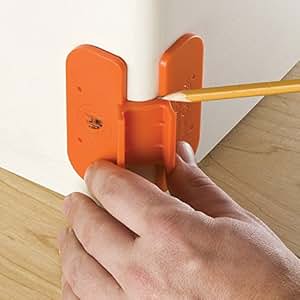
This tool is great for mitering base for rounded corners. It is used to divide your 90 degree cuts into precise lengths at 45 degrees. Available at Amazon under "bench dog 10-030"

aggiemike02
How long do you want to ignore this user?
consider that depending on the shape of casing you remove around your doors, the new casing you install may not cover gaps in the flooring below, even if you don't have plinths. generally this could be fixed with stained wood putty if you have hardwood, but not in all cases. if tile, might be tougher.

you may also have quarter round you'll need to reinstall on the baseboards.
Caesar4
How long do you want to ignore this user?
Many years ago, I installed moulding at the ceiling and about a foot down from the ceiling in a small downstairs bath with lots of corners. It was very tedious because none (or almost none) of the angles turned out to be 90 degrees.

At the time, I wondered if a tool like this would have helped so that I could measure the angle before making any cuts. https://www.amazon.com/GemRed-Digital-Finder-Protractor-Stainless/dp/B00W395R5E?ref_=bl_dp_s_web_10354604011

DeBoss
How long do you want to ignore this user?
Lucky for me my builder was a POS and didn't do any quarter round!!!
Gary79Ag
How long do you want to ignore this user?
aggiemike02 said:

consider that depending on the shape of casing you remove around your doors, the new casing you install may not cover gaps in the flooring below, even if you don't have plinths. generally this could be fixed with stained wood putty if you have hardwood, but not in all cases. if tile, might be tougher.

you may also have quarter round you'll need to reinstall on the baseboards.
One of the guys that installed hardwood flooring gave me a tip on how to cover the gap if it's a very narrow one...cut some cardboard and fold it in half (if necessary) and put it behind the baseboard at the bottom before nailing it in place. Worked great for a small issue I had when I installed my baseboards.
DriftwoodAg
How long do you want to ignore this user?
DeBoss said:

Lucky for me my builder was a POS and didn't do any quarter round!!!

Your builder may be a POS, but not using quarter round is a good thing
Caesar4
How long do you want to ignore this user?
Quote:

Bob_AgAnother couple tips, when you remove the old trim, cut the caulk line first so you don't rip off paint or drywall. I also suggest priming and painting beforehand, then when you install it, you're just doing touch up after spackling the nail holes.

In a lot of new construction today, builders are simply using 1x4 or 1x6 trim board for molding and trim on some pretty expensive houses. It looks pretty damn easy to do as well.

Kind of like this.


I prefer this look to the curved/contoured moulding that used to be the default. This kind of moulding is easier, IMO, to re-paint and/or clean after a few years of dust, fingerprints, scuff marks from kids, kid toys, pets, etc. Likely easier to install as well.
mneisch
How long do you want to ignore this user?
Agreed, quarter round is usually used as a crutch and doesn't look as good in my opinion. I prefer to lay the baseboards on top of the flooring.
Aggietaco
How long do you want to ignore this user?
mneisch said:

Agreed, quarter round is usually used as a crutch and doesn't look as good in my opinion. I prefer to lay the baseboards on top of the flooring.
Not just you, it's the way base is supposed to be installed.
who?mikejones
How long do you want to ignore this user?
Gary79Ag said:

who?mikejones said:

That's what the bondo is for
LOL, sounds like someone else that has actual experience!

Actually turned out that for some unknown reason, one of my pocket doors had a bent nail protruding thru the pocket door frame only in the bottom corner about 3 inches from the floor and at the back end of the pocket. The nail scrapped a gash about 3 inches long and about a quarter inch deep into the door.


Never noticed any issue when the door was installed as I speifically check during the door instllation, but after a couple of years, it became quite evident as the door is painted black and the scratch marked area is an off white color.

I throught it was a nail from the base board, so I took a magnet to locate the nails in that area and removed them first to no avail as they were short and about an inch off from the actual scratch mark area. Then I thought it might be a sheetrock screw and I found it with the magnet and removed it as well, but to no avail as it too was short and off as well. So I cut a hole in the sheet rock in the area slightly above the pocket framing and wolla, there it was. A 16 guage nail approximately 2" long bent like it struck a metal plate and sticking out just enough to make contact with the door.

No idea how it got there...good thing was that when I cut the hole in the sheetrock, it was low enough that the baseboard covered it so no sheetrock patch work was required.

BTW, for patching nail holes, I use painters putty in lieu of caulk as it's much cleaner and easier to work with to get a smooth patch job done!


I only use pocket door frames built with plywood so i do not have to worry about sticking a nail through it.

Really, we use bondo on joints so our paint finish is smooth and uninterrupted
Rustys-Beef-o-Reeno
How long do you want to ignore this user?
I retrimmed my upstairs post Harvey, kobalt 12 inch sliding miter saw with a fine tooth blade, I think it I was like 199 Black Friday, and then I picked up a 199 air tank and brad nailed, 18 gauge nailer and a finish nailer combo on Black Friday.
BKS_Aggie08
How long do you want to ignore this user?
Watch some YouTube videos on coping the corners of your baseboards. Makes life a lot easier than trying to miter when your corners aren't perfect 90s.
IWannaGoFast1
How long do you want to ignore this user?
I absolutely despise my Kobalt 10" compound slider. The fence is bowed, which makes angles tough to get right and the arm assembly is flimsy. I would not do the Kobalt again.

Also, get a good trim blade...meaning Freud. They are worth the price. Don't use it on anything but your trim.
AgCWby90CS
How long do you want to ignore this user?
BKS_Aggie08 said:

Watch some YouTube videos on coping the corners of your baseboards. Makes life a lot easier than trying to miter when your corners aren't perfect 90s.
and this old house videos online specifically about molding trim.


You can also get away from most compound mitre cuts by using matching corner blocks.
CWby '90
62strat
How long do you want to ignore this user?
Just want to chime in on the rounded corners.
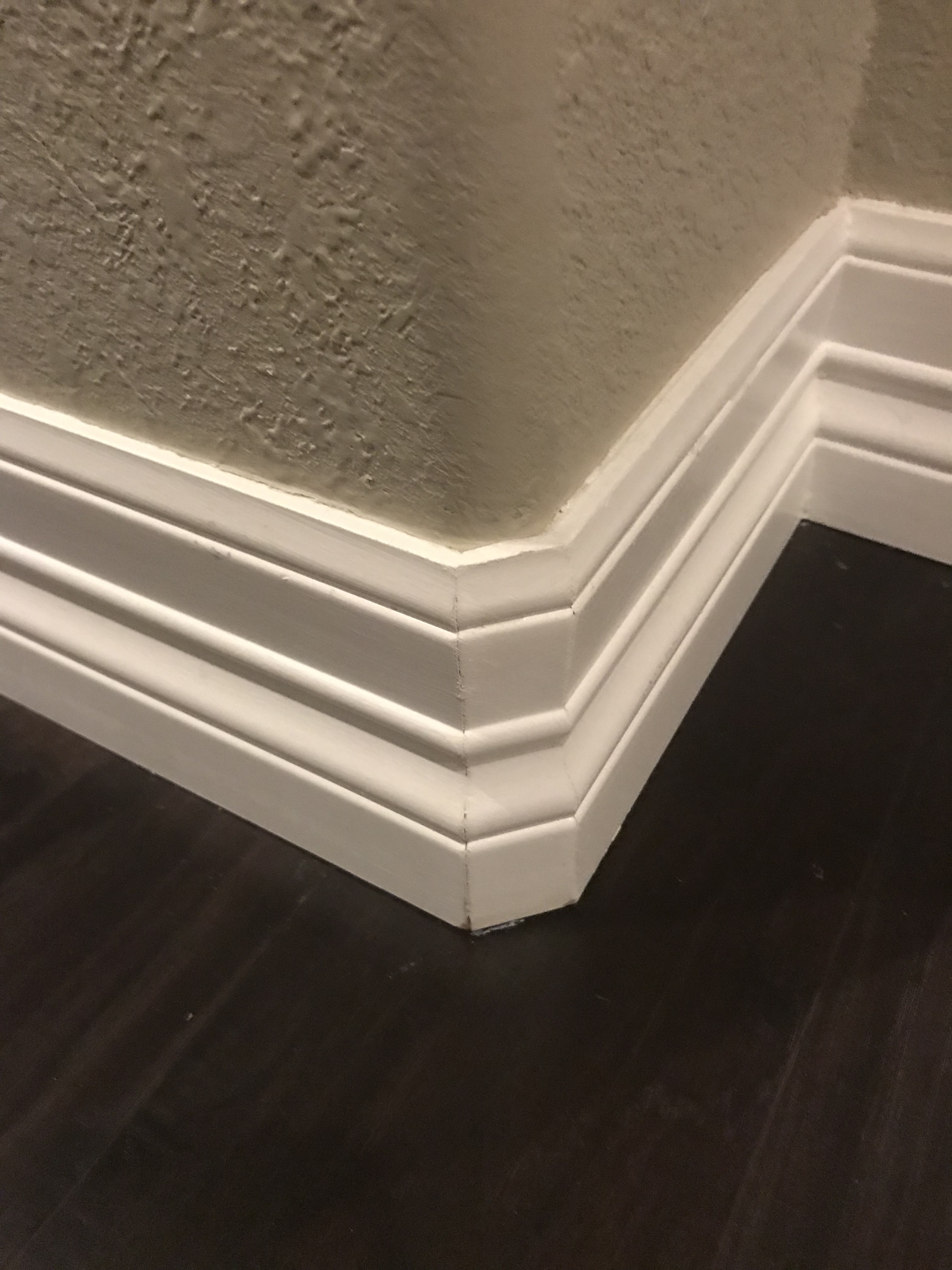
They look like this:


All the middle pieces are that same size, so once you get one corner down, I'd make copies of that middle piece and keep one loose to just hold in place so you can mark the straight pieces.
AgCWby90CS
How long do you want to ignore this user?
Those corners should be at 22.5 degrees on the mitre saw
CWby '90
IowaAg07
How long do you want to ignore this user?
Spring for the bigger miter saw with a good blade. You can justify it by looking at how much you're saving compared to paying someone to do it, and you'll end up not having to find someone to take your smaller, cheaper one off your hands. Not that I'd know anything about that...

One thing to pay attention to when you're buying a saw is a laser, most brands have them but it was a huge difference for me between my cheapie saw and my nicer saw. My wife thought I had cracked when I started laughing after the first few cuts with my new saw, but she hadn't quite seen how frustrated I was with my cheapie piece o' junk. You can also look for deals on miter saws with a stand, I used one of those long folding tables but the videos I saw where they were using stands seemed a little easier to use.

I bought trim from a local trim place that was pre-painted, buying in bulk got it down to under $0.45/linear foot and I didn't have to mess with painting other than touch up for the holes. It was comparable to buying trim at the big box stores and saved me some time, so that might be worth looking into.

I would also recommend watching some YouTube videos like the one linked, they have lots of different tips and tricks that fit different situations. I preferred to use my Dremel with a grinding bit vs hand coping inside corners, that was one that that I learned about halfway though my main floor and it sped things up quite a bit.
Page 1 of 2
 
×
subscribe Verify your student status
See Subscription Benefits
Trial only available to users who have never subscribed or participated in a previous trial.