
From everything ive read online, it seems like engineered is the way to go. Anyone disagree?
engineered hardwood vs hardwood
3,868 Views |
40 Replies |
Last: 12 yr ago by Aggietaco
If you are laying the flooring on a slab foundation, I think engineered hardwood is the only way you can go. Regular hardwood floors require something to nail into, which precludes it being installed on concrete.
House on slab in Houston. They dont glue hardwoods?
Solid hardwood can be installed on a slab, you just have to have add a plywood subfloor. Of course, this is added expense and raises the floor higher, so you have more potential for transition issues. If you intend to be in the house for a long time, I would go with solid, as you can refinish them multiple times.
Of course, some people think you can get a harder, more durable finish on pre-finished floors, although you can get pre-finish solid wood as well (as opposed to site finished).
With all of that said, engineered is probably cheaper.
Of course, some people think you can get a harder, more durable finish on pre-finished floors, although you can get pre-finish solid wood as well (as opposed to site finished).
With all of that said, engineered is probably cheaper.
And engineered is hardwood. It is just not one solid piece. It consists of multiple layers of wood and your top wear layer.
Can you refinish engineered? I would think you could do it at least once.
I do not know if you can refinish engineered or not. I think some manufactures claim you can, but I would not think more than once or twice at most. I am sure there are others here who are more knowledgeable.
You can once or twice, depends on the thickness. After that it's a crap shoot as you'll most likely sand into the next layer and cause some problems.
If you have a spill that ruins a section of your engineered wood floor, how easily can you repair it without replacing the entire thing assuming that you don't have enough extra planks on hand? I know with solid wood floors, it's a fairly straight forward process.
been told you cannot refinish engineered wood, but the finish lasts longer so you don't have to do this - that is the point.
Regarding damage/spills. You can replace individual pieces of engineered wood.
Regarding damage/spills. You can replace individual pieces of engineered wood.
quote:
been told you cannot refinish engineered wood
sure you can. I had a client do just that a few weeks ago.
As others have mentioned, it's not something you want to do more than once or twice though.
i put down a floating engineered floor a little over a year ago, and there's some spots that i wish I could replace.
Unfortunately, this would require breaking appart the whole floor and reinstalling it, because i went with the click-lock system. Which means its very directional in it's installation.
If you go engineered i recommend glue down, and tongue/groove over floating / click lock.
With tongue and groove, you have a much better option for remove / replace individual boards at a later date. You will more than likely have a scratch / gouge that you cant fix with just a minor sand / stain / poly refinishing.
If your subfloor is anywhere near level - spend the time to glue it down - dont float it. The result is much better. While what we have is still waaaay better then it was before, im kicking myself for not going with a glue-down t&g.
that and spend the money on a more durable wear layer.
the wife liked the "flat" look - non-glossy finish, so thats what we picked - only to find that part of the way they get the flat finish is a relatively thinner poly coat - so it scratches pretty easily.
im sure there are more durable flat finishes... but we certainly didnt get one... just beware of cheap flooring.
Unfortunately, this would require breaking appart the whole floor and reinstalling it, because i went with the click-lock system. Which means its very directional in it's installation.
If you go engineered i recommend glue down, and tongue/groove over floating / click lock.
With tongue and groove, you have a much better option for remove / replace individual boards at a later date. You will more than likely have a scratch / gouge that you cant fix with just a minor sand / stain / poly refinishing.
If your subfloor is anywhere near level - spend the time to glue it down - dont float it. The result is much better. While what we have is still waaaay better then it was before, im kicking myself for not going with a glue-down t&g.
that and spend the money on a more durable wear layer.
the wife liked the "flat" look - non-glossy finish, so thats what we picked - only to find that part of the way they get the flat finish is a relatively thinner poly coat - so it scratches pretty easily.
im sure there are more durable flat finishes... but we certainly didnt get one... just beware of cheap flooring.
I would disagree...
Installed hardwoods are virtually indestructable...
And yes 90% of hardwoods are installed on Slabs. You do nail plywood to the slab, not glue... Doors are cut if needed, it's an every day occurence.
Pre-engineered scratch rather easily and there is not much you can do.
http://www.dfwcustomwoodfloors.com
Watch the video and make your own judgements.
Installed hardwoods are virtually indestructable...
And yes 90% of hardwoods are installed on Slabs. You do nail plywood to the slab, not glue... Doors are cut if needed, it's an every day occurence.
Pre-engineered scratch rather easily and there is not much you can do.
http://www.dfwcustomwoodfloors.com
Watch the video and make your own judgements.
quote:
Pre-engineered scratch rather easily and there is not much you can do.
that doesn't make sense to me, since the surface IS hardwood. scratching has to do with the coating and type of wood you are installing. the composite below the surface is just that, below the surface.
Why would an engineered hardwood floor scratch any easier than a solid hardwood floor? Same material on the wear surface with a more predictable substrate with the engineered material.
quote:
And yes 90% of hardwoods are installed on Slabs.
Finding that little made up statistic hard to believe since a lot of the country has basements.
quote:quote:
And yes 90% of hardwoods are installed on Slabs.
Finding that little made up statistic hard to believe since a lot of the country has basements.
What do basements have to do with it?
If you have a basement it's very unlikely your first floor will be a concrete slab.
quote:Huh? My dad is a home builder in the panhandle and 95% of the houses built have basements, of those 100% of them have concrete slabs.
If you have a basement it's very unlikely your first floor will be a concrete slab.
I guess you were referring to Houston, where the water table is much higher.
[This message has been edited by txag2008 (edited 10/16/2013 8:29a).]
No, I'm referring to pretty much every house I've dealt with that had a basement (Seattle, Wyoming, MO, ...). The basement is a concrete slab but the first floor and second if there is one are built on floor joists. Otherwise it seems a bit difficult and expensive to pour concrete for a basement, then find a way to pour a slab above the basement for additional floors above it.
quote:
Huh? My dad is a home builder in the panhandle and 95% of the houses built have basements, of those 100% of them have concrete slabs.
I think you are confused. Homes with basements have floor joists and plywood floors on the main level where you set carpet or nail down wood floors or maybe tile. The basement is a slab.
Not confused. The houses with basements have concretes slabs in the basement and concrete slabs for the main level poured directly overhead. Granted these aren't full sized basements, typically ~20x20'.
quote:You are correct, and I did lots it growing up.
Even a 20x20 basement with a slab overhead would take a lot of support to hold up the concrete. It takes a lot of decking, joists and columns to hold up that type of weight.
quote:
Even a 20x20 basement with a slab overhead would take a lot of support to hold up the concrete
Not really. All you need is properly designed and installed reinforcing. A 20 foot span with little dead load and live load for concrete, even at homebuilding standards (read: low) is not hard to do at all, takes little additional material and minimal expense for shoring during construction.
That being said, I probably would not opt for one in a house. To much flexibility with homes and a more traditional joist floor system with plywood decking would be a better option to deal with stresses induced by house movement.
[This message has been edited by schmellba99 (edited 10/16/2013 4:37p).]
My thoughts on the "engineered floors scratch easier" is simply a matter of quality of the finish.
When you're forking out the money to have solid hardwood installed, you're expecting quality, and you pay for it at all levels.
There are certainly many levels of engineered hardwood - and i know there are some that are much higher quality than others - but because you are going with a "cheaper" product, you're more open to the possiblity of getting a lower quality finish.
Remember - its NOT THE WOOD that's scratching initially, its the clear coat.
You are right, engineered flooring DOES have a hardwood wear layer - but its very thin.
Engineered flooring is technically just plywood / composite with the outer ply being a veneer of a hardwood (hickory, oak, etc).
The simple fact of the matter is - when they're constructing engineered floor boards, they generally DONT put a very thick sealing / poly - clear-coat on them. THIS is what scratches through, or allows moisture to penetrate and causes the veneer surface layer to blister/buckle, and is what ultimately results in the failure of these floors.
YES, there IS hardwood present on the "top" layer (under the poly/clear coat) - and YES you technically COULD sand it and refinish it once.
But, take it from me - I just put down engineered floor a year ago, and the issues that i have with mine are not fixable by sanding / refinishing. I will eventually have to replace boards or the whole floor.
When you're forking out the money to have solid hardwood installed, you're expecting quality, and you pay for it at all levels.
There are certainly many levels of engineered hardwood - and i know there are some that are much higher quality than others - but because you are going with a "cheaper" product, you're more open to the possiblity of getting a lower quality finish.
Remember - its NOT THE WOOD that's scratching initially, its the clear coat.
You are right, engineered flooring DOES have a hardwood wear layer - but its very thin.
Engineered flooring is technically just plywood / composite with the outer ply being a veneer of a hardwood (hickory, oak, etc).
The simple fact of the matter is - when they're constructing engineered floor boards, they generally DONT put a very thick sealing / poly - clear-coat on them. THIS is what scratches through, or allows moisture to penetrate and causes the veneer surface layer to blister/buckle, and is what ultimately results in the failure of these floors.
YES, there IS hardwood present on the "top" layer (under the poly/clear coat) - and YES you technically COULD sand it and refinish it once.
But, take it from me - I just put down engineered floor a year ago, and the issues that i have with mine are not fixable by sanding / refinishing. I will eventually have to replace boards or the whole floor.
Also -
not all solid-wood floors are equal either... Engineered flooring is almost always (if not always) pre-finished. It saves steps for the installer - but the quality of the finish is significantly lower than is achievable by finish-in-place solid wood flooring (which is PROBABLY what people are talking about here - as opposed to pre-finished solid wood). Think about it - applying stain / clear coat to an individual piece of flooring in the factory, vs a wide flat surface after it's installed.
If you've done any wood working, you know that you'll get a MUCH better finish on the bigger surface simply because of the relative ease of the process - and the inherent nature of the application method.
The clear coat will simply go on thicker, and more evenly.
It will likely fill pores in the surface better, and will span the gaps between boards (they may be small gaps - but they're there, and water WILL find its way through if they're not sealed).
Unfilled pores is probably the biggest complaint i have with my flooring. My 2 year old spilled a cup of milk, and i wiped it all up within 30 second (or THOUGHT i did...)
I came back 30 min later to buckling of the hardwood layer itself. The milk penetrated through the unfilled pores in the wood, and caused it to separate from the substrate below.
There's no repairing THAT by sanding / refinishing.
The point is - its easy to convince yourself that engineered floor is just as good as the real thing (i know - i did it to myself...), and tell yourself - "its real wood - not the plastic / laminate stuff". And you're right...
but it has its down sides. Depending on your lifestyle - it can be a decent option - and all things considered, it may make sense for you... but it simply ISNT as durable as true hardwood, and really, isnt as durable as laminate.
It still may make sense for your application - but that's a choice you make.
I likely wont install engineered hardwood again - at least not while i still have kids in the house. I'll either decide that its worth going for real wood, or go with laminate if i ever have to do it again.
[This message has been edited by baumenhammer (edited 10/16/2013 3:55p).]
not all solid-wood floors are equal either... Engineered flooring is almost always (if not always) pre-finished. It saves steps for the installer - but the quality of the finish is significantly lower than is achievable by finish-in-place solid wood flooring (which is PROBABLY what people are talking about here - as opposed to pre-finished solid wood). Think about it - applying stain / clear coat to an individual piece of flooring in the factory, vs a wide flat surface after it's installed.
If you've done any wood working, you know that you'll get a MUCH better finish on the bigger surface simply because of the relative ease of the process - and the inherent nature of the application method.
The clear coat will simply go on thicker, and more evenly.
It will likely fill pores in the surface better, and will span the gaps between boards (they may be small gaps - but they're there, and water WILL find its way through if they're not sealed).
Unfilled pores is probably the biggest complaint i have with my flooring. My 2 year old spilled a cup of milk, and i wiped it all up within 30 second (or THOUGHT i did...)
I came back 30 min later to buckling of the hardwood layer itself. The milk penetrated through the unfilled pores in the wood, and caused it to separate from the substrate below.
There's no repairing THAT by sanding / refinishing.
The point is - its easy to convince yourself that engineered floor is just as good as the real thing (i know - i did it to myself...), and tell yourself - "its real wood - not the plastic / laminate stuff". And you're right...
but it has its down sides. Depending on your lifestyle - it can be a decent option - and all things considered, it may make sense for you... but it simply ISNT as durable as true hardwood, and really, isnt as durable as laminate.
It still may make sense for your application - but that's a choice you make.
I likely wont install engineered hardwood again - at least not while i still have kids in the house. I'll either decide that its worth going for real wood, or go with laminate if i ever have to do it again.
[This message has been edited by baumenhammer (edited 10/16/2013 3:55p).]
Thanks for the on topic post.
Can i ask what brand and model engineered hardwood you have? It seems strange that a single spill caused so much damage. Ive seen things spilled and left on engineered hardwoods before, with no major buckling like that.
Can i ask what brand and model engineered hardwood you have? It seems strange that a single spill caused so much damage. Ive seen things spilled and left on engineered hardwoods before, with no major buckling like that.
Thanks for the insight on your own experiences hammer. We've had both engineered and solid hardwood in houses in the past. As for engineered, we had experiences with stuff that scratched and damaged very easily, and other stuff that seemed to hold up extremely well. We do not have any wood floors in our house current house, but we plan to at some point.
That being said, unless I knew upfront that I was not going to be in the house for very long, I would go with onsite finished solid wood. When you start looking at the cost of some of the better engineered floors, you aren't really saving much, if at all, by going that route.
Site finished, I am sure, would be a major inconvenience, during the install, but if you are going to spend that kind of money, you might as well do something that has a better chance of lasting long-term.
That being said, unless I knew upfront that I was not going to be in the house for very long, I would go with onsite finished solid wood. When you start looking at the cost of some of the better engineered floors, you aren't really saving much, if at all, by going that route.
Site finished, I am sure, would be a major inconvenience, during the install, but if you are going to spend that kind of money, you might as well do something that has a better chance of lasting long-term.
quote:
Unfilled pores is probably the biggest complaint i have with my flooring. My 2 year old spilled a cup of milk, and i wiped it all up within 30 second (or THOUGHT i did...)
I came back 30 min later to buckling of the hardwood layer itself. The milk penetrated through the unfilled pores in the wood, and caused it to separate from the substrate below.
sounds like bad luck. I had fairly bargain basement engineered hardwoods in my last place and the kiddo spilled milk on them quite a bit...occasionally without us noticing immediately. It always wiped up just fine.
quote:
it simply ISNT as durable as true hardwood, and really, isnt as durable as laminate
pretty much no hardwoods are going to be as durable as laminate. It just doesn't look as nice.
Sounds like your problems stem from a cheap material. And veneer isn't exactly the term I'd use for a 6mm wear layer, which should allow your to sand and refinish twice after the initial installation.
to clarify -
its not large areas of bubbling - just small blister in a bad spot.
But as i look at other boards elsewhere, i see similar un-filled pores that are likely just as susceptible, and just havent been exposed to a spill.
I'm somewhat of a cheap-skate and have a default position of not spending a whole lot on materials. I'm actively working on changing that with my home improvement projects going forward. - Just a change in perspective... I figured - "ive got young kids, its gonna get torn up and redone eventually - go low-mid grade for now..." Turns out what i thought was low-mid is more like "low"
I shopped around quite a bit, and got it from a "theboss" flooring warehouse here in DFW for $2.10 a sqft, i dont remember the brand, but I have a couple extra boxes (always overestimate, and keep for replacement boards... while you can still get them...). I can find the brand later.
The quality doesnt seem that much different then I saw at lumber liquidators though.
Like i said before - we went with a flat finish, vs a high gloss, which in generally is a thinner coat. I think going with a higher gloss finish would be more likely to be more durable - so that's something to consider.
its not large areas of bubbling - just small blister in a bad spot.
But as i look at other boards elsewhere, i see similar un-filled pores that are likely just as susceptible, and just havent been exposed to a spill.
I'm somewhat of a cheap-skate and have a default position of not spending a whole lot on materials. I'm actively working on changing that with my home improvement projects going forward. - Just a change in perspective... I figured - "ive got young kids, its gonna get torn up and redone eventually - go low-mid grade for now..." Turns out what i thought was low-mid is more like "low"
I shopped around quite a bit, and got it from a "theboss" flooring warehouse here in DFW for $2.10 a sqft, i dont remember the brand, but I have a couple extra boxes (always overestimate, and keep for replacement boards... while you can still get them...). I can find the brand later.
The quality doesnt seem that much different then I saw at lumber liquidators though.
Like i said before - we went with a flat finish, vs a high gloss, which in generally is a thinner coat. I think going with a higher gloss finish would be more likely to be more durable - so that's something to consider.
And Aggietaco's right on the money.
That's waht i meant by different levels of engineered.
something like this:
 is gonna be a whole lot more durable than something like this:
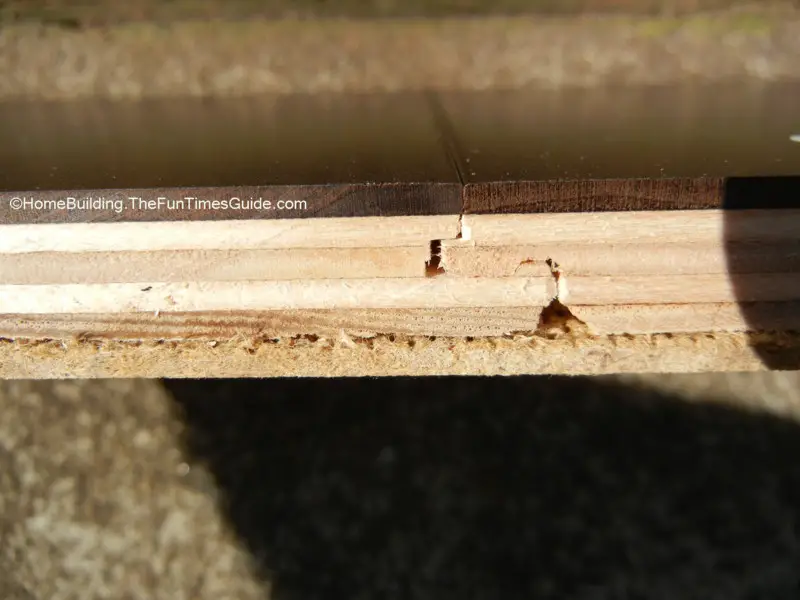
The complexities of my flooring choice are too long to spin into without hijacking the thread - but suffice to say - I chose my material poorly. It still looks good on the whole, but its not nearly as durable as i expected going into it. Lesson learned the hard way.
[This message has been edited by baumenhammer (edited 10/18/2013 2:16p).]
That's waht i meant by different levels of engineered.
something like this:
is gonna be a whole lot more durable than something like this:The complexities of my flooring choice are too long to spin into without hijacking the thread - but suffice to say - I chose my material poorly. It still looks good on the whole, but its not nearly as durable as i expected going into it. Lesson learned the hard way.
[This message has been edited by baumenhammer (edited 10/18/2013 2:16p).]
Featured Stories
See All
LIVE from Globe Life: No. 23 Texas A&M vs. Arizona State
by Richard Zane
22:42
1d ago
4.0k
Agee's workhorse efforts not enough vs. Texas as A&M has work to do
by Olin Buchanan
5 Thoughts: Texas 76, Texas A&M 70
by Luke Evangelist
14:37
2h ago
879
No. 15 Aggies enact revenge on Ragin' Cajuns, 5-1
by Emily Dreger
AgRyan04
FINAL/7 from Globe Life: No. 1 UCLA 11, No. 23 Texas A&M 1
in Billy Liucci's TexAgs Premium
23