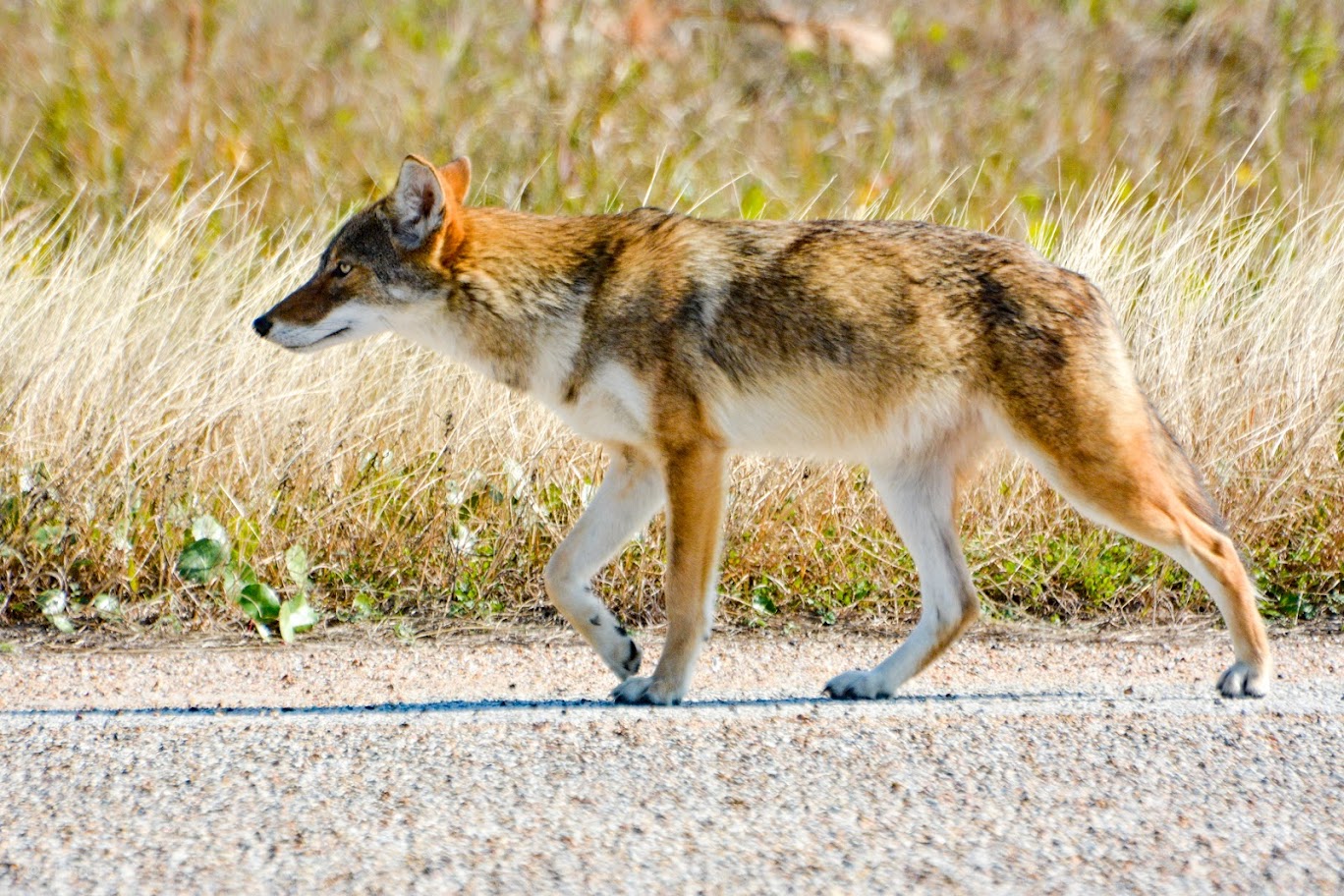

The Ghost Wolves of Galveston vs. Margaritaville
I know I know, TL R,
R,
AND if I am a German bombing the moon, apologies, but I am just catching up and found this fascinating. Red Wolf DNA in coyotes, a sub-species previously not known, and on the beach of a populated tourist area? Plus the guy who found it is an Aggie? Pretty awesome. I posted the contents in case the link did the pay wall nonsense.
"Ron Wooten stands on the side of a busy highway, wiping sweat from his brow and gazing down at a dead coyote. She's young and gaunt. Her rib cage shows through her reddish fur. Pointy teeth protrude from black gums, and her big ears seem to stand at attention.
Even as cars whiz by on this steamy June morningthe heat index is 97 degrees at 9:15 a.m.the animal retains a wild dignity, one that Wooten wants to preserve. By the time I arrive, he's already dragged her onto a grassy median along Galveston's TerminiSan Luis Pass Road, the strip of Gulf-side highway that traverses the western half of the roughly thirty-mile-long island.
Earlier this morning, Wooten was getting ready for workhe's a communications specialist with the U.S. Army Corps of Engineerswhen a friend texted: a coyote was lying just west of where the seawall ends. Wooten, a gracious Aggie with a "God Is Good" bracelet and a background in wildlife biology, has played roadside coroner before. Over the past decade, he's attended to at least fifteen coyotes killed by cars. (His work with the coyotes is entirely separate from his day job.)
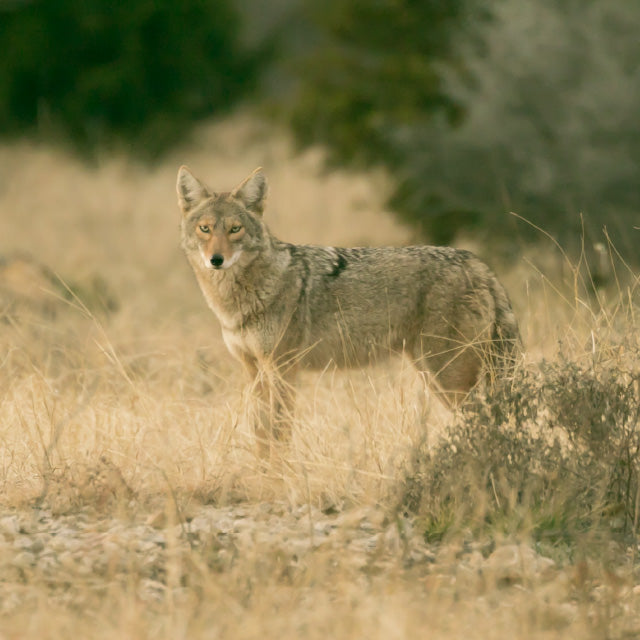
To Wooten, the animal at his feet isn't your average roadkill. She's a Galveston ghost wolf, so called because coyotes on the island carry unusually high levels of DNA from red wolves, the most endangered species within the genus Canis, which includes wolves, coyotes, and domesticated dogs. Recent scientific research has pinpointed Galveston Island as a genetic hot spot within a larger regionsoutheast Texas and southwest Louisianathat hosts these creatures. Scientists hope that studying the coyotes will help them reconstruct the red wolves' ancestral past and provide a key to preventing the extinction of the species.
Many islanders have embraced the animals as part of the community's quirky identity. "Galveston has a unique history and a unique vision and culture," says Bridgett vonHoldt, an associate professor of evolutionary genomics and epigenetics at Princeton University whose research helped draw attention to ghost wolves. "And to have people even be interested in coyote is novel for me."
Wolves, and their close cousins coyotes, aren't typically welcomed by humans. The Mexican gray wolf was hunted, trapped, and poisoned out of existence in Texas by 1970. And coyotes, still abundant in the state, are considered by many to be nuisances or worse. In 2010, Governor Rick Perry famously dispatched one with his laser-sighted pistol while out for a jog in West Austin.
Based on the smell, Wooten says, she was killed last night. He points to a boggy, brushy green lot on the other side of the road, a rare undeveloped tract on the booming island. The young female was probably making her way from there to the beach when she was hit by a caran unsurprising occurrence given that open spaces in this part of town are rapidly giving way to condos and RV parks. "It makes me very sad," he says. "This is a fairly small island, and there's not a whole lot of them.
But as interest in the animals is growing, so is a potential threat to their survival. A real estate boom, fueled by tourism and beach-seeking homeowners, is gobbling up many of Galveston's remaining green spaces. I hadn't visited Galveston in years, and I was struck by how the island had been transformed. It felt thoroughly urbanized, its wild spaces mostly paved over. The growth has helped revive a place ravaged by Hurricane Ike in 2008, but it's also displacing working-class Galvestonians and destroying wildlife habitat. Many locals have focused their ire on the state's newest Margaritaville, a resort planned for a 95-acre site in one of the last undeveloped parts of the island's East End. The vast scale of the development, which is scheduled to open in 2026, and its location near a lagoon frequented by ghost wolves worry conservationists. And the symbolism is inescapable: there's something distinctly American about wild critters being sacrificed to make way for cheeseburgers in paradise.
I'd come to Galveston hoping to lay eyes on at least one of the island's estimated fifty ghost wolves. Kristin Brzeski, a conservation geneticist at Michigan Technological University and an expert on the Galveston canids, had marveled at the ease with which they can be spotted. "You can go see them every morning. You can listen to them. You can watch them, you can count them. You can start to understand their behavior." And many do. A Facebook group devoted to the Galveston creatures features stories and photos of ghost wolf sightings. A city website documents hundreds of citizen-reported encounters.
But despite help from both Brzeski and Wooten, who spent hours in the field swatting mosquitoes and peering through binoculars with me, the only ghost wolf I spotted was Wooten's roadside carcass. Some speculated that the early-summer heat was causing the animals to hunker down in the shade. Or maybe it was the island's madhouse tourist seasonone weekend in May saw nearly half a million visitorsthat scared them into keeping a low profile. I certainly hoped their scarcity was just my bad luck and not a sign of trouble on the horizon.
The discovery of the ghost wolves of Galveston can be credited in great part to Wooten's late dog Scruffy. One day in late 2008, not long after Hurricane Ike devastated Galveston, Wooten let Scruffya vagabondish rescue who could be a bit grumpyoutside without his leash. Scruffy never made it back home.
While searching for the pup, Wooten discovered that a pack of coyotes, desperate for food, had made a meal of him. Many dog owners might have reached for their rifles. But Wooten reached for his camera. He began documenting the island's coyotes. Soon he noticed something odd about the animals: they were bigger than regular 'yotes, with long legs and reddish fur. Over time, he developed a hunch: these were either red wolves or coyotes whose ancestors had bred with red wolves generations ago. Either way, he knew the animals could be a big deal.
Red wolves once roamed across much of Texas and the southeastern U.S., before habitat loss, hunting, and hybridization drove them to the brink of extinction. In the seventies, U.S. Fish and Wildlife Services rounded up the remaining members of Canis rufus to start a captive breeding program. Of the dozens of captured animals, only fourteen successfully reproduced. Today just twenty or so red wolves remain in the wild, in eastern North Carolina. The critically endangered population has been weakened by inbreeding and continues to be threatened by conflicts with humans.
Wooten began sending his photos of the mystery canids to scientists. Eventually he found his way to vonHoldt, who was intrigued. Did he have any DNA samples? "I said, 'Well, by golly, I sure do. In my freezer right next to the ice cream and a couple of dead fish from offshore.' " Wooten, anticipating the need for DNA, had carved some tissue from roadkilla macabre roadside excision that left him feeling a tad guilty. But it worked. In 2018, Brzeski, vonHoldt, Wooten, and other researchers confirmed the existence of the Galveston ghost wolves in a scientific paper. "After that," Wooten said, "it just kind of exploded."
The ghost wolves' genetic heritage opens up tantalizing possibilities for the recovery of the red wolf. The coyote-wolf admixtures could become part of a "good old-fashioned breeding program"crossing particularly wolfy individual coyotes in pursuit of creating a revived version of the historic red wolf. Brzeski said introducing a single red wolf to the Galveston packs could lead to a vigorous red wolf population within just a few generations. But such a decision would be up to the U.S. Fish and Wildlife Service, which has faced fierce resistance from ranchers and other landowners in western states where wolves have been reintroduced and have been blamed for killing livestock. Another option: scientists could turn to new biotech methodologies such as gene splicing.
Brzeski and vonHoldt are collaborating with locals on efforts to study and protect the ghost wolves. When I visited Galveston in June, Brzeski was training two of her students to collect samples of the animals' poop for genetic testing. Such work will help the scientists determine the ghost wolves' range. At one point, the three of them were hunched on the side of the road near the Margaritaville site, using tweezers to place turds in tubes.
Meanwhile, the two scientists are collaborating with the Galveston Island Humane Society on a program to outfit coyotes with tracking collars. Josh Henderson, the executive director for the Humane Society, says he has collected "mind-blowingly remarkable GPS data" that shows how far some of the animals range, including pings from the collar of a yearling male that traveled 2,090 mileswith sojourns down the coast to Port O'Connor and across the Interstate 45 causeway to League City, on the mainlandthe equivalent of a trip from San Diego to Atlanta. Henderson also helped set up a system to gather citizen-reported coyote sightings, and the resulting data indicate that coyotes pose no threat to humans, though they do kill the occasional unleashed pet."
I know I know, TL
R, AND if I am a German bombing the moon, apologies, but I am just catching up and found this fascinating. Red Wolf DNA in coyotes, a sub-species previously not known, and on the beach of a populated tourist area? Plus the guy who found it is an Aggie? Pretty awesome. I posted the contents in case the link did the pay wall nonsense.
"Ron Wooten stands on the side of a busy highway, wiping sweat from his brow and gazing down at a dead coyote. She's young and gaunt. Her rib cage shows through her reddish fur. Pointy teeth protrude from black gums, and her big ears seem to stand at attention.
Even as cars whiz by on this steamy June morningthe heat index is 97 degrees at 9:15 a.m.the animal retains a wild dignity, one that Wooten wants to preserve. By the time I arrive, he's already dragged her onto a grassy median along Galveston's TerminiSan Luis Pass Road, the strip of Gulf-side highway that traverses the western half of the roughly thirty-mile-long island.
Earlier this morning, Wooten was getting ready for workhe's a communications specialist with the U.S. Army Corps of Engineerswhen a friend texted: a coyote was lying just west of where the seawall ends. Wooten, a gracious Aggie with a "God Is Good" bracelet and a background in wildlife biology, has played roadside coroner before. Over the past decade, he's attended to at least fifteen coyotes killed by cars. (His work with the coyotes is entirely separate from his day job.)
To Wooten, the animal at his feet isn't your average roadkill. She's a Galveston ghost wolf, so called because coyotes on the island carry unusually high levels of DNA from red wolves, the most endangered species within the genus Canis, which includes wolves, coyotes, and domesticated dogs. Recent scientific research has pinpointed Galveston Island as a genetic hot spot within a larger regionsoutheast Texas and southwest Louisianathat hosts these creatures. Scientists hope that studying the coyotes will help them reconstruct the red wolves' ancestral past and provide a key to preventing the extinction of the species.
Many islanders have embraced the animals as part of the community's quirky identity. "Galveston has a unique history and a unique vision and culture," says Bridgett vonHoldt, an associate professor of evolutionary genomics and epigenetics at Princeton University whose research helped draw attention to ghost wolves. "And to have people even be interested in coyote is novel for me."
Wolves, and their close cousins coyotes, aren't typically welcomed by humans. The Mexican gray wolf was hunted, trapped, and poisoned out of existence in Texas by 1970. And coyotes, still abundant in the state, are considered by many to be nuisances or worse. In 2010, Governor Rick Perry famously dispatched one with his laser-sighted pistol while out for a jog in West Austin.
Based on the smell, Wooten says, she was killed last night. He points to a boggy, brushy green lot on the other side of the road, a rare undeveloped tract on the booming island. The young female was probably making her way from there to the beach when she was hit by a caran unsurprising occurrence given that open spaces in this part of town are rapidly giving way to condos and RV parks. "It makes me very sad," he says. "This is a fairly small island, and there's not a whole lot of them.
But as interest in the animals is growing, so is a potential threat to their survival. A real estate boom, fueled by tourism and beach-seeking homeowners, is gobbling up many of Galveston's remaining green spaces. I hadn't visited Galveston in years, and I was struck by how the island had been transformed. It felt thoroughly urbanized, its wild spaces mostly paved over. The growth has helped revive a place ravaged by Hurricane Ike in 2008, but it's also displacing working-class Galvestonians and destroying wildlife habitat. Many locals have focused their ire on the state's newest Margaritaville, a resort planned for a 95-acre site in one of the last undeveloped parts of the island's East End. The vast scale of the development, which is scheduled to open in 2026, and its location near a lagoon frequented by ghost wolves worry conservationists. And the symbolism is inescapable: there's something distinctly American about wild critters being sacrificed to make way for cheeseburgers in paradise.
I'd come to Galveston hoping to lay eyes on at least one of the island's estimated fifty ghost wolves. Kristin Brzeski, a conservation geneticist at Michigan Technological University and an expert on the Galveston canids, had marveled at the ease with which they can be spotted. "You can go see them every morning. You can listen to them. You can watch them, you can count them. You can start to understand their behavior." And many do. A Facebook group devoted to the Galveston creatures features stories and photos of ghost wolf sightings. A city website documents hundreds of citizen-reported encounters.
But despite help from both Brzeski and Wooten, who spent hours in the field swatting mosquitoes and peering through binoculars with me, the only ghost wolf I spotted was Wooten's roadside carcass. Some speculated that the early-summer heat was causing the animals to hunker down in the shade. Or maybe it was the island's madhouse tourist seasonone weekend in May saw nearly half a million visitorsthat scared them into keeping a low profile. I certainly hoped their scarcity was just my bad luck and not a sign of trouble on the horizon.
The discovery of the ghost wolves of Galveston can be credited in great part to Wooten's late dog Scruffy. One day in late 2008, not long after Hurricane Ike devastated Galveston, Wooten let Scruffya vagabondish rescue who could be a bit grumpyoutside without his leash. Scruffy never made it back home.
While searching for the pup, Wooten discovered that a pack of coyotes, desperate for food, had made a meal of him. Many dog owners might have reached for their rifles. But Wooten reached for his camera. He began documenting the island's coyotes. Soon he noticed something odd about the animals: they were bigger than regular 'yotes, with long legs and reddish fur. Over time, he developed a hunch: these were either red wolves or coyotes whose ancestors had bred with red wolves generations ago. Either way, he knew the animals could be a big deal.
Red wolves once roamed across much of Texas and the southeastern U.S., before habitat loss, hunting, and hybridization drove them to the brink of extinction. In the seventies, U.S. Fish and Wildlife Services rounded up the remaining members of Canis rufus to start a captive breeding program. Of the dozens of captured animals, only fourteen successfully reproduced. Today just twenty or so red wolves remain in the wild, in eastern North Carolina. The critically endangered population has been weakened by inbreeding and continues to be threatened by conflicts with humans.
Wooten began sending his photos of the mystery canids to scientists. Eventually he found his way to vonHoldt, who was intrigued. Did he have any DNA samples? "I said, 'Well, by golly, I sure do. In my freezer right next to the ice cream and a couple of dead fish from offshore.' " Wooten, anticipating the need for DNA, had carved some tissue from roadkilla macabre roadside excision that left him feeling a tad guilty. But it worked. In 2018, Brzeski, vonHoldt, Wooten, and other researchers confirmed the existence of the Galveston ghost wolves in a scientific paper. "After that," Wooten said, "it just kind of exploded."
The ghost wolves' genetic heritage opens up tantalizing possibilities for the recovery of the red wolf. The coyote-wolf admixtures could become part of a "good old-fashioned breeding program"crossing particularly wolfy individual coyotes in pursuit of creating a revived version of the historic red wolf. Brzeski said introducing a single red wolf to the Galveston packs could lead to a vigorous red wolf population within just a few generations. But such a decision would be up to the U.S. Fish and Wildlife Service, which has faced fierce resistance from ranchers and other landowners in western states where wolves have been reintroduced and have been blamed for killing livestock. Another option: scientists could turn to new biotech methodologies such as gene splicing.
Brzeski and vonHoldt are collaborating with locals on efforts to study and protect the ghost wolves. When I visited Galveston in June, Brzeski was training two of her students to collect samples of the animals' poop for genetic testing. Such work will help the scientists determine the ghost wolves' range. At one point, the three of them were hunched on the side of the road near the Margaritaville site, using tweezers to place turds in tubes.
Meanwhile, the two scientists are collaborating with the Galveston Island Humane Society on a program to outfit coyotes with tracking collars. Josh Henderson, the executive director for the Humane Society, says he has collected "mind-blowingly remarkable GPS data" that shows how far some of the animals range, including pings from the collar of a yearling male that traveled 2,090 mileswith sojourns down the coast to Port O'Connor and across the Interstate 45 causeway to League City, on the mainlandthe equivalent of a trip from San Diego to Atlanta. Henderson also helped set up a system to gather citizen-reported coyote sightings, and the resulting data indicate that coyotes pose no threat to humans, though they do kill the occasional unleashed pet."
 ?v=1671716397