

I have seen many people use railroad ties for raised garden beds. I am getting ready to put in some garden beds, but my wife is paranoid about the creosote in the timbers leaching into the foods and causing cancer. Thoughts?
Post Reply
1 of 1
Railroad ties for raised beds
18,734 Views |
30 Replies |
Last: 15 yr ago by 35chililights
Does your wife know that creosote comes from wood or coal, which was a plant at one time?
If you want something scientific : http://www.ncbi.nlm.nih.gov/pubmed/16010195
Remind her that the same people that think you get cancer from anything man-made eat things grown in untreated chicken sh*t and drink unpasteurized milk.
If you want something scientific : http://www.ncbi.nlm.nih.gov/pubmed/16010195
Remind her that the same people that think you get cancer from anything man-made eat things grown in untreated chicken sh*t and drink unpasteurized milk.
There is no way in he'll I would use them for a veggie garden. There are too many other thing that you can use that are readily available to take a chance with it.
Unless you beds are going to be really tall no need to put anythin around.
Unless you beds are going to be really tall no need to put anythin around.
I think Log's garden is made of RR ties, he's mostly normal so you should be ok.
I'm trying to get my head around the concept of an oil based product leaching.
quote:
I think Log's garden is made of RR ties, he's mostly normal so you should be ok
Have you seen his forearms? That is NOT normal...
j/k

[This message has been edited by Artemis (edited 4/26/2011 3:48p).]
one time we put a telephone pole in the fire... I swelled up really bad and had a decent rash but I don't have cancer yet...
How does she feel about arsenic?
I don't know about the ties but I did a bit of reading about using pressure treated lumber and found an article that basically said that after running some experiments they came to the conclusion that even if it leached far enough into the soil it didn't pose any danger to growing plants in it - basically the arsenic concentration was minimal. If you're really worried just line it with that weed blocker or something.
How did we jump from creosote to arsenic?
IMHO, creosote = bad juju
OTOH... from what I read, MODERN pressure treated lumber has trace amounts of arsenic if that. I think they've switched to a copper based product?
OTOH... from what I read, MODERN pressure treated lumber has trace amounts of arsenic if that. I think they've switched to a copper based product?
I suspect that the railroad ties you would buy for whatever use you wanted would not be new railroad ties treated with newer methods that do not use arsenic.
quote:How can you be worried about the creosote used in treating railroad ties, but not the arsenic?
How did we jump from creosote to arsenic?
Look at the Q&A's inside the link.
http://www.epa.gov/opp00001/factsheets/chemicals/creosote_main.htm
http://www.epa.gov/opp00001/factsheets/chemicals/creosote_main.htm
Railroad ties are fine. Had them around my garden for over 25 years.
The ties you buy are used and the creosote has already leached out.
The ties you buy are used and the creosote has already leached out.
quote:
How can you be worried about the creosote used in treating railroad ties, but not the arsenic?
Because railroad ties are treated with creosote, not arsenic?
Arsenic is used for treated wood that does not have creosote.
quote:
The ties you buy are used and the creosote has already leached out
LOL.
You're certainly welcome to laugh at the truth.
As long as you aren't using ties that still look like they are dripping in tar, you should be fine. They'll just look like a weathered piece of wood.
And if you are still concerned, think about it this way: the ties are on the outside of the bed and water is going to flow down and out of the bed. Any creosote that might leach in is going to be on the perimeter, and will flow out in short order.
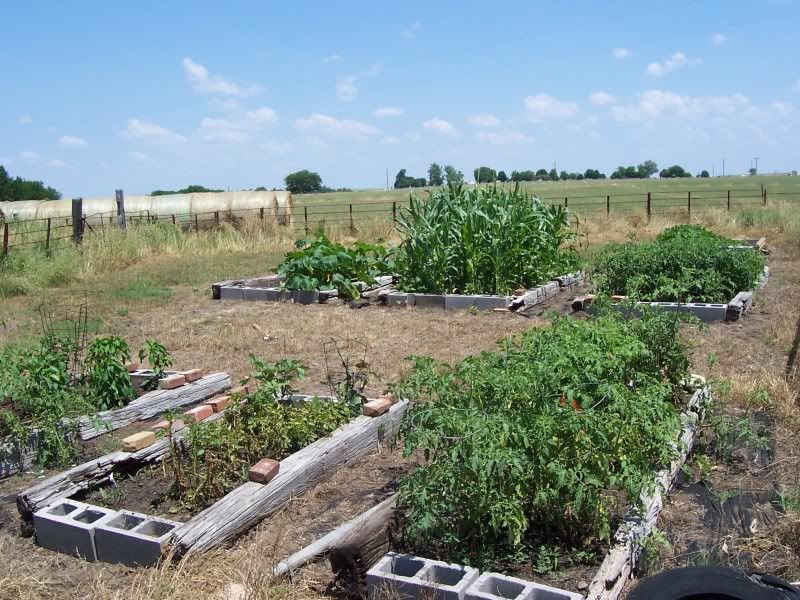
On second thought, maybe creosote caused this to happen both to my zucchini and forearms. Kinda like Miracle-Gro.

And if you are still concerned, think about it this way: the ties are on the outside of the bed and water is going to flow down and out of the bed. Any creosote that might leach in is going to be on the perimeter, and will flow out in short order.
On second thought, maybe creosote caused this to happen both to my zucchini and forearms. Kinda like Miracle-Gro.
LOL!!
I like how Log has to put his forearms in any picture he posts....
I like how Log has to put his forearms in any picture he posts....
quote:
You're certainly welcome to laugh at the truth.
Why dont you take that 50 year old rail tie and cut it open and tell me there isnt any creosote left it it. I'll stand back and watch the gray smoke billow off your table saw.
No one has yet explained to me how creosote is water soluble.
What does that have to do with anything?
quote:
I'm trying to get my head around the concept of an oil based product leaching.
Ahhh, sorry. I somehow overlooked this earlier.
Well, an oil based product isnt going to readily mix with water, however, that doesnt mean it doesnt ever mix with water. What happens is that the water molecules have a greater affinity for associating with themselves due to their polarity (charge seperation). Since the hydrocarbon (oil) doesnt have a charge, the water molecules dont associate with them anywhere near the amount they do with each other. However, the hydrocarbons can dissociate with each other and become surrounded by water molecules. The amount this happens depends on the viscosity of the hydrocarbon.
For instance, toluene does not associate with water, but you can be damn sure that if that corner gas station's underground tanks leak, you are going to find levels of it in the ground water that will make the state take action.
Will a small amount of creosote kill you? Probably not. Will a large amount of creosote kill you? Probably not. But if petroleum hydrocarbons of all kinds have been proven to cause mutations in your genes, you are just rolling the dice every time you expose yourself. That is simple biology.
Everything that is "cancer causing" doesnt cause cancer. They are just mutagens. Most genetic mutations are harmless, get corrected, or eliminate themselves. But some dont.
Edited to correct horrible spelling and grammar.
[This message has been edited by 35chililights (edited 4/26/2011 11:25p).]
http://www.epa.gov/region6/6sf/pdffiles/0601975.pdf
http://www.epa.gov/region6/6sf/pdffiles/0601735.pdf
http://www.epa.gov/superfund/accomp/success/conroe.htm
http://www.tceq.state.tx.us/publications/gi/gi-285.html/at_download/file
[This message has been edited by 35chililights (edited 4/26/2011 11:05p).]
http://www.epa.gov/region6/6sf/pdffiles/0601735.pdf
http://www.epa.gov/superfund/accomp/success/conroe.htm
http://www.tceq.state.tx.us/publications/gi/gi-285.html/at_download/file
[This message has been edited by 35chililights (edited 4/26/2011 11:05p).]
quote:Chill out.
Are railroad ties okay to use to construct vegetable gardens?
I'm using railroad ties to construct flower beds. I heard this is fine for flowers but not for vegetable gardens. Is this true? Can the creosote that is used to treat the ties leach into the soil and harm the vegetables?
Submitted by BHGanonymous
Yes, creosote does leach out of the ties and into the soil, but worn-out ties are generally not a problem, because most of their creosote has already leached away.
Better Homes and Gardens: The Quintessential Cornerstone of Science.
"The results indicated the following general ranking of the materials (from the lowest to highest LC(50) values); ACQ > creosote > zinc naphthenate > copper naphthenate > CCA (treated at 22.4 kg/m(3)) > concrete > red pine > western red cedar > red oak > zinc-coated steel > epoxy-coated steel > CCA (6.4 kg/m(3)). Furthermore, the toxicity results indicated that plastic wood, certain untreated wood species (hemlock, tamarack, Douglas fir, and red oak), hot-rolled steel, Ecothermo wood, and wood treated with Lifetime Wood Treatment were generally nontoxic to the test species."
http://www.ncbi.nlm.nih.gov/pubmed/21222116
"Squamous cell carcinoma of the skin and coal tar creosote exposure in a railroad worker."
http://www.ncbi.nlm.nih.gov/pubmed/15626654
"Exocrine pancreatic neoplasms in the mummichog (Fundulus hetero****us) from a creosote-contaminated site."
http://www.ncbi.nlm.nih.gov/pubmed/7817115
[This message has been edited by 35chililights (edited 4/26/2011 11:41p).]
"The results indicated the following general ranking of the materials (from the lowest to highest LC(50) values); ACQ > creosote > zinc naphthenate > copper naphthenate > CCA (treated at 22.4 kg/m(3)) > concrete > red pine > western red cedar > red oak > zinc-coated steel > epoxy-coated steel > CCA (6.4 kg/m(3)). Furthermore, the toxicity results indicated that plastic wood, certain untreated wood species (hemlock, tamarack, Douglas fir, and red oak), hot-rolled steel, Ecothermo wood, and wood treated with Lifetime Wood Treatment were generally nontoxic to the test species."
http://www.ncbi.nlm.nih.gov/pubmed/21222116
"Squamous cell carcinoma of the skin and coal tar creosote exposure in a railroad worker."
http://www.ncbi.nlm.nih.gov/pubmed/15626654
"Exocrine pancreatic neoplasms in the mummichog (Fundulus hetero****us) from a creosote-contaminated site."
http://www.ncbi.nlm.nih.gov/pubmed/7817115
[This message has been edited by 35chililights (edited 4/26/2011 11:41p).]
Let's assume that creosote somehow is still present in high enough amounts that it will end up in the soil of the vegetable garden.
The question is still, so what?
Will the plants take up creosote?
If they do take up creosote, will they concentrate it in the edible parts?
If creosote does end up in the edible parts, will it survive picking, cooking and digestion to get into your system?
And if it does get into your system, is it a toxin in your digestive system?
Bottom line, lots of worry over not much.
The question is still, so what?
Will the plants take up creosote?
If they do take up creosote, will they concentrate it in the edible parts?
If creosote does end up in the edible parts, will it survive picking, cooking and digestion to get into your system?
And if it does get into your system, is it a toxin in your digestive system?
Bottom line, lots of worry over not much.
quote:
Bottom line, lots of worry over not much.
Absolutely correct. But isnt that with everything in life? Isnt everything an odds game?
What type of bullet is best?
How many more feet per second can I get with a better load?
Can I squeeze more accuracy out of this rifle?
Is this the best steel for a skinning knife?
Should I get more horsepower or save money with the ***** V6?
Should I study for this neuroscience exam or fart around on the Outdoors Board?
The fact of the matter is what are you(collective) willing to accept? What risk/reward ratio works for you might not be a ratio someone else can swallow.
I dont care what you use to line your vegetable garden. I just wanted to clarify the facts. You are free to decide what you are willing to accept.
I dont know what your purpose of having your own garden is. If your purpose is 'to have full knowledge of what pesticides and chemicals go on my table fare', I find it humorous that rail ties line your garden. But again, that might not be your reason for a garden, and even if it is, you are free to do what you want.
My only goal with posting on this thread was to clarify what I perceived to be misinformation.
To answer your question about the plants taking it up: there doesnt seem to be any research that shows that plants can uptake creosote. They easily take up heavy metals (mercury, lead, etc) and thus are actually used to remediate impacted soils in this manner. But as far as creosote, it is unclear. IF they do take it up, they look like they dont have the enzymes to break them down. Therefore, IF they do take them up, they will be ingested if the plant is eaten.
Sort of my point 35. Folks are up in arms about creosote in RR ties in the garden....then they'll go light up a cigarette (of tobacco or other substances) and take in more carcinogens per puff than they'd ever get from the RR tie. Unless they smoked the RR tie.
Or they'll worry about airplane travel, then jump on I-35 on a motorcycle.
Or they'll worry about airplane travel, then jump on I-35 on a motorcycle.
quote:
Or they'll worry about airplane travel, then jump on I-35 in any vehicle.
FIFY. and great point, Canyon.
I took down an old fence for a buddy's dad several years ago. The posts were a mixture of bois de arc, metal t-posts, and rail ties. Since I can only assume it wasnt built as a patch work fence, there was no telling how old the rail ties were. One of the ties had weathered in such a way that I didnt even recognize it as a rail tie. The end had produced a cavity down the middle in such an odd fashion that I thought would make an interesting planter. So I held it aside and took it home. When i fired up the table saw, it proceeded to exclaim its prior history as a rail tie with thick smoke reeking of creosote (hence my earlier comment). What I am getting at is there is a reason they used creosote for railroad ties: it keeps the wood from rotting, and it persists for a long time.
[This message has been edited by 35chililights (edited 4/27/2011 1:01a).]
Featured Stories
See All
5:39
6h ago
1.9k
CHAMPS! Aggie women's tennis claims second national championship
by Richard Zane
Deluded push for 24 teams would dilute the CFP
by Olin Buchanan
Matthews is another big-time Elko Era recruiting win
by Jason Howell
9:41
4h ago
1.0k
Anto Saka is working hard during his summer vacation
by David Nuño
96AgGrad
Anonymous Coach Comment on Elko: "Mike Elko is a real-deal ball coach"
in Billy Liucci's TexAgs Premium
92
Bay Ag
Anonymous Coach Comment on Elko: "Mike Elko is a real-deal ball coach"
in Billy Liucci's TexAgs Premium
90
DeepETX_Aggie
Anonymous Coach Comment on Elko: "Mike Elko is a real-deal ball coach"
in Billy Liucci's TexAgs Premium
87