Science Lesson Needed

2,709 Views | 23 Replies | Last: 24 days ago by IIIHorn
JamiesChallengeCard
How long do you want to ignore this user?
I'm no nuclear physicist; but we keep blowing up places where Iran has nuclear material, bomb or not. They have constantly for the past many decades (my entire life) been 'on the verge' of having these nuclear weapons.

Is there a magic point where we have to blow them up and as long as we get them before that point there is no nuclear fall out? How did bombing their nuclear facility not cause and radiation concerns in the area?
agdoc2001
How long do you want to ignore this user?
From my limited understanding:

No reactor = No fission = No fallout

Take that with many salt grains
ABATTBQ11
How long do you want to ignore this user?
There is a chance of radiological ejection when you bomb anything radioactive. That risk is minimized when it's underground, but it's never really 0.

We want to blow them up as early in the enrichment process as possible, though, in the event they recover the material. For instance, if they have converted the uranium gasses used in centrifuges into metal for transport and that gets buried under tons of rock, they can still just dig down, recover it, concert it back to gas, and continue enriching. If it's still in gas form, it may still be in holding tanks or parts of the process that are recoverable. If they were really desperate, they could (in theory) try to refine the rubble to recover the gas. The uranium is still there and the right isotopes are still heavily concentrated, it's just not nearly as easy as before. The conversion processes don't take support long, from what I understand, so it's entirely plausible and even probable that they converted their highly enriched stockpile to metal.
JamiesChallengeCard
How long do you want to ignore this user?
Thanks for this response ABatt. Still don't fully get it but that helps make it more logical.
ABATTBQ11
How long do you want to ignore this user?
Basically, blowing up anything radioactive just breaks it into smaller pieces that are all still radioactive. If the explosion is underground, it's a lot harder for little radioactive pieces to escape, but the radioactivity is all still there. At no stage can you bomb an enrichment or processing facility without risking some level of fallout.

Blowing up Iran's nuclear material doesn't really destroy it. It's all still there, just buried or more spread out. The state it was in when bombed makes a difference because the gas form used in enrichment will spread much easier than the refined metal created from separating the uranium from the gas carrier (hexafluoride IIRC). In theory, if Iran had converted the uranium to a solid, metal form, they could just dig it up and pick up right where they left off.

The magic point for bombing is really as far away from fully enriched as you can do it to keep them as far away as you can. It has nothing to do with the risk of fallout. Unfortunately, with what they have, they're pretty close if they can get their hands back on it or if they still have it.


ETA The difference between blowing up nuclear material and a nuclear explosion in terms of fallout and radiation is in the different nature of the explosions.

Bombing their uranium stockpile is a chemical explosion that breaks the uranium apart, but without splitting atoms. Even if it's fully enriched, it's hard to set off a core because nuclear bombs require a lot of compression using incredibly precise explosive lenses and tampers to reflect neutrons to reach critical mass and set off a nuclear chain reaction.

A nuclear explosion is when that core hits critical mass and atoms start splitting rapidly and uncontrollably from free neutrons, forming more free neutrons and driving the reaction. It is the release of all the neutrons that and dispersal of radioactive material from the explosion that produces the fallout from the nuclear blast that is mostly absent from just bombing the material or facility.
Rapier108
How long do you want to ignore this user?
The bombing is also intended to destroy all of their remaining equipment needed to enrich the uranium.
Bazooka Joe
How long do you want to ignore this user?
Instead of bombing, we should have just promised them nuclear bombs, but instead, steal their uranium and give them useless casings filled with old pinball machine parts. It worked for the Libyan nationalists. They bought it hook, line and sinker.
HollywoodBQ
How long do you want to ignore this user?
Outside of Super Sabot penetrators (made from depleted uranium), this is not my area of expertise at all but...

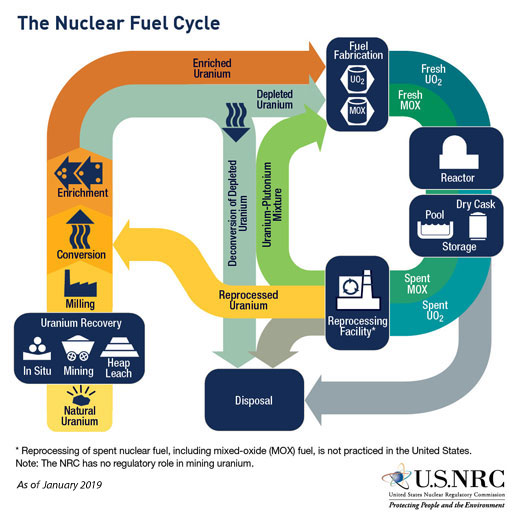
Here's a relevant diagram from the US NRC web site.

It's focused on energy and doesn't get into bomb making. Also, it doesn't describe at what point things become dangerous which I assume is from the very beginning.

https://www.nrc.gov/materials/fuel-cycle-fac/stages-fuel-cycle
ABATTBQ11
How long do you want to ignore this user?
Uranium is the preferred material for a bomb, but only a specific uranium isotope. Enrichment is the process of separating out that isotope. Nuclear fuel benefits from enrichment, but better nowhere near the level necessary for a bomb. What you need is a forecast flowchart of the enrichment process.
schmellba99
How long do you want to ignore this user?
JamiesChallengeCard said:

I'm no nuclear physicist; but we keep blowing up places where Iran has nuclear material, bomb or not. They have constantly for the past many decades (my entire life) been 'on the verge' of having these nuclear weapons.

Is there a magic point where we have to blow them up and as long as we get them before that point there is no nuclear fall out? How did bombing their nuclear facility not cause and radiation concerns in the area?

U235 and U238 are naturally occuring and, generally speaking, don't pose any hazards in their natural state.

In order to get to the point where you have nuclear fallout you need ot enrich the uranium 235 to at least 80% (that is what the Nagasaki Hiroshima bomb was). Fallout is the unspent uranium that wasn't fizzled in the explosion and instead ejected by the explosion into the surrounding area.

It takes a lot of fuel to make a nuke warhead, and it needs to be enriched to 90% or better for modern warhead technology. That takes months, if not years, depending on the quality of your raw uranium cake, the quality and number of your centrifuges and your ability to keep the material after it has been enriched.

Fun fact - Nagasaki Hiroshima was about ~64kg of enrinched U235. IIRC, only about .75kg actually fizzled before the explosion ejected the rest of the material across the area. Something like .001kg was converted from mass to energy. (Don't quote me on those numbers as 100% correct).

Rapier108
How long do you want to ignore this user?
Hiroshima was the uranium gun weapon (Little Boy).

Nagasaki was plutonium implosion (Fat Man).
schmellba99
How long do you want to ignore this user?
ABATTBQ11 said:

Uranium is the preferred material for a bomb, but only a specific uranium isotope. Enrichment is the process of separating out that isotope. Nuclear fuel benefits from enrichment, but better nowhere near the level necessary for a bomb. What you need is a forecast flowchart of the enrichment process.

Fuel for nuclear reactors to generate engergy is something like 5% enriched.

SMR's can use up to about 20% enriched.

Navy reactors in subs and CVN's are closer to the 90% range that is considered weapons grade enrichment.

Depelted uranium is more or less the byproduct of enrichment and is the non-radioactive (for all intents and purposes) isotopes.
schmellba99
How long do you want to ignore this user?
Rapier108 said:

Hiroshima was the uranium gun weapon (Little Boy).

Nagasaki was plutonium implosion (Fat Man).

Dammit, I got them backwards.
DavysApprentice
How long do you want to ignore this user?
ABATTBQ11 said:

Uranium is the preferred material for a bomb, but only a specific uranium isotope. Enrichment is the process of separating out that isotope. Nuclear fuel benefits from enrichment, but better nowhere near the level necessary for a bomb. What you need is a forecast flowchart of the enrichment process.


To add to this. Most of uranium Ore contains a small fraction of pure uranium and most of that is uranium 238. Of pure uranium, 99.3 percent will be uranium 238 while 0.7 percent will be uranium 235. Enrichment removes the uranium 235 from the pure uranium.


It is a very energy and time intensive process. As the enrichment needed to make a bomb needs to be around 90 percent U-235 while a power plant only needs enriched to about 5 percent or so
rocky the dog
How long do you want to ignore this user?
Elections are when people find out what politicians stand for, and politicians find out what people will fall for.
HollywoodBQ
How long do you want to ignore this user?
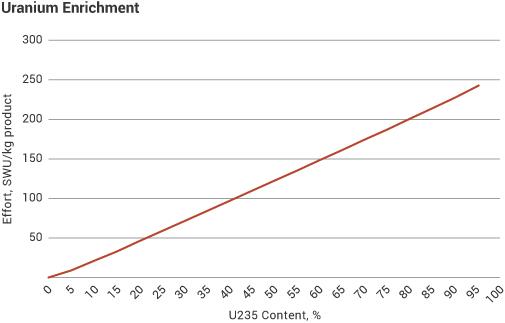
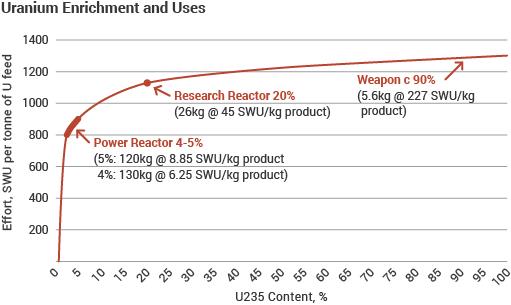
Alright... so digging deeper, I think I found the graphs that answer the questions I care about.

How much effort does it take to go from Fuel grade to Weapons grade.

https://world-nuclear.org/information-library/nuclear-fuel-cycle/conversion-enrichment-and-fabrication/uranium-enrichment


Quote:

The first graph shows enrichment effort (SWU) per unit of product. The second shows how one tonne of natural uranium feed might end up: as 120-130 kg of uranium for power reactor fuel, as 26 kg of typical research reactor fuel, or conceivably as 5.6 kg of weapons-grade material. The curve flattens out so much because the mass of material being enriched progressively diminishes to these amounts, from the original one tonne, so requires less effort relative to what has already been applied to progress a lot further in percentage enrichment. The relatively small increment of effort needed to achieve the increase from normal levels is the reason why enrichment plants are considered a sensitive technology in relation to preventing weapons proliferation, and are very tightly supervised under international agreements. Where this safeguards supervision is compromised or obstructed, as in Iran, concerns arise.

About 140,000 SWU is required to enrich the annual fuel loading for a typical 1000 MWe light water reactor at today's higher enrichment levels. Enrichment costs are substantially related to electrical energy used. The gaseous diffusion process consumes about 2500 kWh (9000 MJ) per SWU, while modern gas centrifuge plants require only about 50 kWh (180 MJ) per SWU.

Enrichment accounts for almost half of the cost of nuclear fuel and about 5% of the total cost of the electricity generated. In the past it has also accounted for the main greenhouse gas impact from the nuclear fuel cycle where the electricity used for enrichment is generated from coal. However, it still only amounts to 0.1% of the carbon dioxide from equivalent coal-fired electricity generation if modern gas centrifuge plants are used.

cecil77
How long do you want to ignore this user?
A fission reactor produces Pu239 with is also highly fissile and better for weapons than U235
TrumpsBarber
How long do you want to ignore this user?
I don't know much about science. Ask this guy.
fullback44
How long do you want to ignore this user?
We should probably start dropping pig waste bombs on all their uranium sites… there are certain things they won't F with… they don't like the pig
Rapier108
How long do you want to ignore this user?
cecil77 said:

A fission reactor produces Pu239 with is also highly fissile and better for weapons than U235

True, but many designs, especially modern ones, produce very little, and it is a mixture of various plutonium isotopes.

There are reactors designed specifically to produce plutonium in larger quantities for weapons.

And what makes U-235 attractive for a weapon, is once you have enough HEU, building a weapon is simple. While it would not be overly efficient, a uranium gun weapon is easy to produce and virtually certain to work. Would not produce the biggest boom, but one of those weapons leveled Hiroshima and that was tech that is now 80 years old.
IIIHorn
How long do you want to ignore this user?
So, anyway ...

This nuclear physicist walked into a bar and ordered a gin atomic.

IIIHorn
How long do you want to ignore this user?
Later ...

I neutron walks into a bar and asks: "How much for a beer?"

Bartender: "For you, no charge."
IIIHorn
How long do you want to ignore this user?
Then ...

An electron walks into a bar and the bartender asks: "How's the weather?"

Electron: "Cloudy"
IIIHorn
How long do you want to ignore this user?
A Proton walked into a bar order a double.

The barman asks "What is the matter?"

Proton says: "Two good friends were in a collision yesterday."
Refresh
Page 1 of 1
 
×
subscribe Verify your student status
See Subscription Benefits
Trial only available to users who have never subscribed or participated in a previous trial.