
Climate Change & Ice Cores Question

3,749 Views | 31 Replies | Last: 2 yr ago by one safe place
Beat40
How long do you want to ignore this user?
I have a genuine question on ice cores for anyone here. I've tried to look it up, but maybe I'm just missing it.

Obviously scientists can date ice cores back to thousands, even hundreds of thousands of years and can identify differing eras by ice melt and gasses sort of like tree rings. Here's my question:

What is the smallest unit of time they can identify? For example, say a 1,000 year old ice core, can they reliably break it out 100 years at a time or smaller?

Again, maybe I've just missed this in my reading.

The reason I'm asking is whenever climate change gets brought up, it's readily agreed the Earth has been hotter than today because the ice cores tell us so. So then the rate of change as being "never as fast as it has been these last 100-150years" gets brought up.

I'm trying to nail down when they look at ice cores if they can even look at ranges as small as 100-150 years as part of the total ice core, and if not, what's the smallest range observable in an ice core.
Kenneth_2003
How long do you want to ignore this user?
They'll say they can. During winter you get accumulation of snow. Then in the summer part of that snow melts and forms a hard layer. Repeat winter snow, summer ice layer, winter snow summer, etc etc. Over the years the"snow" compacts and produces a ring like structure.

I don't think they ever can be 100% certain years or even decades aren't missing. If there's dust or some other layer that can be correlated to known events in time then great, but I think I'm general they overstate resolution and overall correlation.
AggieIce
How long do you want to ignore this user?
Scientists have also carbon dated live mice to be 10,000 years old.

So there's also that…
AustinScubaAg
How long do you want to ignore this user?
Kenneth_2003 said:

They'll say they can. During winter you get accumulation of snow. Then in the summer part of that snow melts and forms a hard layer. Repeat winter snow, summer ice layer, winter snow summer, etc etc. Over the years the"snow" compacts and produces a ring like structure.

I don't think they ever can be 100% certain years or even decades aren't missing. If there's dust or some other layer that can be correlated to known events in time then great, but I think I'm general they overstate resolution and overall correlation.


Sure but what happens if the summer melt erases the previous year or years ring. I have never seen a complete explanation for that.
DallasAg 94
How long do you want to ignore this user?
MouthBQ98
How long do you want to ignore this user?
They can find seasonal layers of deposits at a fine level, ie summer winter….sort of.
one safe place
How long do you want to ignore this user?
I suspect they can "find" whatever fits the narrative.
samurai_science
How long do you want to ignore this user?
They will find whatever it takes to keep the funding coming
TexAgs91
How long do you want to ignore this user?
A year to several decades depending on snowfall rates.

It depends on what techniques are used too. Measuring the ratio of oxygen isotopes can potentially provide a resolution of a few years to decades, while techniques based on measuring the concentration of certain gases trapped in the ice might only provide a resolution of several decades to centuries.
No, I don't care what CNN or MSNBC said this time
Ad Lunam
BCG Disciple
How long do you want to ignore this user?
I believe it is as accurate as it needs to be to know that humanity will end by 2023.
zoneag
How long do you want to ignore this user?
Pretty sure the answer is "the science is settled", full blown marxism is the only way to save humanity. Stop asking questions and eat your cricket paste.
p_bubel
How long do you want to ignore this user?
Quote:

The main limitation of the ice-core data is that it is effectively a 10-year or longer running average, because air of slightly different ages is mixed together in firn layers layers of compacted snow that falls in one year and survives unmelted to the following year before the air is sealed off into bubbles in the ice layers below the firn. The ice-core record therefore not as sharp in time as the direct atmospheric record, but it's plenty sharp enough to document changes decade by decade, and therefore the rise from preindustrial times towards the present.
Link

The article if from WAY back in 2014 before things got really amped up to 11. I'm not sure if the process has gotten any sharper or if its just glossed over.


I really dislike the use of averages.
Teslag
How long do you want to ignore this user?
AggieIce said:

Scientists have also carbon dated live mice to be 10,000 years old.

So there's also that…


The entire mouse or particles in the mouse.
eric76
How long do you want to ignore this user?
Beat40 said:

I have a genuine question on ice cores for anyone here. I've tried to look it up, but maybe I'm just missing it.

Obviously scientists can date ice cores back to thousands, even hundreds of thousands of years and can identify differing eras by ice melt and gasses sort of like tree rings. Here's my question:

What is the smallest unit of time they can identify? For example, say a 1,000 year old ice core, can they reliably break it out 100 years at a time or smaller?

Again, maybe I've just missed this in my reading.

The reason I'm asking is whenever climate change gets brought up, it's readily agreed the Earth has been hotter than today because the ice cores tell us so. So then the rate of change as being "never as fast as it has been these last 100-150years" gets brought up.

I'm trying to nail down when they look at ice cores if they can even look at ranges as small as 100-150 years as part of the total ice core, and if not, what's the smallest range observable in an ice core.
I think that the rate of change at the start and end of the Younger Dryas is supposedly far greater than it is today.

That's some really good questions of how small a period that we can distinguish in the ice cores.
Kenneth_2003
How long do you want to ignore this user?
AustinScubaAg said:

Kenneth_2003 said:

They'll say they can. During winter you get accumulation of snow. Then in the summer part of that snow melts and forms a hard layer. Repeat winter snow, summer ice layer, winter snow summer, etc etc. Over the years the"snow" compacts and produces a ring like structure.

I don't think they ever can be 100% certain years or even decades aren't missing. If there's dust or some other layer that can be correlated to known events in time then great, but I think I'm general they overstate resolution and overall correlation.


Sure but what happens if the summer melt erases the previous year or years ring. I have never seen a complete explanation for that.


That was my point. They're over confident while ignoring what they don't know.

I've seen folks use Oxygen 18 and Carbon 16 isotopes for paleo-temperatures. Great, yes we can measure the a very clear correlation in water temperature to those isotopes and then their incorporation into an animals shell. But if the rock unit you collected the fossil shell from is only +/- 1,000,000 years. Also you're measuring seawater temp, not land surface temp. SoCal is warm and beautiful but the water is cold.
JohnLA762
How long do you want to ignore this user?
Climate scientist on their way to work…

richardag
How long do you want to ignore this user?
AustinScubaAg said:

Kenneth_2003 said:

They'll say they can. During winter you get accumulation of snow. Then in the summer part of that snow melts and forms a hard layer. Repeat winter snow, summer ice layer, winter snow summer, etc etc. Over the years the"snow" compacts and produces a ring like structure.

I don't think they ever can be 100% certain years or even decades aren't missing. If there's dust or some other layer that can be correlated to known events in time then great, but I think I'm general they overstate resolution and overall correlation.


Sure but what happens if the summer melt erases the previous year or years ring. I have never seen a complete explanation for that.
Or
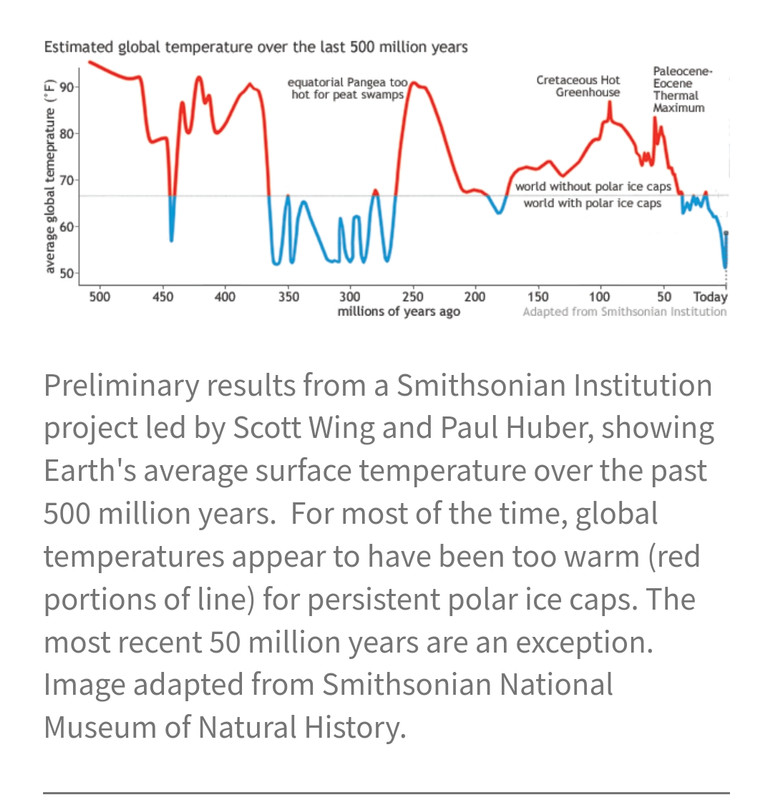
Did you know that the polar ice caps are a relatively recent geologic feature on Earth?
from the link
  • Conversely, during warm periods, the ice sheets retreated, and may not have existed at all.
I guess the era when there were no ice caps could predate all multicellular life about 600 million years ago?
Among the latter, under pretence of governing they have divided their nations into two classes, wolves and sheep.”
Thomas Jefferson, Letter to Edward Carrington, January 16, 1787
frenchtoast
How long do you want to ignore this user?
Most "science" is fake
halfastros81
How long do you want to ignore this user?
Summary of the current state of the "science"- polar ice caps have grown and shrunk significantly over at least 5 cycles but this time if it's really happening it's definitely caused by man.
AggieDruggist89
How long do you want to ignore this user?
Earth was without polar ice majority of the time.

I don't really understand why warmer earth is a bad thing ? What's the big deal?
AggieDruggist89
How long do you want to ignore this user?
Multicellular organisms definitely existed during no polar ice periods. Earth went through all these climate changes without human intervention and survived just fine.

halfastros81
How long do you want to ignore this user?
It's not a big deal beyond perhaps having some sort of basis for projecting future impacts on us earthlings . It's just a tool the left uses in an attempt to get more power , influence and control and take same from others . It has been remarkably successful.
GeorgiAg
How long do you want to ignore this user?
AggieIce said:

Scientists have also carbon dated live mice to be 10,000 years old.

So there's also that…
Wut?
eric76
How long do you want to ignore this user?
richardag said:

AustinScubaAg said:

Kenneth_2003 said:

They'll say they can. During winter you get accumulation of snow. Then in the summer part of that snow melts and forms a hard layer. Repeat winter snow, summer ice layer, winter snow summer, etc etc. Over the years the"snow" compacts and produces a ring like structure.

I don't think they ever can be 100% certain years or even decades aren't missing. If there's dust or some other layer that can be correlated to known events in time then great, but I think I'm general they overstate resolution and overall correlation.


Sure but what happens if the summer melt erases the previous year or years ring. I have never seen a complete explanation for that.
Or
Did you know that the polar ice caps are a relatively recent geologic feature on Earth?
from the link
  • Conversely, during warm periods, the ice sheets retreated, and may not have existed at all.
I guess the era when there were no ice caps could predate all multicellular life about 600 million years ago?
As I understand it, we have only been in this ice age for about 2.6 or 2.7 million years.
e=mc2
How long do you want to ignore this user?
one safe place said:

I suspect they can "find" whatever fits the narrative.


Yep. I've lost all faith in the fields of science, medicine, and politics.
AgGrad99
How long do you want to ignore this user?
I saw this story, a few days ago.

https://www.the-messenger.com/news/national/article_12b5e420-9f7c-5e70-a4b2-073318edc748.html

Scientists had estimated the ice on Greenland to be 2.5 million years old. This past week they were all...'oops, probably 350k-400k years old'.

If there is one thing I've observed, these dates are always changing, and being revised.

Funky Winkerbean
How long do you want to ignore this user?
You can't show they are "right", but you also can't prove it is inaccurate. I think that's the point (politically). The ambiguity allows enough room for politicians to try and exploit the masses for money and votes, as money and votes are what keeps the wheel spinning. It's for the children.
Russell Bradleys Toupee
How long do you want to ignore this user?
Warming has everything to do with Milankovitch cycles and nothing to do with Marxist politicians' thermometers.
Ag with kids
How long do you want to ignore this user?
eric76 said:

richardag said:

AustinScubaAg said:

Kenneth_2003 said:

They'll say they can. During winter you get accumulation of snow. Then in the summer part of that snow melts and forms a hard layer. Repeat winter snow, summer ice layer, winter snow summer, etc etc. Over the years the"snow" compacts and produces a ring like structure.

I don't think they ever can be 100% certain years or even decades aren't missing. If there's dust or some other layer that can be correlated to known events in time then great, but I think I'm general they overstate resolution and overall correlation.


Sure but what happens if the summer melt erases the previous year or years ring. I have never seen a complete explanation for that.
Or
Did you know that the polar ice caps are a relatively recent geologic feature on Earth?
from the link
  • Conversely, during warm periods, the ice sheets retreated, and may not have existed at all.
I guess the era when there were no ice caps could predate all multicellular life about 600 million years ago?
As I understand it, we have only been in this ice age for about 2.6 or 2.7 million years.
This is what many people don't understand.

We are CURRENTLY in an Ice Age.

We are just in an INTERGLACIAL PERIOD where the temperatures are slightly warmer.
ShinerAggie
How long do you want to ignore this user?
PhD author Markus Ott: Ten minutes on CO2 proxies
________________________________________________________
“Those who cannot change their minds cannot change anything.”
- George Bernard Shaw
richardag
How long do you want to ignore this user?
halfastros81 and AggieDruggist89
Thanks for the replies.
Among the latter, under pretence of governing they have divided their nations into two classes, wolves and sheep.”
Thomas Jefferson, Letter to Edward Carrington, January 16, 1787
one safe place
How long do you want to ignore this user?
eric76 said:

Beat40 said:

I have a genuine question on ice cores for anyone here. I've tried to look it up, but maybe I'm just missing it.

Obviously scientists can date ice cores back to thousands, even hundreds of thousands of years and can identify differing eras by ice melt and gasses sort of like tree rings. Here's my question:

What is the smallest unit of time they can identify? For example, say a 1,000 year old ice core, can they reliably break it out 100 years at a time or smaller?

Again, maybe I've just missed this in my reading.

The reason I'm asking is whenever climate change gets brought up, it's readily agreed the Earth has been hotter than today because the ice cores tell us so. So then the rate of change as being "never as fast as it has been these last 100-150years" gets brought up.

I'm trying to nail down when they look at ice cores if they can even look at ranges as small as 100-150 years as part of the total ice core, and if not, what's the smallest range observable in an ice core.
I think that the rate of change at the start and end of the Younger Dryas is supposedly far greater than it is today.

That's some really good questions of how small a period that we can distinguish in the ice cores.
Not only that, but then extrapolating what they found in an ice core to temps and the like in what became France, and what became Texas, and what became Fiji. All from core samples taken at Greenland and Antarctica. Color me skeptical.
Refresh
Page 1 of 1
 
×
subscribe Verify your student status
See Subscription Benefits
Trial only available to users who have never subscribed or participated in a previous trial.