

The War in the Ukraine is a terrible calamity for the world. It is, however, a very understandable and predictable event. It really should be no surprise if you have been paying attention. Most Americans have not, so I'm going to give a few thoughts. I'm no great expert, but I am a historian, veteran intelligence officer (Iraq, Afghanistan, Korea) and national security student who has followed Ukraine intensely over many years.
First of all, Americans are taking all of the wrong interpretations and meanings from this because we're looking at it from a stupid, narcissistic view, as if it's all about America and our politics. Look, it doesn't matter who is president. Liberals are blaming Trump for supposedly coddling Putin and Conservatives are blaming Biden for being weak. To a small degree, both charges are true, but this is really on the margins stuff. Unless an American president had made a direct commitment to defend the Ukraine with American troops (and nobody in either party has seriously suggested that) this has almost nothing to do with us. Saying it does is really about as stupid as saying the Mexican American War of 1846 happened because of some policy decisions by British Prime Ministers William Lamb or Robert Peel, who somehow let it happen. That's nonsense.
I chose that war, because it's kind of analagous. Consider Texas as the breakaway regions that declared independence from the mother country, to some degree aided and abetted by a powerful neighbor with cultural and linguistic ties, then slowly began to integrate and finally join the said neighboring country, to the immense consternation of its original owner. Texas = Donbass, America = Russia, Mexico = Ukraine. It's not precise, and it's irrespective of any moral claims, but it's a rough parallel. In this case, you can clearly see how conflict (war or otherwise) was inevitable.
There's also centuries of history here. Too much to go into in a short post, but I'll give a few points. Kiev, the capital of Ukraine, is really the ancestral home of the Rus people. It's quite literally where Russia began. In the 10th and 11th Centuries, Kievan Rus was the most powerful country in Europe. After a decline in the 14th Century, Ukraine was dominated by Lithuania, Poland, even subjected to several colonies of the Italian City State of Genoa. So while still Russian in culture, it was basically the beneficiary of an infusion of (the Russians might say poison of) many more Western cultural influences. There were some Catholic influences (under Poland), but most Ukranians remained Orthodox, like their cousins in Russia, but still very independent-minded.
Ukraine by language: Blue is Ukranian, Red is Russian. The two languages are very similar. More like Spanish and Portuguese.

Russia defeated Poland in a series of wars in the 17th and 18th Centuries, resulting in the recapture of the Ukraine. But there was still a hostility between the two cousins. In World War I, while 3.5 million Ukranians fought for the Tsar, 250,000 fought for the other side, in the Ukranian Legion of the Austro-Hungarian Army. After the war, when Russia was rocked by revolution, many Ukranians fought the Bolshevists, and there were breakaway movements from Russia during the revolution, even by socialist groups that loved Marx, but wanted nothing to do with Lenin. There was even a revolution within Ukraine between East and West. By 1921, however, the Soviet Union had triumphed against its enemies and captured most of Ukraine, except for several parts by then incorporated into Poland.
The worst tragedy for Ukraine, however, came during the following years. The Ukraine was the breadbasket of the Soviet Union, and the Soviet policy of collectivisation forcing individual farmers into collectives, with unrealistic production quotas and severe punishments for "hoarding" (even though many were on the brink of starvation) led to a massive famine in the Ukraine. Some call it genocide. Whether or not it fits that definition, millions of Ukranians died due to the polices of Moscow.
When World War II came, it at first was positive for Ukraine. The Polish-controled Ukranian populations were united with their brethren. But it went downhill from there. When Germany invaded the Soviet Union, most of the early battles - and bloody ones they were - took place on Ukranian soil. Once again, a large minority of Ukranians sided with what outsiders might see as the enemy. As many as 500,000 joined the German Army to fight against the communists. This was partly lingering Ukranian/Russian conflict, but mostly anti-communism. Either way, the Nazis threw away this boon. By treating the Ukranians terribly, they drove many of these would-be-collaborators back into the arms of Stalin as resistance fighters. It didn't help. Ukraine was punished after the war for this collaboration, even though it was a minority. Ukraine was once again reincorporated into the Soviet Union, now with expanded borders at the expense of Poland. (Notably, Putin gave a hint of this deep resentment against Ukranians by calling for "denatzification," effectively painting the pro-Western leadership of today with this brush).
Pro-German "Ukranian liberation army" in World War II:

Ukraine was not treated great under later Soviet times, but not terribly either. (Partly because Stalin's successor, Nikita Krushchev, was from near the Ukranian border and had worked in Eastern Ukraine, so was more favorably disposed to it). So Ukraine saw nothing like the 1920s famine, although they were the victims of Soviet incompetence when the Chernobyl reactor melted down on their territory.
Fast forward to the final days of the USSR. In 1990, as the Soviet Union was falling apart, Ukranians demanded independence from the Soviet Union, just as Russia (under Boris Yeltsin) was demanding independence too. It happened, and the Soviet Union couldn't stop it, and Boris Yeltsin didn't care. Putin, who was simply a regional leader, couldn't do anything, but Russians resentful about the collapse pushed him behind the scenes until he became heir apparent of Yeltsin, and eventually, premier of Russia and the federation it was putting together.
Throughout most of this time, however, the Ukranian government was not particularly anti-Russian. They felt themselves to be simply neighbors and not really threatened. So much so that they became, as they say the first and only nation in history to give up nuclear weapons (though technically South Africa did as well). They did so with vague assurances that their territorial integrity would be protected, and they had no concern that Russia would violate it.
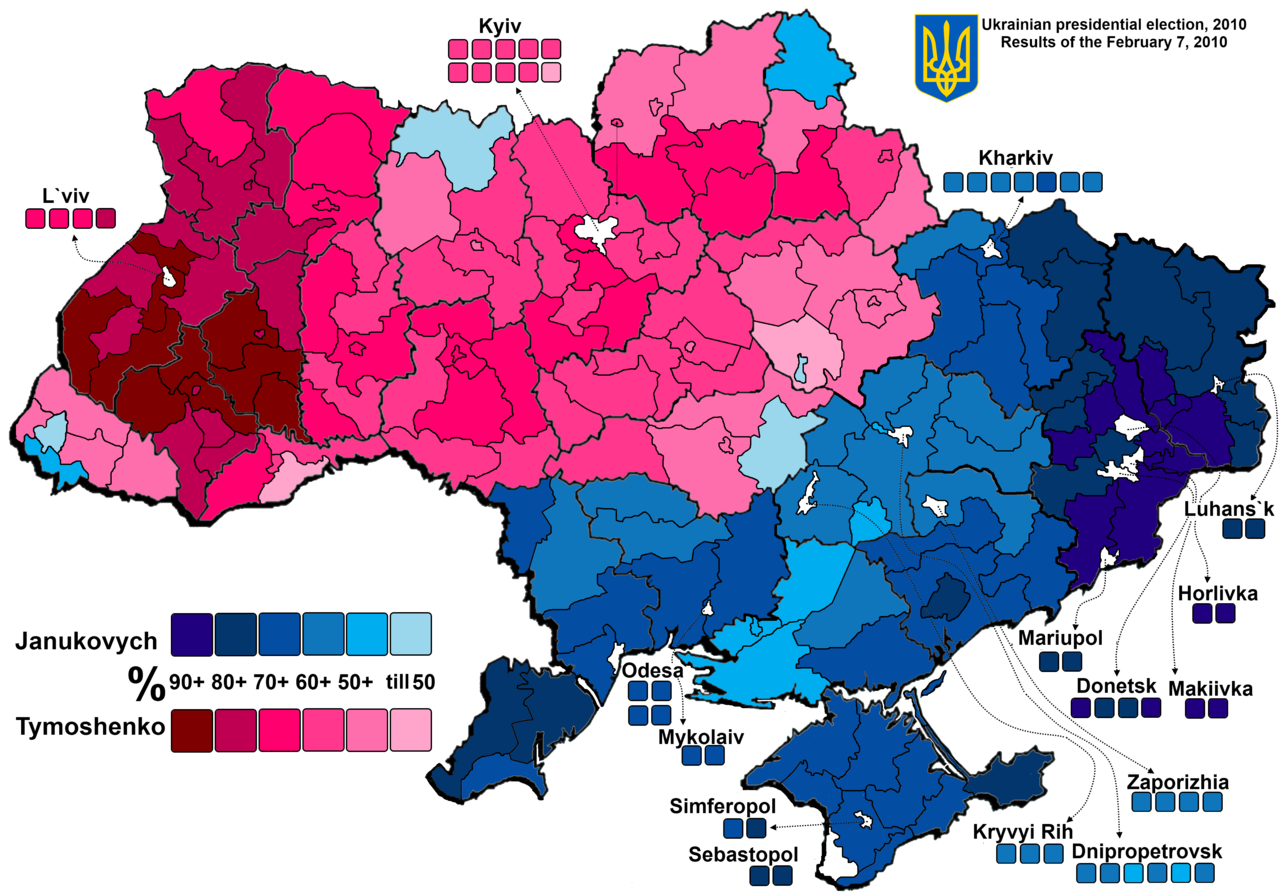
Now, moving on to the expansion of NATO into Eastern Europe. This came along with a wave of economic growth. I visited Poland in the mid 1990s and it was still very economically backward. Warsaw was like Matamoros, only the streets were dirtier. But by the early 2000s, that was changing and Eastern Europe was growing stronger. The Ukranians saw this in their neighbors and started hoping for change. In 2004, shortly after Putin's rise, Victor Yanukovych was elected president in widely disputed elections, beating out the opposition candidate, Yulia Tymoshenko, a charismatic pro-Western woman. A protest movement and revolution brought her and a partner, Victor Yuschenko, to power the next year (he had been the victim of a poisoning, a Putin trademark). But the coutnry was still divided between pro-Russian and pro-Western elements, with Tymoshenko (pro-Western) and Yanukovych (the pro-Russian, Putin stooge) trading the premiership. Still, the parliament was moving pro-West and in 2014, Yanukovych basically cancelled some proposed pro-Western trade deals, which led to the Euromaidain protests in 2013. Yanukovych used violent methods to shut down the protests, but they grew and he ultimately fled the country. This brought the pro-Western forces decisively into power. But of course, the pro-Russian groups were strong in the East and Russia grew fearful about losing the Crimea.
Politics of Ukraine: Tymoshenko voters (Western) in red and Yanukovych voters (pro-Russia) in blue:
The Crimea is a peninsula in the Black Sea that basically houses the only warm-water port in all of the former Soviet Union. It's been a strategic flashpoint for centuries. It was the focal point of the 1850s Crimean War, which pitted England and France against Russia (think "Charge of the Light Brigade" and Florence Nightengale) several wars against the Ottoman Turks, and some of the most brutal fighting of WWII. It is still crucial, and for Russia, losing it would be like the U.S. losing the entire West Coast. It is unthinkable. So Russia in 2014 used a force of shadow troops who quickly came in, supported local separatists in creating snap elections to secede from Ukraine, and then Russia quickly annexed it. Soon later, separatists in the eastern Donbass Region also tried to break away, and the low-level war that began there is still ongoing. This war is known in the West mostly for the tragic downing of an Malaysian Airliner shot down by separatists operating Russian anti-aircraft weapons targeting what they thought was a Ukrainian fighter jet.
And this is where we found ourselves until recently. Putin began his period in office trying to reverse the decline of the old Soviet Union, with a re-engagement and successful invasion of Chechnya, a Muslim province that had broken away. That was a brutal conflict, but that nation has now been safely controlled by Russian Proxies for decades. (Consider that when the talking heads tell you Russia can't control Ukraine if they win. It doesn't mean it will play out the same way. Ukraine is much, much larger.) Putin then led a war against another breakaway region known as Georgia, and essentially wrested a large part of their country away from them.
This is what Putin will do. He may not take all of Ukraine now. It is enough for him to force them to become vassals again. But then again, he's also growing older, and starting to care less and less about what the world thinks. Almost certainly, he has some sort of agreement with China that he thinks will make up for the trade that he will lose with the west. Whether this will be a short conflict, followed by years of slow creeping, or a full-out war to regain the biggest jewel of the end-of-communism heist back into the fold, we shall see. But Putin will not back down, and he does not care what America thinks. We are naive and narcissistic to think that we can simply tell him to stop and he will do it.
