Evolution For Dummies

4,184 Views | 169 Replies | Last: 20 yr ago by footballfan
schizmann
How long do you want to ignore this user?
Please note that nowwhere in this very basic discussion of evolution (see below) is there any mention of ultimate origins/ultimate causes. Maybe now that you fundy types know this...you may not find evolutionary theory such a threat to your beliefs (unless you are a 6000 year creationist type - in which case you are just a lost cause). You can always have comfort in the belief that GOD placed the original ancestor on earth to start the process running.


An Introduction to Evolution
http://evolution.berkeley.edu/evosite/evo101/IIntro.shtml

The Definition:
Biological evolution, simply put, is descent with modification. This definition encompasses small-scale evolution (changes in gene frequency in a population from one generation to the next) and large-scale evolution (the descent of different species from a common ancestor over many generations). Evolution helps us to understand the history of life.

The Explanation:
Biological evolution is not simply a matter of change over time. Lots of things change over time: trees lose their leaves, mountain ranges rise and erode, but they aren't examples of biological evolution because they don't involve descent through genetic inheritance.

The central idea of biological evolution is that all life on Earth shares a common ancestor, just as you and your cousins share a common grandmother.

Through the process of descent with modification, the common ancestor of life on Earth gave rise to the fantastic diversity that we see documented in the fossil record and around us today. Evolution means that we're all distant cousins: humans and oak trees, hummingbirds and whales.


[This message has been edited by schizmann (edited 5/13/2005 7:08p).]
Alpha and Omega
How long do you want to ignore this user?
quote:
Evolution means that we're all distant cousins: humans and oak trees, hummingbirds and whales.


My wife's distant cousin is an oak tree? No wonder she is so hard-headed!

BizAg01
How long do you want to ignore this user?
AO -

Can she float?
Ol Jock 99
How long do you want to ignore this user?
i say we burn her!!!! /python
BizAg01
How long do you want to ignore this user?
Beat me to the punchline Jock.

Maybe she is a duck?
Notafraid
How long do you want to ignore this user?
Sir, I perceive that you are a man of science!
Picadillo
How long do you want to ignore this user?
Both your definition and premise are flawed; they cannot be lumped into the same definition.

Organic evolution is a naturally occurring, beneficial change that produces increasing and inheritable complexity. Increased complexity would be shown if the offspring of one form of life had a different and improved set of vital organs. This is sometimes called the molecules-to-man theory—or macroevolution.

Microevolution, on the other hand, does not involve increasing complexity. It involves changes only in size, shape, color, or minor genetic alterations caused by a few mutations.

Microevolution can be thought of as “horizontal” change, whereas macroevolution, if it were ever observed, would involve an “upward,” beneficial change in complexity.

Given enough time, does microevolution produce macroevolution?
BMX Bandit
How long do you want to ignore this user?
A&O:

good one!
flechenbones
How long do you want to ignore this user?
Piccadillo-

Need to be careful with words like "beneficial" and "improved" and remember that it is situation dependent. Things that are improved or beneficial in one environment may not be in another, or may not be later in time within the same environment. For example, sickle-cell anemia helps Africans fight off malaria - so it is beneficial there. However, African-Americans can have sickle-cell anemia but it doesn't help them against malaria in the US because we don't have a problem with malaria these days. Here, sickle cell anemia is detrimental, not beneficial.
flechenbones
How long do you want to ignore this user?
Also, macroevolution does not have to result in more complexity and it HAS been observed.

http://www.talkorigins.org/faqs/faq-speciation.html
http://www.talkorigins.org/faqs/speciation.html

ramblin_ag02
How long do you want to ignore this user?
quote:
However, African-Americans can have sickle-cell anemia but it doesn't help them against malaria in the US because we don't have a problem with malaria these days. Here, sickle cell anemia is detrimental, not beneficial.


This is one of the reasons I think natural selection is bunk. Sickle cell is obviously detrimental in the absence of malaria. However, the gene frequency of sickle cell remains constant in our population despite lack of malaria. This is true of any gene that achieves about a 5% frequency in any given population. Even when outbreeding occurs later in absence of the selective pressure, the gene frequency remains constant when corrected for dilution. In addition, the selective pressure required to remove the sickle cell gene from the population would be more likely to cause extinction than a separation between "more" and "less" adapted individuals.
flechenbones
How long do you want to ignore this user?
You must not know much about sickle cell anemia because it certainly doesn't provide any indication that natural selection is "bunk".
Do you know that it is a recessive trait and that people who are heterozygous for it are carriers who are primarily asymptomatic? Even if two carriers breed they have only a 25% chance that their offspring will be homozgyous for sickle cell anemia. Even people who are homozygous for sickle cell anemia and are affected can and do survive well into adulthood. Hopefully that helps.
Picadillo
How long do you want to ignore this user?
flechenbones

The link you provided I am familiar with. By their own admission, they define
speciation around a Biological Species Concept, which is frought with variances of opinion if it is a fitting definition of speciation. This concept defines a species as a "reproductive" community.
From the website, an example of the author's own doubts:
quote:
There has been considerable criticism of the theoretical validity and practical utility of the BSC. (Cracraft 1989, Donoghue 1985, Levin 1979, Mishler and Donoghue 1985, Sokal and Crovello 1970).


That said, I’ll still play along. Again, from your link:

quote:
3.0 The Context of Reports of Observed Speciations
The literature on observed speciations events is not well organized. I found only a few papers that had an observation of a speciation event as the author's main point (e.g. Weinberg, et al. 1992). In addition, I found only one review that was specifically on this topic (Callaghan 1987). This review cited only four examples of speciation events.


Your source cites several instances of speciation of the fruit fly, but nothing definitive. A century of fruit fly experiments, have given absolutely no basis for believing that any natural or artificial process can cause an increase in complexity and viability. No clear genetic improvement has ever been observed in any form of life, despite the many unnatural efforts to increase mutation rates.

Indeed, one of the persons frequently cited in your link, is quoted
quote:
“Most mutants which arise in any organism are more or less disadvantageous to their possessors. The classical mutants obtained in Drosophila [the fruit fly] usually show deterioration, breakdown, or disappearance of some organs. Mutants are known which diminish the quantity or destroy the pigment in the eyes, and in the body reduce the wings, eyes, bristles, legs. Many mutants are, in fact, lethal to their possessors. Mutants which equal the normal fly in vigor are a minority, and mutants that would make a major improvement of the normal organization in the normal environments are unknown.” Theodosius Dobzhansky, Evolution, Genetics, and Man (New York: John Wiley & Sons, 1955), p. 105.


quote:
“It is a striking, but not much mentioned fact that, though geneticists have been breeding fruit-flies for sixty years or more in labs all round the world—flies which produce a new generation every eleven days—they have never yet seen the emergence of a new species or even a new enzyme.” Gordon Rattray Taylor (former Chief Science Advisor, BBC Television), The Great Evolution Mystery (New York: Harper & Row, 1983), p. 48.


[This message has been edited by Piccadillo (edited 5/14/2005 4:18p).]
ramblin_ag02
How long do you want to ignore this user?
flech,

I know enough about sickle cell anemia. I do not see how anything you said affects anything I said. Selection is nearly powerless to remove detrimental traits once they are established in a population.

By your own admission,

quote:
Here, sickle cell anemia is detrimental, not beneficial.


Detrimental traits lower fitness by definition. However, as I pointed out, selective pressures cannot eliminate this detrimental trait. There are hundreds of other examples of these detrimental genes strung out along the human genome that selection can never get rid of. If natural selection is not selecting out detrimental traits then what is it doing?


[This message has been edited by ramblin_ag02 (edited 5/14/2005 4:39p).]
heteroscedasticity
How long do you want to ignore this user?
ramblin - Selection does indeed select out detrimental "phenotypic" traits. However, it cannot select out recessive alleles that code for these traits if they are carried in the heterozygous condition such that the carrier does not have the detrimental phyenotypic trait.
ramblin_ag02
How long do you want to ignore this user?
I will not argue with you there hetero, but the phenotype is sometimes merely a symptom of an underlying genetic deficit. The inability of natural selection to select out genetic deficit has little implication on short-term variation. However, when you begin arguing long-term selection as a mechanism for "ascension" of species you run into problems.

In the short history of humanity, we have accumulated hundreds, if not thousands, of these small genetic deficits due to various short-term selective pressures. With interbreeding and a loss of these pressures, we are now at a stage where our genome is considerably burdened by these deficits. Selection, however, has almost no power to remove these deficits from our genome.

It is not difficult to extrapolate this effect to the billions of years given as explanation for a random speciation. If selection is more adaptive to short term selective pressures than long term, nearly all organisms on Earth would be burdened by detrimental mutations that aided the survival of an ancient bacteria for a couple hundred generations. Given the extreme amount of time postulated and further extrapolation, it is amazing that any organism on Earth can carry out basic oxidative or reductive respiration. That is not even beginning to mention the coordinated activity of a higher multi-cellular self-aware organism.


[This message has been edited by ramblin_ag02 (edited 5/14/2005 5:08p).]
flechenbones
How long do you want to ignore this user?
LOL. The author doesn't have doubts as to whether the biological species concept (BSC) is useful, he is saying that it is necessary to understand what species concept is being used when we discuss different examples of speciation. He noted: "Over the last few decades the theoretically preeminent species definition has been the biological species concept (BSC)".
Noting, as you did, that some argue for a different approach does not detract from the fact that it has been a very successful appraoch to looking at speciation. This is exactly the kind of stuff creationists do - limited criticisms ("by their own admission" - lol), often out of context quotes from scientists, and then want you others to think that scientists think that it is ALL crap.
Most importantly for the discussion he added "What is all of this doing in a discussion of observed instances of speciation? What a biologist will consider as a speciation event is, in part, dependent on which species definition that biologist accepts. The biological species concept has been very successful as a theoretical model for explaining species differences among vertebrates and some groups of arthropods. This can lead us to glibly assert its universal applicability, despite its irrelevance to many groups. When we examine putative speciation events, we need to ask the question, which species definition is the most reasonable for this group of organisms? In many cases it will be the biological definition. In many other cases some other definition will be more appropriate."
flechenbones
How long do you want to ignore this user?
That first link focused on a few cases of speciation, but in your own bolded section "as the author's main point". Speciation events are not a huge deal in scientific research because most of biology makes no sense in the absence of evolutionary theory. Everybody knows speciation occurs. That is why, if you check that 2nd link, you will not only see many more articles that mention speciation events (even then, only pre-dating 1997), but one contributor notes that her own research database includes about 100 articles per year on the topic. Hardly insufficient evidence as you creationists like to pretend.

You quote Dobzhansky, but be honest about it - it is from a list of out of context quotes on a creationist website. SOURCE: http://www.creationscience.com/onlinebook/ReferencesandNotes9.html

You creationists understand so little about evolution you are still missing the point. Most mutations do not improve the functioning of the organism, but evolution does not have to be an improvement. What is detrimental in one environment, can be advantageous in another. Albinos and individuals with non-functioning eyes would be selected against in most environments, but not if you are living in a cave where you can't see anyways and you don't need melanin to protect against the sun or camouflage from predators. Most cave species of fish, insects, and crayfish are blind and albino. They are different species, but not necessarily an "improvement" in your limited and wrong perception of evolution.

Your 2nd quote, over 20 years old, is just plain wrong and dated, as are most on creationist websites. The links I provided document multiple speciation events, including ones by Dobzhansky himself.
flechenbones
How long do you want to ignore this user?
Ramblin...

Many mutations have little or no effect. Those that have major effects are often selected against early. That is why approximately half of miscarriages during the 1st trimester are due to chromosomal abnormalities. However chromosomal abnormalities are only found in 0.7% of live births. It is even lower when you look at individuals who survive to adulthood. Abnormalities seen in adults tend to be less serious, as I (and hetero) pointed out, can easily be kept in a population due to carriers. Sickle cell anemia is an extremely poor example to suggest problems with natural selection because there is little selection pressure against it since long-term survival is common! Hardly the worst mutation to have, particularly since in some environments it can be advantageous.

edited to add data on chromosomal abnormalities

[This message has been edited by flechenbones (edited 5/14/2005 5:45p).]
ramblin_ag02
How long do you want to ignore this user?
flech,

I based the discussion on sickle cell, because it had been brought up already. In today's term, it has only a mild survival deficit and almost no deficit at all for carriers. However, in the time period and region the trait developed either would have a serious survival deficit.

Homozygous sickle cell would have likely been fatal in childhood in the Mediteranean and in sub-Saharan regions of Africa where malaria was prevalent. Heterozygotes are also at a drastic disadvantage in situations of "fight or flight" stress or water deprivation, both of which would be common in that environment.

You still have the problem of selection introducing a short-term fix that becomes a long-term problem.
Picadillo
How long do you want to ignore this user?
quote:
The author doesn't have doubts as to whether the biological species concept (BSC) is useful, he is saying that it is necessary to understand what species concept is being used when we discuss different examples of speciation.

Then how to you answer the fact this definition has drawn so much criticism?

And you were the first to bring up Dobzhansky's work, not me.

And of course he supports this definition! It supports a fruit fly becoming a new species, when in fact, it remains a fruit fly. Unable to breed normally, perhaps, but still a fruit fly! It is amazing the stretches that evolutionists will take to support their beliefs! And this same folly extends to so-called observations of a few plant speciations? Come on!

quote:
Everybody knows speciation occurs.


Everybody?
quote:
“It was a shock to the people of the 19th century when they discovered, from observations science had made, that many features of the biological world could be ascribed to the elegant principle of natural selection. It is a shock to us in the twentieth century to discover, from observations science has made, that the fundamental mechanisms of life cannot be ascribed to natural selection, and therefore were designed. But we must deal with our shock as best we can and go on. The theory of undirected evolution is already dead, but the work of science continues.” Michael J. Behe, “Molecular Machines,” Cosmic Pursuit, Spring 1998, p. 35.


quote:
"The central question of the Chicago conference was whether the mechanisms underlying microevolution can be extrapolated to explain the phenomena of macroevolution. At the risk of doing violence to the positions of some of the people at the meeting, the answer can be given as a clear, No." Roger Lewin, “Evolution Theory under Fire,” Science, Vol. 210, 21 November 1980, p. 883.


quote:
“One could argue at this point that such ‘minor’ changes [microevolution], extrapolated over millions of years, could result in macroevolutionary change. But the observational evidence will not support this argument ... [examples given] Thus, the changes observed in the laboratory are not analogous to the sort of changes needed for macroevolution. Those who argue from microevolution to macroevolution may be guilty, then, of employing a false analogy—especially when one considers that microevolution may be a force of stasis [stability], not transformation. ... For those who must describe the history of life as a purely natural phenomenon, the winnowing action of natural selection is truly a difficult problem to overcome. For scientists who are content to describe accurately those processes and phenomena which occur in nature (in particular, stasis), natural selection acts to prevent major evolutionary change.” Michael Thomas, “Stasis Considered,” Origins Research, Vol. 12, Fall/Winter 1989, p. 11.


quote:
You creationists understand so little about evolution


While I don't propose that I have a fraction of your towering intellect, don't paint me with the broad brush of being a creationist. I believe in the evolutionary process of microevolution, but I do not believe in the fantasy known as macroevolution, particularly when it is assumed to have occurred in ALL species.


[This message has been edited by Piccadillo (edited 5/14/2005 8:54p).]
flechenbones
How long do you want to ignore this user?
Then how to you answer the fact this definition has drawn so much criticism?

Again, if you actually look at the context, the criticism is that it can't be used to apply to all species since some species undergo asexual reproduction, self-pollination, etc. The criticism is NOT that it can't be used. In fact, he notes that it is the preminent species concept, except in the limited circumstances described above.

it supports a fruit fly becoming a new species, when in fact, it remains a fruit fly. Unable to breed normally, perhaps, but still a fruit fly! It is amazing the stretches that evolutionists will take to support their beliefs! .

Actually I find it amazing that you don't even know what a species is. Of course it still remains a fruit fly - there are many different fruit fly species! What did you think it would suddenly evolve into?

don't paint me with the broad brush of being a creationist.
LOL - I knew you were getting those out of context quotes from a creationist website. Source:
http://www.creationscience.com/onlinebook/ReferencesandNotes7.html

That is too funny! As for those quotes, Behes is a believer in pseudoscience - ID to be exact. Your other quotes are out of context so that it seems that the scholars don't agree with evolution. The first is a great example - did you even know that Roger Lewin has authored several books on macroevolution, including human evolution? In your effort to imply that scientists disagree, you are actually picking people who are the least likely to disagree. Pick up one of his books some time, you will learn a lot more than you will cherry-picking quotes of a creationist website.

Just because you admit (rightly so) that microevolution occurs, doesn't mean that you aren't a creationist. Your sources give you away my friend. It is impossible to deny microevolution, so many of you try to shed your creationist label by latching onto it, and then deny macroevolution.

Again, the evidence of macroevolution is overwhelming and includes much much more than just fossils. You are kidding yourself if you think most scientists think otherwise.

heteroscedasticity
How long do you want to ignore this user?
flechen..

quote:
Actually I find it amazing that you don't even know what a species is. Of course it still remains a fruit fly - there are many different fruit fly species! What did you think it would suddenly evolve into?


Flechenbones. Well done!!

I don't think pic would be satisfied unless you demonstrated a fruit fly speciating directly into a redwood tree, in which case it would be magic...not evolution.
Picadillo
How long do you want to ignore this user?
flech: And your sources give you away as well! Please note I've not pounded the bible or used religious sources; my quotes, no matter what the source, still come from mainstream scientists, in peer reviewed material. Are you saying they are wrong?

quote:
Of course it still remains a fruit fly - there are many different fruit fly species! What did you think it would suddenly evolve into?

You guys are the ones who believe a chimp can turn into a man, so you explain it.


All you've been able to show for proof of macroevolution is some plants and a few insects, as defined by a narrow, somewhat controversial definition called BCS.

Considering all the species that have existed, why aren't there more? How do you explain the lack of transitional forms in the fossil record?


[This message has been edited by Piccadillo (edited 5/15/2005 8:15a).]
1aaron
How long do you want to ignore this user?
http://www.calpoly.edu/~fotoole/321.1/feyer.html
heteroscedasticity
How long do you want to ignore this user?
pic

quote:
You guys are the ones who believe a chimp can turn into a man, so you explain it.


All this does is show your ingnorance rather than support your view. The statement above is pretty typical - There is no evolutionist that has ever said that a chimp can turn into a human. You really enjoy ripping apart strawamen don't you.
flechenbones
How long do you want to ignore this user?
Piccadillo-

My sources give me away as a scientist. I'm not the one trying to pretend I'm something other than what I'm am. You are the one who was trying to pretend that you were not a creationist. I do applaud you for not trying to employ religious sources, but I am continually surprised at the lengths to which a Christian will engage in dishonesty and manipulation in a debate such as this. Either you are innocently employing dishonest, out of date, out of context quotes from your creationist websites, or you are aware that they are deficient and use them anyways. You cannot have it both ways. If you truly wish to use scientific peer-reviewed literature, you should consult the actual sources and view them in context. Those individuals, apart from Behe, are all people who study and publish on evolution and disagree with the way their words are being manipulated.

You brought up the quotes again in your last post, as well as regurgitated the "controversial" BSC definition of a species.
That indicates to me a lack of integrity on your part, after I have already shown them to be lacking in substance. I already explained the actual criticisms of the BSC concept, yet you insist on manipulation. Thankfully, I know you are not representative of Christians, because you do them a disservice.

You really should consult the scientific literature, because the supposed lack of transitional fossils is one of the most repeated lies within the creationist community. If fact, not only do we have transitional fossils, but molecular genetics indicates the transition between many different species. Hetero is right - a species that suddenly turned into another very different species would be magic - and actually evidence against evolution!! Instead, daughter species must be similar and NOT extremely different.
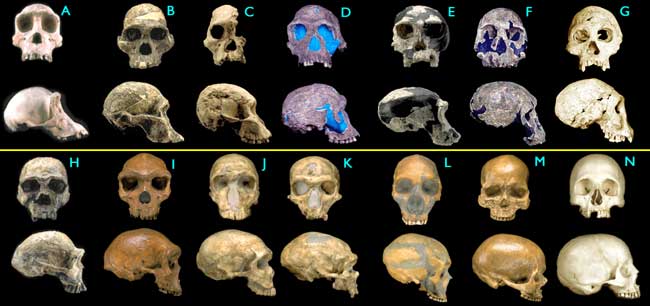
Since you brought up chimps and humans, feast your eyes on this depiction of many of the transitional fossils between chimps and modern humans. A is a chimp and N is a modern human. B through M are fossil species ranging in antiquity from 2.6 million to 30,000 years ago that are transitional between chimps and humans. http://www.talkorigins.org/faqs/comdesc/images/hominids2.jpg
To see the legend for it and other evidence of transitional forms in the fossil record go to: http://www.talkorigins.org/faqs/comdesc/section1.html#morphological_intermediates
Ag with kids II
How long do you want to ignore this user?
Just to show how taking things out of context can be duplicitous ( 'cause everyone else was usin' big words)...from above..

quote:
flech: And your sources give you away as well! Please note I've not pounded the bible or used religious sources; my quotes...are wrong


BTW, a creationist website IS a religious source...


Eric '90

A good spanking helps to settle a child's nerves
Picadillo
How long do you want to ignore this user?
flech: Engaging in insults already, I see. You are chasing your own tail, no pun intended. The quotes I give you may have been found on a creationist website, but if you will take the time to read the "origin" of the quote, you will find them to be from peer reviewed, credible sources, from mainstream scientists.

Michael J. Behe, “Molecular Machines,” Cosmic Pursuit, Spring 1998, p. 35.

Roger Lewin, “Evolution Theory under Fire,” Science, Vol. 210, 21 November 1980, p. 883.

Michael Thomas, “Stasis Considered,” Origins Research, Vol. 12, Fall/Winter 1989, p. 11.


These are but a few. You say you are a scientist. Please explain these quotes and how they are false, according to your understanding.

And...how are these being dishonest? You are taking this discussion to a personal level. I am a believer in microevolution, but have not drunk the purple koolaid of the macroevolutionists. I do not think creationism should be taught in science classes, as it is not science. I do however, believe both sides need to be presented.

Now please explain to us how that can be dishonest?

[This message has been edited by Piccadillo (edited 5/15/2005 3:49p).]
Notafraid
How long do you want to ignore this user?
Any position anyone takes on an “ultimate reality” is a faith position.
Picadillo
How long do you want to ignore this user?
Just for fun, I'm going to present the chart that fletch challenged me to "feast my eyes on" regarding what he believes to be the plethora of transitional forms of man. This is what he is hanging his hat on.


Nearly all of us have seen such charts. None of them, I repeat, none, have ever been proven, hence the conundrum of the "missing link"...because there isn't any!

You may not like it, but here are some additional quotes from mainline scientists, peer reviewed literature. Forbid that they may have been posted on a creationist website, but the quotes and sources are nonetheless valid.

quote:
“... existing phylogenetic hypotheses about human evolution [based on skulls and teeth] are unlikely to be reliable.” Mark Collard and Bernard Wood, “How Reliable Are Human Phylogenetic Hypotheses?” Proceedings of the National Academy of Sciences, Vol. 97, No. 9, 25 April 2000, p. 5003.


quote:
“Fossil evidence of human evolutionary history is fragmentary and open to various interpretations. Fossil evidence of chimpanzee evolution is absent altogether.” Henry Gee, “Return to the Planet of the Apes,” Nature, Vol. 412, 12 July 2001, p. 131.


quote:
“The dethroning of Ramapithecus—from putative [supposed] first human in 1961 to extinct relative of the orangutan in 1982—is one of the most fascinating, and bitter, sagas in the search for human origins.” Lewin, Bones of Contention, p. 86.


quote:
“At present we have no grounds for thinking that there was anything distinctively human about australopithecine ecology and behavior. ... [T]hey were surprisingly apelike in skull form, premolar dentition, limb proportions, and morphology of some joint surfaces, and they may still have been spending a significant amount of time in the trees.” Matt Cartmill et al., “One Hundred Years of Paleoanthropology,” American Scientist, Vol. 74, July–August 1986, p. 417.


In addition, care to explain to us the now-proven fallacies of Nebraska Man, Piltdown Man, Java Man, Neanderthal Man, Narmada Man?


[This message has been edited by Piccadillo (edited 5/15/2005 5:37p).]
flechenbones
How long do you want to ignore this user?
Piccadillo-

I'm not saying they aren't quotes from the peer-reviewed scientific literature. The quotes are valid but your interpretations of them are not. Which part of "out of context quotes" don't you understand? Behe is a creationist, so his quote doesn't surprise me. How many times do I have to say that none of the rest of the individuals actually share your position? You are blatantly misinterpreting their quotes out of context. Either you are doing it by accident because you don't understand science or scientific literature (a point you have demonstrated beyond a reasonable doubt), or you are doing it intentionally. Your choice - are you ignorant or deceitful?

Thanks for putting up the pic I posted. As for transitional fossils between humans and chimps - that picture has TWELVE! As expected by evolutionary theory, the morphology changes consistently through time.

BTW, I'm not hanging my hat on that picture. It shows that you are wrong about the absence of transitional species (or "missing links". But, as I've pointed out before, there are plenty of other scientific fields that have even better data then fossils. They all indicate evolution occurred. You like to attack fossils, but in reality you are up against many scientific fields.

quote:
None of them, I repeat, none, have ever been proven,


You went from creationist to expert of hominid fossils pretty quick there didn't you?
Picadillo
How long do you want to ignore this user?
So let me see if I understand your ground rules...

- ALL my quotes from mainstream scientific literature are somehow "out of context". You've been unable to address these, I notice.

- I CANNOT use any creationist source; peer reviewed or not.


The theory of human evolution desperately requires a missing link, so in the post-Darwin era many candidates have been put forward. Not one has stood the test of honest, rigorous investigation, as all have turned out to be from either an extinct ape or an extinct human.


Since you have been unable to deal with the list of false human evolutionary forms that I have provided you to address, I’ll give you a list. Any credible evolutionist should at least be able to give a cursory explanation to these collosal failures of the scientific/evolutionist community:


Piltdown Man. Mainstream science fawned all over this discovery until it was proven to be a hoax in 1953.


Australopithecus The most well known australopithecine is ‘Lucy’, a 40% complete skeleton found by Donald Johanson in Ethiopia in 1974 and called Australopithecus afarensis. However, the original Lucy fossil did not include the upper jaw, nor most of the skull, nor hand and foot bones! The evolutionists Matt Cartmill (Duke University), David Pilbeam (Harvard University) and the late Glynn Isaac (Harvard University) are quoted

quote:
‘The australopithecines are rapidly sinking back to the status of peculiarly specialized apes … . Ref. 3, p. 167, which quotes Cartmill, M., Pilbeam, D. and Isaac, G., One hundred years of paleoanthropology, American Scientist 74:419, July–August 1986.


Homo habilis The most well known, comprising a fossil skull and leg bones was found by Richard Leakey in Kenya in 1972. CAT scans of the inner ear (conducted by Spoor, below) of a Homo habilis skull show that it walked more like a baboon than a human. Today most researchers regard Homo habilis as ‘a waste-bin of various species’, including bits and pieces from Australopithecus and Homo erectus, and not as a valid category. In other words, it never existed as such, and so cannot be the supposed link between australopithecine apes and true man. Spoor, F., et al., Implications of early hominid labyrinthine morphology for evolution of human bipedal locomotion, Nature 369(6482):645–648, 23 June 1994. Spoor is Professor of Evolutionary Anatomy at University College London, UK, and joint editor of the Journal of Human Evolution.


Homo erectus Spoor’s CAT scans of their inner ear architecture show that their posture was just like ours. Even some evolutionists concede that they should be put in the same species as modern man, i.e. Homo sapiens. See Early man underestimated (again), Creation 21(1):9, 1998, based on Thwaites, T., Ancient mariners: Early humans much smarter than we expected, New Scientist 157(2125):6, 14 March 1998.


Neandertal Man The researchers who first reconstructed these fossils gave them a bent-over (i.e. ape-like) appearance. However, the early reconstructions suffered from a heavy dose of evolutionary bias, along with the fact that some specimens suffered from bony diseases such as rickets, which is caused by vitamin D deficiency from childhood and can result in bowing of the skeleton. Modern reconstructions of Neandertals are consistent with the contention that they are fully human. Their minor skeletal variations from the modern average, including a larger braincase volume on average, are no different in principle from the minor physical differences between people groups today, which have been shown to be consistent with the genetic unity of humanity. Despite attempts made on the basis of mitochondrial DNA fragments in one set of Neandertal bones to try to assign them to a separate species, even some evolutionist authorities claim that they should be regarded as Homo sapiens. See White, M., The caring Neandertal, Creation 18(4):16–17, 1996; also Lubenow, M., Recovery of Neandertal mtDNA: An evaluation, CEN Tech. J. 12(1):87–97, 1998.


I guess I don't understand science very much, like you say, so forgive me for relying on mainstream scientific literature. Please explain once again how I have either misquoted or taken out of context the materials above or how these men are incorrect?

Do you have an explanation for the falsehoods above that science has desperately tried to foist upon the public?


[This message has been edited by Piccadillo (edited 5/16/2005 9:48a).]
flechenbones
How long do you want to ignore this user?
Well, as far as ground rules, it would be good for you to actually undertstand the topics you are talking about. Or even to have read a single one of those articles whose quotes you are using out of context. This is a well-known scenario that plays out between creationists and out of context quotes. I can refute them, but it takes an incredible amount of time for me to look up and read each one. Then you reload by spending just 30 seconds pulling up more crap off creationist websites.

You can use creationist sources, just not any that are so blatantly false. Unfortunately that is the primary kind of evidence on creationist websites. Creationist sources are not peer-reviewed because creationists don't do research. They sit at home, examining real scientific articles for quotes that seem to support their view, and then they use that. In the process, they are contorting the views of reputable scientists.

You think that your quotes show that evolution is not true. You are wrong. I go to the same conferences as the people you are quoting, and I hear their presentations, and read their publications. Their careers are spent documenting human & primate evolution, not refuting it. This may come as a surprise to you, but they are not creationists.

To further display the impressive depth of your ignorance in this area, lets look at just a couple of your quotes:

The australopithecines are rapidly sinking back to the status of peculiarly specialized apes.

This one is good, almost as good as you not understanding what species or fruit flies are. Humans ARE apes. Saying australopithecines are "peculiarly specialized apes" does not imply that they are not related to us.

Despite attempts made on the basis of mitochondrial DNA fragments in one set of Neandertal bones to try to assign them to a separate species, even some evolutionist authorities claim that they should be regarded as Homo sapiens..

First of all, you don't seem to be aware of more recent publications with additional mtDNA sequences from Neandertals. Why should I be surprised, when it is obvious that you have never picked up a single peer-reviewed article on the topic? Mitochondrial DNA from Neandertal remains found in different countries show that they are all fairly similar, and they are much more different from humans than humans are too each other. In other words, more and more evidence suggests they are different species, and fewer anthropologists support them as a subspecies of modern humans.

Your dismissal of all twelve species in that chart as "Not one has stood the test of honest, rigorous investigation, as all have turned out to be from either an extinct ape or an extinct human" is laughable. We will put aside your obvious ignorance of what an ape is. The rest is either a lie of your own creation (because you obviously know so much about evolutionary science), or you are continuing to mimic the misinformed views you find on creationist websites.

Honestly, I'm surprised by your insistence on arguing about something you obviously don't understand.


flechenbones
How long do you want to ignore this user?
As for Piltdown - that is the only debunked fossil known. And guess who proved it? Scientists. Not creationists.
Science is a critical discipline that is self-correcting. Scientific finds and discoveries are published in peer-reviewed publications so that they can be studied and examined by other researchers.
Creationists don't actually advance knowledge because they have no theories, no research, and no data. All they have is misguided and typically ill-founded criticism.
 
×
subscribe Verify your student status
See Subscription Benefits
Trial only available to users who have never subscribed or participated in a previous trial.