
St. Thomas Aquinas speaks abut biblical fruit

1,565 Views | 25 Replies | Last: 1 day ago by Zobel
Thaddeus73
How long do you want to ignore this user?
AG
The Good Fruit of the Virgin's Womb

The sinner at times seeks but does not find, whereas the righteous seeks and finds…. Thus Eve sought the fruit [of the tree], but did not find in it all that she coveted; whereas the Blessed Virgin in her Fruit found all that Eve had desired.

In her fruit, Eve sought to become like gods, knowing good and evil (which the devil falsely promised)…. Through eating the fruit, Eve did not become like God, but unlike him, since by sinning she turned away from God, her salvation, and was expelled from paradise. On the other hand, the Blessed Virgin found likeness to God in the Fruit of her womband so do all followers of Christsince through Christ we are united and likened to God. When he shall appear, we shall be like unto him, for we shall see him as he is.

Eve in her fruit sought pleasure, since it was good to eat; yet she did not find it, for at once she perceived that she was naked, and tasted sorrow. But in the Fruit of the Blessed Virgin we find sweetness and salvation. He that eateth my flesh…hath eternal life.

Eve in her fruit sought beauty: Eve's fruit was fair to the eyes. Yet fairer still is the Virgin's Fruit on whom the angels long to gaze: Thou art fairer than the sons of men (Ps 45:3). This is because he is the brightness of the Father's glory (Heb 1:3).

Therefore, let us seek in the Virgin's Fruit that which we desire to have. This Fruit is blessed by God, because God so filled him with all grace that it overflows upon us who bow to him in adoration: Blessed be the God and Father of our Lord Jesus Christ, who hath blessed us with every spiritual blessing on high in Christ (Eph 1:3). He is blessed by the angels: Blessing and glory and wisdom and thanksgiving and honor and power and might be to our God for ever and ever (Rv 7:12). And he is blessed by men: Let every tongue confess that our Lord Jesus Christ is in the glory of God the Father (Phil 2:11)….

Thus is the Virgin blessed, but still more blessed is her Fruit.

Saint Thomas Aquinas
DirtDiver
How long do you want to ignore this user?
Do you think he missed what appears to be Eve's restoration and jumped the gun claiming she lost salvation?

Eve was deceived and sinned with fatal consequences, was cursed, and expelled from the garden AND...

God made a sacrifice and she was clothed... 21 The Lord God made garments of skin for Adam and his wife, and clothed them.
She praised the Lord for her firstborn. Now the man had relations with his wife Eve, and she conceived and gave birth to Cain, and she said, "I have gotten a manchild with the help of the Lord."

16 Then Cain went out from the presence of the Lord, and settled in the land of Nod, east of Eden. - May indicate that Eve, while expelled from the garden was not expelled from the presence of God.


Thaddeus73
How long do you want to ignore this user?
AG
I think the point he is making is that Eve gave us forbidden fruit, which leads to damnation, and Mary gave us the fruit of her womb, Jesus, who leads to salvation if we comsume Him in the Eucharist....
DirtDiver
How long do you want to ignore this user?
Thaddeus73 said:

I think the point he is making is that Eve gave us forbidden fruit, which leads to damnation, and Mary gave us the fruit of her womb, Jesus, who leads to salvation if we comsume Him in the Eucharist....


God made the fruit that Eve ate.
Eve gave the fruit to Adam.
They sinned and the world crumbled.
God's eternal redemptive plan was launched with promises He would fulfill.
Jesus pre-existed Mary.
God placed Jesus into Mary (fruit of the womb).
God gave us Jesus, not Mary.
She was the human vehicle that God used in a special way at a point in time.


What scripture does NOT say....

16 "For Mary so loved the world, that she gave her only begotten Son, that whoever believes in Him shall not perish, but have eternal life. 17 For Mary did not send the Son into the world to judge the world, but that the world might be saved through Him. 18 He who believes in Him is not judged; he who does not believe has been judged already, because he has not believed in the name of the only begotten Son of God.


Also notice the lack of conditionals here.... why doesn't it say, "Whoever believers in Him AND consumes Him in the Eucharist shall not perish?
Thaddeus73
How long do you want to ignore this user?
AG
Quote:

She was the human vehicle

Do you call your mother a human vehicle?

Mary IS the mother of God, the Mother of the 2nd person of the Holy Trinity, chosen by God the Father.

DirtDiver
How long do you want to ignore this user?
Thaddeus73 said:

Quote:

She was the human vehicle

Do you call your mother a human vehicle?

Mary IS the mother of God, the Mother of the 2nd person of the Holy Trinity, chosen by God the Father.


I do, specifically a FedEx Truck....because she delivered.


  • Mary, like you and me is also a sinner in need of a savior. Luke 1:46 And Mary said: "My soul exalts the Lord,
    47 And my spirit has rejoiced in God my Savior.
  • Mary like all believers are chosen by God the Father. Eph 1:3 Blessed be the God and Father of our Lord Jesus Christ, who has blessed us with every spiritual blessing in the heavenly places in Christ, 4 just as He chose us in Him before the foundation of the world, that we would be holy and blameless before Him. In love 5 He predestined us to adoption as sons through Jesus Christ to Himself, according to the kind intention of His will,
  • Christ was physically in Mary, the Holy Spirit and Christ as also physically in body of believers
    Rom 8:11 But if the Spirit of Him who raised Jesus from the dead dwells in you, He who raised Christ Jesus from the dead will also give life to your mortal bodies through His Spirit who dwells in you.
    2 Cor 13:5 Test yourselves to see if you are in the faith; examine yourselves! Or do you not recognize this about yourselves, that Jesus Christ is in youunless indeed you fail the test?
  • Jesus pre-existed Mary and created the very womb He was to live in. Mary didn't create Jesus. Col. 1:16 For by Him (Jesus) all things were created, both in the heavens and on earth, visible and invisible, whether thrones or dominions or rulers or authoritiesall things have been created through Him and for Him. John 17:24 Father, I desire that they also, whom You have given Me, be with Me where I am, so that they may see My glory which You have given Me, for You loved Me before the foundation of the world.
Mary has a unique place in History and His Story but is not worthy of worship. In the same way Eve was tempted, how many people are tempted to forsake the commands and the person of God to worship Mary?
Thaddeus73
How long do you want to ignore this user?
AG
Glad you agree with Catholics for 2000 years who have never worshiped Mary. In the BIBLE, worship is offering sacrifice to a deity on an altar. We have NEVER done that.

Mary of course did need a savior, who saved her from sin BEFORE she fell into it. She was full of grace, when Gabriel appeared to her, so there was and is no room for sin in her. Satan is full of evil, and there is no room for good in him.
DirtDiver
How long do you want to ignore this user?
Question:

If someone prays to Buddha, is this an act of worship to Buddha?
If someone prays to Allah, is this an act of worship to Allah?
If someone prays to God, is this an act of worship to God?

Do you as a Catholic pray to Mary?
Howdy, it is me!
How long do you want to ignore this user?
AG
I was studying Hebrews 9 yesterday and thought, "Why didn't Mary just sacrifice herself since she was blameless and without blemish?".

I told my spouse the other day that all the Mary stuff may be the biggest thing that would ever stop me from converting.
Zobel
How long do you want to ignore this user?
AG
Yeah I think this gets into a kind of weird confusion about the cross. Jesus was offering himself as a sacrifice. But all the sacrifices - he is a thank offering, a sin offering, the paschal lamb, and both goats in the day of atonement ritual. All of those are images of the worship Moses saw in the heavenly tabernacle, which st Paul in Hebrews identifies with Christ. St John calls him the lamb slain before the world. So in other words, Moses saw the crucifixion, or the heavenly reality of it, and the sacrifices in the Torah participante in that. He specifically creates the tabernacle as a copy of the heavenly one. Where Christ is, where St. Paul says he entered.

The other piece is that Christ is the theanthropos, the God-Man. He is fully God and fully Man, and so by dying he destroyed death. He conquered death through death. Death took a body and met God face to face!

So… Mary the mother of God, the Theotokos, cannot do that. But! She did offer herself! Which St. Paul says we are to do, offer ourselves as living sacrifices.
Zobel
How long do you want to ignore this user?
AG
DirtDiver said:

Question:

If someone prays to Buddha, is this an act of worship to Buddha?
If someone prays to Allah, is this an act of worship to Allah?
If someone prays to God, is this an act of worship to God?

Do you as a Catholic pray to Mary?


This is a bad argument.

The reason praying to Allah or Buddha is wrong is not because it is prayer - pray just means asking. It's wrong because they are demons!

And second, prayer is not worship. They're different things. Worship is serving and bowing down, and very specifically is the offering of sacrifice. We are commanded to do none of these things to idols, or the demons the represent.

There is nothing wrong with asking for the prayers of the saints to intercede for us! Those here and the saints in glory are praying for us, along with the angels.

Your false equivalence here is like saying "making a deal with the devil is worship so you can't make a business deal with human because that's worship."
Thaddeus73
How long do you want to ignore this user?
AG
We ask for Mary's intercession (see Cana in the Bible) with the King; The role of the Queen mother in the bible is intercession with the king (see Solomon and Bathsheeba and Cana). Biblical worship is offering sacrifice to God, usually with an altar. We do that with the Mass, where we offer the one-time sacrifice of Jesus to God the Father. We never ever offer sacrifice to Mary....We only ask for her intercessory prayers....
Thaddeus73
How long do you want to ignore this user?
AG
1 Thessalonians 5:23 May the God of peace himself sanctify you wholly; and may your spirit and soul and body be kept sound and blameless at the coming of our Lord Jesus Christ. 24 He who calls you is faithful, and he will do it.
25 Brethren, pray for us.

Here Paul worships his brothers, by asking them to pray for him....NOT...
DirtDiver
How long do you want to ignore this user?
What is the difference between intercessory prayer by people living on earth compared to praying to saints and Mary who were once alive on earth and are alive in heaven?

Context is everything...

25 Brethren, pray for us.
26 Greet all the brethren with a holy kiss. 27 I adjure you by the Lord to have this letter read to all the brethren.

The "brethren" here Paul is referring to are people alive on earth during his life.
The ask is that they would go to God in prayer on his their behalf. This checks out. Paul is not ascribing a deified state to these brethren.


When someone is asking Mary or a dead saint for intercessory prayer are they not ascribing abilities to that person that only God posses?
  • Assuming Mary or the saints are omnipresent. They can hear the prayers of people all over the earth at all times. (ascribing these abilities to Mary is a form of deification)
  • Assumes Mary's function is to relay prayers from people on earth to God.
  • Assumes Mary can hear peoples prayers on earth.
  • Assumes Mary is concerned with the things that are happening on earth at this time.
Are people praying to Mary or to God?
You shall not make for yourselves idols, nor shall you set up for yourselves an image or a sacred pillar, nor shall you place a figured stone in your land to bow down to it; for I am the Lord your God. Lev. 26:1


Lessons about prayer....from Jesus.

  • 5 "When you pray, you are not to be like the hypocrites; for they love to stand and pray in the synagogues and on the street corners so that they may be seen by men. Truly I say to you, they have their reward in full.
  • 6 But you, when you pray, go into your inner room, close your door and pray to your Father who is in secret, and your Father who sees what is done in secret will reward you.
  • 7 "And when you are praying, do not use meaningless repetition as the Gentiles do, for they suppose that they will be heard for their many words.
  • 8 So do not be like them; for your Father knows what you need before you ask Him.

9
"Pray, then, in this way: (Jesus is giving then an example of how to pray, not telling them what to pray)
'Our Father who is in heaven,
Hallowed be Your name.
10 'Your kingdom come.
Your will be done,
On earth as it is in heaven.
11 'Give us this day our daily bread.
12 'And forgive us our debts, as we also have forgiven our debtors.
13 'And do not lead us into temptation, but deliver us from evil. [For Yours is the kingdom and the power and the glory forever. Amen.']

When Jesus prayers in John 17, notice that he's not reciting the Lord's prayer as that is a template and not meant to be a repeated mantra.

Jesus spoke these things; and lifting up His eyes to heaven, He said, "Father, the hour has come; glorify Your Son, that the Son may glorify You, 2 even as You gave Him authority over all flesh, that to all whom You have given Him, He may give eternal life. 3 This is eternal life, that they may know You, the only true God, and Jesus Christ whom You have sent.
Zobel
How long do you want to ignore this user?
AG
Nah. The saints in heaven are neither omnipresent nor are they required to be. They are no longer within time, and we know this because of the experience at Mt Tabor, for example.

And deification is, of course, nothing more than theosis, which is the entire promise of the scriptures. We become like God, through participation in his grace, communicants of the divine nature, to grow up to his full stature, gods by Grace what God is by nature, without losing our identity or ceasing to be human. This is the deep mystery of the Incarnation, that Christ Jesus added the human nature to the divine, "without confusion, without change, without division, without separation". To the extent He lowered Himself to us, He raises us up by grace to Himself.

The New Man, revealed in the Resurrected Christ, is a vision of what we shall be. We will be like the angels, who are gods (created, not properly God the divine nature), but actually higher than them because we are communicants of the Divine nature in the person of Jesus.

How does time affect Gabriel? He is a creature, but he is also not subject to time, space, temporal reality in the same we we humans are.

How does time affect Christ Jesus, who is the lamb slain before the world? The same person gave the Torah at Sinai, was in the heavenly Tabernacle, was on the Cross, in Hades, and on the Throne, uncircumscribed.

To describe God as omnipresent is just to imagine Him as a really really big human - these categories do not strictly apply. And the promises of scripture is that we will be like Him.

Can He hear our prayers? Is He concerned with us, and what is happened with His faithful on earth?
Thaddeus73
How long do you want to ignore this user?
AG
Quote:

When someone is asking Mary or a dead saint for intercessory prayer are they not ascribing abilities to that person that only God posses?

No saint in heaven is "dead." Why any Christian actually believes this lie is beyond me. We have the words of Jesus on this.

Luke 20:36 for they cannot die any more, because they are equal to angels and are sons of God, being sons of the resurrection. 37 But that the dead are raised, even Moses showed, in the passage about the bush, where he calls the Lord the God of Abraham and the God of Isaac and the God of Jacob.[a] 38 Now he is not God of the dead, but of the living; for all live to him."

Very much alive saints in heaven do have special powers that we don't have here on earth. In fact. 2 Peter 1:4 says that they are partakers in divine nature, which would include a lot, including hearing prayers....

DirtDiver
How long do you want to ignore this user?
Thaddeus73 said:

Quote:

When someone is asking Mary or a dead saint for intercessory prayer are they not ascribing abilities to that person that only God posses?

No saint in heaven is "dead." Why any Christian actually believes this lie is beyond me. We have the words of Jesus on this.

Luke 20:36 for they cannot die any more, because they are equal to angels and are sons of God, being sons of the resurrection. 37 But that the dead are raised, even Moses showed, in the passage about the bush, where he calls the Lord the God of Abraham and the God of Isaac and the God of Jacob.[a] 38 Now he is not God of the dead, but of the living; for all live to him."

Very much alive saints in heaven do have special powers that we don't have here on earth. In fact. 2 Peter 1:4 says that they are partakers in divine nature, which would include a lot, including hearing prayers....


You've picked out a gnat and missed the elephants of the argument. When I referred to a "dead saint" I meant a saint that was once alive on earth, who died, and is now spiritually alive with God in heaven.

I'm fully convinced of the resurrection and that to be absent from the body as a believer is to be present with the Lord. I'm fully convinced that Paul is spiritually alive at this time with Jesus.

I'm not convinced at all that these "living saints"...
1. Have the ability to hear all of the prayers of people on earth. (an ability that we know God has and that humans do not)
2. Are concerned with the things going on at this time on earth.
3. Can see or have knowledge about what's going on, on earth.
4. Are interceding for us.
5. are not being prayer to
6. provide and advantage vs going straight to God in prayer.
DirtDiver
How long do you want to ignore this user?
Zobel said:

Nah. The saints in heaven are neither omnipresent nor are they required to be. They are no longer within time, and we know this because of the experience at Mt Tabor, for example.

And deification is, of course, nothing more than theosis, which is the entire promise of the scriptures. We become like God, through participation in his grace, communicants of the divine nature, to grow up to his full stature, gods by Grace what God is by nature, without losing our identity or ceasing to be human. This is the deep mystery of the Incarnation, that Christ Jesus added the human nature to the divine, "without confusion, without change, without division, without separation". To the extent He lowered Himself to us, He raises us up by grace to Himself.

The New Man, revealed in the Resurrected Christ, is a vision of what we shall be. We will be like the angels, who are gods (created, not properly God the divine nature), but actually higher than them because we are communicants of the Divine nature in the person of Jesus.

How does time affect Gabriel? He is a creature, but he is also not subject to time, space, temporal reality in the same we we humans are.

How does time affect Christ Jesus, who is the lamb slain before the world? The same person gave the Torah at Sinai, was in the heavenly Tabernacle, was on the Cross, in Hades, and on the Throne, uncircumscribed.

To describe God as omnipresent is just to imagine Him as a really really big human - these categories do not strictly apply. And the promises of scripture is that we will be like Him.

Can He hear our prayers? Is He concerned with us, and what is happened with His faithful on earth?


Then God said, "Let Us make man in Our image, according to Our likeness; and let them rule over the fish of the sea and over the birds of the sky and over the cattle and over all the earth, and over every creeping thing that creeps on the earth."

When you used the phrase "we become like God".... my questions are these...

  • What does scripture mean when it uses this phrase?
  • When does one conclude that we have all of this abilities? (for the believer there will be an eternal future but not an eternal past)
  • Does it mean we will be like God in every way with all of His abilities or something else? Will we have life within ourselves that no longer depends on the Father?
Observation: Man was made in the likeness of God without God's abilities.
Zobel
How long do you want to ignore this user?
AG
Why do you say spiritually alive and contrast it with body? Is Christ not with His Body?

Why do you put living saints in quotes? You either think they are alive or you don't. Which is it?

Moses and Elijah were in the body on Mt Tabor, not force ghosts.
Zobel
How long do you want to ignore this user?
AG
Image and likeness are not talking about nature, per se. We are icons of God (which is what image is literally translating, icon) which means we are something like an inverted idol. Idols imaged pagan gods, demons, and those demonic spirits indwelled in them. Adam was made to be an image of the Living God, and the Spirit of God went into Him. Humans make images of false gods; God made humans as images of the True God.

Likeness is the degree to which that image is intact. Humans are always images of God, but the likeness is marred to the extent that we fall from our true calling, which is to be a perfect image and likeness. This is why Christ Jesus is the exact copy or "express image" of the Father. We are image bearers because we are created after the pattern of the Incarnate Christ!

Powers or abilities are not the same thing as an image. An image of something doesn't have the same abilities as the thing. Powers and abilities are proper to the nature of a thing. Human nature has one set of powers, the Divine Nature a different. Christ, when He became incarnate, added to the Divine nature the human nature. The fathers at Chalcedon defined this addition as "without confusion, without change, without division, without separation". So accordingly, He has the powers of both God and Man - He shares with us our blameless passions - things which act on us like hunger, thirst, fatigue - without setting aside the powers of the Divine.

But this Incarnation joined the human nature to the divine nature!

And when we become like Him - to the measure of the stature of the fullness of Christ, the firstborn of many brothers. So as far down as He came to join with our nature, He draws us up in union with His.

We never become God, we never become gods by nature, we are always creatures. We do become gods by grace, through the Incarnation, through participation in the divine nature. Sons of God.

As far as eternal future or past - this is somewhat of a nonsensical framing. Eternity doesn't mean *time forever* because God is eternal, and Is before time. He created all things visible and invisible, which includes time. So the eternity of God has NO past, NO future. It is completely outside of time. Christ Jesus, then, is also outside of time. That's why He is the lamb slain from the foundation of the world. Christ walked in the garden as the God Man. He ate with Abraham and wrestled with Jacob, and spoke to Moses face to face. Adam was created after His image.

And as for your last question - no. Humans never stop being human in our nature. Our nature gets deified by grace, but we don't become divine in and of ourselves. That does mean, though, that things which are by nature divine as shared with us (for example, life).
DirtDiver
How long do you want to ignore this user?
Zobel said:

Why do you say spiritually alive and contrast it with body? Is Christ not with His Body?

Why do you put living saints in quotes? You either think they are alive or you don't. Which is it?

Moses and Elijah were in the body on Mt Tabor, not force ghosts.


Good questions:

To question 1: I think there's a distinction of how resurrection works and when. I'm definitely not an expert on the metaphysics of all of this but just want to make a few observations.

Distinction #1:
Moses: When he died, his bones were in the ground. I think He was spiritually alive with God but not reunited with his earthy body.
Jesus: When Jesus resurrected, all of His body was resurrected. No bones left in the grave and the markings in His flesh were visible.

Christs body was resurrected.

John 20:24 But Thomas, one of the twelve, called Didymus, was not with them when Jesus came. 25 So the other disciples were saying to him, "We have seen the Lord!" But he said to them, "Unless I see in His hands the imprint of the nails, and put my finger into the place of the nails, and put my hand into His side, I will not believe."
26 After eight days His disciples were again inside, and Thomas with them. Jesus *came, the doors having been shut, and stood in their midst and said, "Peace be with you." 27 Then He *said to Thomas, "Reach here with your finger, and see My hands; and reach here your hand and put it into My side; and do not be unbelieving, but believing." 28 Thomas answered and said to Him, "My Lord and my God!" 29 Jesus *said to him, "Because you have seen Me, have you believed? Blessed are they who did not see, and yet believed."


Some questions are: What happens to believers in the OT and NT when they die given their bodies are still in the ground unlike Jesus'. How are they raised at that point in time? Are they will God or not with God? Will they be reunited with their bodies at a later time?


There's also a few references to the human bodies (not Jesus) being physically resurrected at a later time.
"Many of those who sleep in the dust of the ground will awake, these to everlasting life, but the others to disgrace and everlasting contempt." Dan 12:2

"Do not marvel at this; for an hour is coming, in which all who are in the tombs will hear His voice, and will come forth…"
"I will raise him up on the last day."

There's an indication here that for a believer, when we are absent from the Body, we will be with the Lord and I think the best interpretation here is spiritually (because our body is still in the ground) and in that day will be resurrected.
6 Therefore, being always of good courage, and knowing that while we are at home in the body we are absent from the Lord 7 for we walk by faith, not by sight 8 we are of good courage, I say, and prefer rather to be absent from the body and to be at home with the Lord. 2 Cor 5.

  • 1 Thessalonians 4:1317 "the dead in Christ will rise" when Christ returns.
  • Philippians 3:2021 Christ "will transform the body of our lowly state into conformity with the body of His glory."
  • Romans 8:11 God will "give life to your mortal bodies."
  • Romans 8:23 believers await "the redemption of our body."
  • 2 Corinthians 5:15 Paul discusses the heavenly dwelling and specifically says he does not want to be "unclothed" but "clothed."
  • Revelation 20:1213 "the sea gave up the dead which were in it," and death and Hades gave up their dead.

  • Why Saints in quotes?

    1. I think all sinners who put their trust/faith in Jesus' death and resurrection for their sins are saints.

    Proof Text: Look at how Paul addresses the Corinthian believers before he calls them out on their sinful behavior throughout the rest of the book..

    2 To the church of God which is at Corinth, to those who have been sanctified in Christ Jesus, saints by calling, with all who in every place call on the name of our Lord Jesus Christ, their Lord and ours:
    3 Grace to you and peace from God our Father and the Lord Jesus Christ.
    4 I thank my God always concerning you for the grace of God which was given you in Christ Jesus, 5 that in everything you were enriched in Him, in all speech and all knowledge, 6 even as the testimony concerning Christ was confirmed in you, 7 so that you are not lacking in any gift, awaiting eagerly the revelation of our Lord Jesus Christ, 8 who will also confirm you to the end, blameless in the day of our Lord Jesus Christ. 9 God is faithful, through whom you were called into fellowship with His Son, Jesus Christ our Lord.

    Point 1: We may have a different definition of saints.

    2. I think all believers who have died are with Jesus. They are spiritually alive with Him but may not live in their final resurrected state - the unification with their earthly body. I could be wrong but I think Moses and Elijah were in a glorified state but may not have been in their final resurrected body. Not sure how this worked for OT believers as to the when but we know there bones where in the ground in the OT which is a different type of resurrection than Jesus.

    The reason that term was in quotes is definitely not because I'm questioning the resurrection. I'm questioning their ability to listen to people on earth pray.
    DirtDiver
    How long do you want to ignore this user?
    Zobel said:

    Image and likeness are not talking about nature, per se. We are icons of God (which is what image is literally translating, icon) which means we are something like an inverted idol. Idols imaged pagan gods, demons, and those demonic spirits indwelled in them. Adam was made to be an image of the Living God, and the Spirit of God went into Him. Humans make images of false gods; God made humans as images of the True God.

    Likeness is the degree to which that image is intact. Humans are always images of God, but the likeness is marred to the extent that we fall from our true calling, which is to be a perfect image and likeness. This is why Christ Jesus is the exact copy or "express image" of the Father. We are image bearers because we are created after the pattern of the Incarnate Christ!

    Powers or abilities are not the same thing as an image. An image of something doesn't have the same abilities as the thing. Powers and abilities are proper to the nature of a thing. Human nature has one set of powers, the Divine Nature a different. Christ, when He became incarnate, added to the Divine nature the human nature. The fathers at Chalcedon defined this addition as "without confusion, without change, without division, without separation". So accordingly, He has the powers of both God and Man - He shares with us our blameless passions - things which act on us like hunger, thirst, fatigue - without setting aside the powers of the Divine.

    But this Incarnation joined the human nature to the divine nature!

    And when we become like Him - to the measure of the stature of the fullness of Christ, the firstborn of many brothers. So as far down as He came to join with our nature, He draws us up in union with His.

    We never become God, we never become gods by nature, we are always creatures. We do become gods by grace, through the Incarnation, through participation in the divine nature. Sons of God.

    As far as eternal future or past - this is somewhat of a nonsensical framing. Eternity doesn't mean *time forever* because God is eternal, and Is before time. He created all things visible and invisible, which includes time. So the eternity of God has NO past, NO future. It is completely outside of time. Christ Jesus, then, is also outside of time. That's why He is the lamb slain from the foundation of the world. Christ walked in the garden as the God Man. He ate with Abraham and wrestled with Jacob, and spoke to Moses face to face. Adam was created after His image.

    And as for your last question - no. Humans never stop being human in our nature. Our nature gets deified by grace, but we don't become divine in and of ourselves. That does mean, though, that things which are by nature divine as shared with us (for example, life).


    There's a lot of truth here. To be super nit-picky...

    We are image bearers because we are created after the pattern of the Incarnate Christ!

    We are image bearers because all of the entire human race, even before Christ was incarnated, was made in the image of God. Gen 1:27 and Gen. 9.

    "Whoever sheds man's blood,
    By man his blood shall be shed,
    For in the image of God
    He made man.

    Once a person is born again, new birth, new life, no longer spiritually dead but alive in the eyes of God, God goes to work though the person confirming them more into the image or likeness of His Son. This describes one definition of the word, sanctification to press the believer to maturity. We become partakers of his divine nature but that is not all clearly spelled out.

    The root of my question is this: What convinces a person that Mary, Saint Peter, Saint Paul, have the abilities or power to 1. Listen to all prayers on earth through all time (from the time that they died), that 2. or that that is their role, function, job, or pleasure to do?

    just did a word study on this phrase, The term "Divine Nature" is used 3 times in Scripture.

    speaking of God
    28 for in Him we live and move and exist, as even some of your own poets have said, 'For we also are His children.' 29 Being then the children of God, we ought not to think that the Divine Nature is like gold or silver or stone, an image formed by the art and thought of man.

    For since the creation of the world His invisible attributes, His eternal power and divine nature, have been clearly seen, being understood through what has been made, so that they are without excuse. Romans 1:20

    2 Peter 1: 2
    2 Grace and peace be multiplied to you in the knowledge of God and of Jesus our Lord; 3 seeing that His divine power has granted to us everything pertaining to life and godliness, through the true knowledge of Him who called us by His own glory and excellence. 4 For by these He has granted to us His precious and magnificent promises, so that by them you may become partakers of the divine nature, having escaped the corruption that is in the world by lust.

    Now, it's not clear what all being a partaker in the divine nature means, but it seems to be connected with having escaped the corruption that is in the world by lust. Possible interpretation: now that a believer has the Spirit of God indwelling them, they have the resources to battle the temptations of the flesh that they didn't have previously? Aligns with Galatians 5

    I'm not 100 percent sold on this interpretative option but I see nothing related to us having the ability to watch are loved ones on earth after we die, or do be able to hear all of their prayers and intercede for them.
    Zobel
    How long do you want to ignore this user?
    AG
    All of this comes down to one really simple thing. You are bounding all existence, including God's, to linear notions of time (before/after). I think this is not intentional, but it is what is confusing all of your perspective here.

    When St John had his vision in the Apocalypse, he saw the twenty four elders - interpreted as the patriarchs and the apostles. In other words, he saw himself. One of the elders speaks to him in 5:5 - maybe he spoke to himself. How? Because the heavens have a different relationship with time than we do.

    Things which have heavenly or eternal ("of the ages") reality enter into human experience at different times, but that is not "when" they happen in an absolute sense. Because "when" is to bring them down and subordinate them to human time. Christ Jesus is eternally who He is. He is eternally the lamb slain before the world, He is eternally incarnate. Moses spoke to Jesus face to face, Abraham saw Jesus, Jacob literally wrestled with Jesus, Joshua worshipped at his feet.

    So when you say, "later time" this is from our perspective; from the perspective of the eternal, it is in a kind of eschatological now. "when" is for us humans, not for those in glory. Our when has no map to their when. So, were Moses bones in the ground? Yes. Was Moses physically on Mt Tabor? Yes.

    Does this mean that those in glory are "omnipresent" - no, because that is only needed from our perspective by them being subject to OUR constraints on space and time. We know Christ is not; we know His Resurrected Body has a very different relationship with space and time (He can show up inside locked doors, vanish, be in the Garden with Adam, etc). We will be like Him - and in the eternal life, the saints are already like Him, because "already" is time language which doesn't apply.

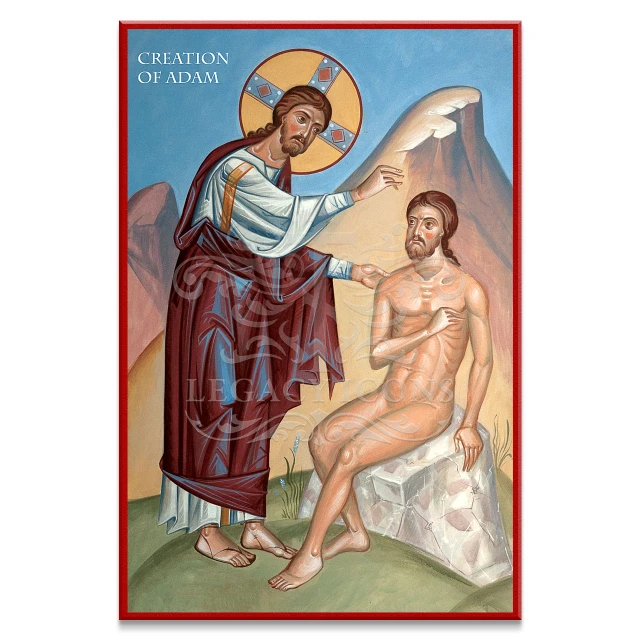
    You see why this answers the question about image. When you say "whos image are we?" God's. But God the Father is Spirit, we are not imaged after Him - no man can see Him and live, how could you possibly image Him? So who's image are we? Christ Jesus. "Before" He was incarnate is again applying wrong categories. In Orthodox Icons of the creation of Adam, Adam always is depicted with the face of Jesus.


    This is incredibly important because it is both why Christ's humanity is real, and why we are His brethren. It explains how, what we do to His image bearers, we do to Him (in the parable of the last judgment). We are made after His image.

    So if you're asking me, why do the saints care about the Church? Because they're not separate from us any more than the Lord is. He guides the Church, through His Spirit, actively. His Spirit animates the Body, makes it alive - and we are members of that Body. His powers and potentialities are actualized by His Body. This includes the saints in glory! They are still members of the one Body. Asking whether they care is no different than asking whether you care or more importantly whether the Lord cares. He does, you do, so they do. One Body.

    When we worship, our earthly worship mirrors and participates in the eternal, heavenly worship - the same worship Moses saw, that the tabernacle worship was imaging. We enter into that with them and worship with all the angels and all the saints and participate in the marriage feast of the Lamb.

    ///

    The nature of God is what makes God, God. We need to understand "nature" because it is the symbol of faith - "of one essence with the Father". Each person of the Triune Godhead is of the same essence (ousia in Greek). The divine essence is what the Son possesses according to His divine nature. In the Incarnation the divine person the Son takes on human nature - adds the nature and potentialities of Man to himself - so that the one person of Christ exists fully in the divine nature and fully in the human nature.

    St Paul in Acts is speaking to Greek philosophers. So when he says, the divine nature isn't something that can be imaged in stone that's right, but it is revealed through creation as he says in Romans. And, ultimately, perfectly imaged to us in Christ Jesus, who IS fully divine - the exact image of the invisible God, where all the fullness of Deity dwells in bodily form.

    The question about being a partaker in the divine nature is much more about what that nature is than anything else. Because it is an astounding promise! How can a creature participate in the divine? The answer is in the same word, because participants are the noun version of communion. Communion : communicants. In other words, in the divine and holy mystery of the Eucharist, that is communion, we become communicants (partakers) of the divine nature. And not only in the Eucharist, but this is what grace is, the Eucharist being grace par excellence.

    ///

    So, human nature is indelibly and unchangeably joined to the divine nature in the person of Christ Jesus, who is God by nature and became Human by nature by adding Human nature to Himself: the Theanthropos, the God-Man.

    As the God-Man He conquered death - death took a body but came face to face with God!

    As God, the firstborn, He is the means and end of all Creation - and through His joining of Himself to us, we become His brothers - by His grace, not because of anything we did.

    Through faithfulness, we become heirs to this promise made available to us.

    And through grace, we become more like Him, both now and in the Resurrection, and into eternity, so we can grow to the full stature of Christ. Gods by grace what He is by nature, through His literally incomprehensible condescension and love and mercy and grace. These are the precious and magnificent promises St Peter talks about.
    Thaddeus73
    How long do you want to ignore this user?
    AG
    2 Peter 1:4 says that we become partakers of the divine nature.
    1 Corinthians 6:17 says that if we are united with the Lord, we become one spirit with him.
    James 5:16 says that the prayers of a righteous person are very powerful.
    If God will listen to the prayers of a slob like me on earth, why won't he listen to the prayer of someone who is a partaker in His divine nature, who is one spirit with Him, and is VERY righteous?

    It boggles the mind to think that He won't....
    DirtDiver
    How long do you want to ignore this user?
    Thaddeus73 said:

    2 Peter 1:4 says that we become partakers of the divine nature.
    1 Corinthians 6:17 says that if we are united with the Lord, we become one spirit with him.
    James 5:16 says that the prayers of a righteous person are very powerful.
    If God will listen to the prayers of a slob like me on earth, why won't he listen to the prayer of someone who is a partaker in His divine nature, who is one spirit with Him, and is VERY righteous?

    It boggles the mind to think that He won't....


    Yes, we can be partakers in the divine nature
    Yes, we are united into the body of Christ when we believe along with all of the believers who have passed before us,
    Yes, the prayers of a righteous person are very powerful.

    None of these facts are under dispute. What is under dispute is the abilities of a saint or Mary, or any believer that has died and now with the Lord.

    What causes us to believe they have God's unique abilities: Can hear all prayers at all times? And that their job is to intercede on our behalf?


    1 Peter 1:4 To those who have received a faith of the same kind as ours, by the righteousness of our God and Savior, Jesus Christ: 2 Grace and peace be multiplied to you in the knowledge of God and of Jesus our Lord; 3 seeing that His divine power has granted to us everything pertaining to life and godliness, through the true knowledge of Him who called us by His own glory and excellence. 4 For by these He has granted to us His precious and magnificent promises, so that by them you may become partakers of the divine nature, having escaped the corruption that is in the world by lust.


    When I see the phrase: Partaker in the divine nature.

    What from this context would lead me to believe that my grandpa, who was a man of faith, can intercede on my behalf in prayer?
    What from this context would lead me to believe that Peter and Paul could hear my prayers and interceded for me upon my behalf?

    What leads me to believe that divine nature means that they have the ability to hear all prayers from all people from all time and that they are interceding upon our behalf?


    When we pray to the Father...

    26 In the same way the Spirit also helps our weakness; for we do not know how to pray as we should, but the Spirit Himself intercedes for us with groanings too deep for words; 27 and He who searches the hearts knows what the mind of the Spirit is, because He intercedes for the saints according to the will of God. Romans 8:26

    Christ Jesus is He who died, yes, rather who was raised, who is at the right hand of God, who also intercedes for us. Romans 8:34


    Notice this phrase about prayer as well and notice the call out about on-earth.

    19 "Again I say to you, that if two of you agree on earth about anything that they may ask, it shall be done for them by My Father who is in heaven. 20 For where two or three have gathered together in My name, I am there in their midst."


    1. We have clear instructions from the NT to pray to the Father.
    2. When the word "intercede" is used in the NT it's referring to the Spirit and Jesus interceding on our behalf.
    3. We have community on earth that can petition the Father.
    4. We do not have any indication that Mary can hear our prayers. (we ascribe attributes of God to her when we assume this).
    5. We do not have any indication that we should ask Mary to pray for us.
    6. We do not have any indication that being a partaker of the divine nature gives us abilities other than (no more sin nature, and eternal life, no pain, suffering, or lack).

    We know that even being a partaker in the divine nature does not make us worthy of worship, we don't know what our preoccupation will be when we die or other abilities.
    Zobel
    How long do you want to ignore this user?
    AG
    What causes you to believe that these are God's unique abilities? This seems like a completely unfounded assumption.
    Refresh
    Page 1 of 1
     
    ×
    subscribe Verify your student status
    See Subscription Benefits
    Trial only available to users who have never subscribed or participated in a previous trial.