If you're wanting to be a quant you're either getting your PhD in physics or at the very least a masters in financial engineering. If you decide to stick it out and get your PhD, and you're really good, and your real passion lies in academia, you might as well stick it out. You might be making six figures before you're 40. Maybe. If you're exceptional That said, from my personal point of view, I would not recommend a PhD in physics. I'm probably a year and a half from finishing, however I don't intend to finish at this point.
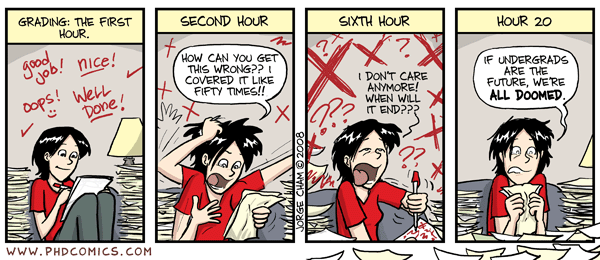
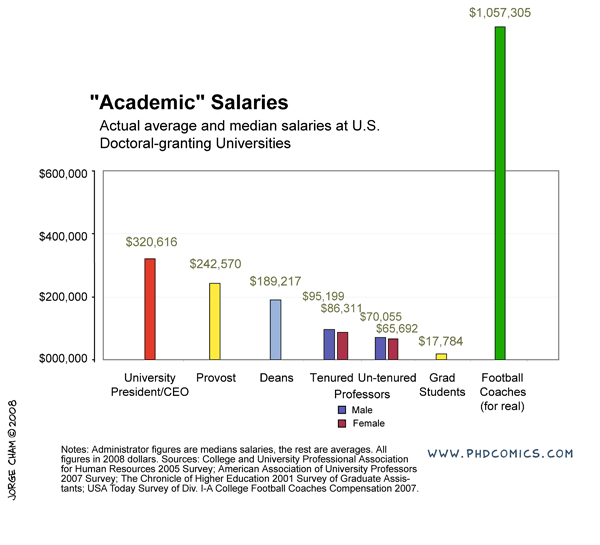
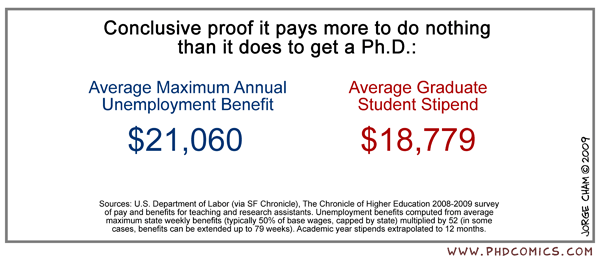
A PhD in physics requires a grueling amount of work. In your first year, if you want to do well, every week is at least an 80 hour week. During exam time/qual time your workload can be 100+ hours/week. You will probably spend 9-10 hours a week in class. In addition to that, you will probably get somewhere between 12 and 20 homework questions per week. The amount of homework this actually is is horrific. I simply could not do it on my own. Easy questions are 1-2 hour questions. Difficult questions are 20+ hour questions. Solving some of these questions gives you a solution that somebody is famous for initially finding. While it's certainly a gratifying feeling to solve a question like that it comes at a huge cost. You don't have much time for friends. You don't have much time for family. You don't have much time to progress your life in any other aspect. If I had to estimate, if I was to honestly do all of that homework I would have probably spent 120 hours every week. The general strategy is to divide and conquer, but still to understand everything that is going on is still a 40-60 hour commitment. In addition to that, you will be teaching a course. You will have to prepare a small lecture. You will have to grade labs (which, if you do it right is probably 5-10 hours/week). You will need to have office hours. At UH, I also have to commit a few hours a week to the physics tutoring center. All in all, it's a very time-consuming process. For all of this you get a whopping 2,000/month.
Once you pass your quals, things become a bit easier. You start working on a project of your own. Depending on who your advisor is, your time commitment will vary, but 80 hour weeks are still not out of the question. Your salary, however, does not change much. All in all you will probably spend 5-6 years on this process. All of a sudden, you're 28+ years old. Your friends, if you still have any outside the physics department, are lawyers. Doctors. Pharmacists. Successful salesmen. They're making money. They're starting to have families. They're settling down and buying houses of their own. You're in school making 2000ish per month. You don't have the time or money for a family. You don't really have much time for friends, and you certainly don't have a comparable amount of money to spend doing the kind of things they're doing. Wanting to grow personally when you haven't had the opportunity to do that in many years becomes a big deal.
And after you get your PhD? You become a post doc. You can have a PhD in physics, be a full-time researcher, and make as little as 25000 dollars per year. I have heard of folks being post-docs for 10 years and not getting that elusive associate professorship. If you're exceptional, though, you might get the professorship. Eventually. Of course, there are people who decide to go a different route. I know a guy who got his PhD in QCD (what I'm doing...*gulp*) who wants to be a quant which is quite a competitive field as well. Currently he's working at Best Buy. I know a guy who started a thesis three times. The first time he got scooped. The second time his advisor died and he had to start over. After having to start a third time he said **** it. He now works for some chemical engineering company and seems much happier.
My advice to you is to really evaluate what you want. I can't speak to how you feel, but as an undergrad a lot of these things didn't seem to matter to me very much. Hell, it even sounded kind of romantic to zealously pursue truth, knowledge, science for little compensation. However, things other than physics eventually started mattering more and more to me. Even if you're absolutely sure that physics is what you want to do, consider that their their is no knowledge you can get from a formal university education that you can't get with the right set of books, a computation pad, a pencil, and a computer so that you can visit the appropriate forums to ask your questions. What a formal university education makes easier is that it gives you the time to spend with those books, teaches you a bit about the publishing process, and gets you a piece of paper that says you're a doctor. Aside from the last one, if you look in the right places you can do all of this without a PhD. While that will still be a major time commitment, at least you won't have to set the rest of your life on hold. It will be at your pace.
Personally, I ended up finding a wonderful woman. I have a kid now. I do my research at UH, and I teach at HCC. I'm still not able to provide the kind of life for my family that I would like. I have decided that I want my daughter and wife to not worry about money. Not worry about the future. I'd like to be able to put my daughter through college eventually. I want to progress in other aspects of my life. To further those goals I have started studying for actuarial work. This is along the lines of what I do, as it's quite mathematical. Getting in is not as hard as getting into quantitative finance. I'm really hoping (atheists can hope too!) that this field works out. I'm hoping that I have a job before this semester is over. From my research into the field I believe that I should. I've passed the first two exams. With my masters degree I should be well qualified for an entry-level position, which pays pretty decently (certainly a lot better than what I get now). This is the route I've chosen to go. I hope that one day I can get my PhD in physics, however I would like to get other aspects of my life in order first. I would like to buy a nice home for my family. A dog. Perhaps a toy for myself. Maybe I can finally get that Harley I've been eyeing for years. Note, even if I did not have a wife and kid I would probably be going this route. There are parts of me that have been dormant for years now that are yearning to grow.
Anyway, I feel like I've rambled quite a bit. Let's address your questions directly. Once you get your bachelors you'll have a few options. If you decide you want to be a quant, go the financial engineering route. If you decide to stick it out and get your PhD in physics you'll have the option of either going into academia or going into quantitative finance. But that too is a very competitive field, and you should have a second option lined up if you don't go into academia for the aforementioned reasons. A third option you might consider is starting a career right after your bachelors. If I may be so bold, if you're interested in a quantitative finance career you might want to check out actuarial careers as well. The standard for entry isn't quite so high, and the pay is quite competitive as well. I've seen actuaries make as much as $600,000/year+. This is of course a bit outside the norm, but $250,000 is well within your reach after 10 years of work. While pure quants might make somewhat more you also probably have to work twice as much. Just something possibly worth considering.
So, if you were just asking me for my advice I'd say don't get your PhD. Don't pursue a career in academia unless you're willing to put everything else in your life off. And even if you're willing to do that at this point, consider if you'll feel the same way in several years. Seriously ponder that question. The things that mattered to me have changed in the last five years. As someone with a bachelors in physics you will have skills that can transfer over to other careers that you might enjoy, and might be worth researching before you make your final decision. I hope that sharing my experience has helped somewhat in your future decisions. Whatever you decide, best of luck!